

E-commerce fulfillment strategies directly impact your ability to scale sales and meet growing customer expectations. With the global e-commerce fulfillment services market projected to reach $272.14 billion by 2030 (Grand View Research, 2024), businesses that optimize their fulfillment operations gain significant competitive advantages.
This comprehensive guide explores proven strategies to enhance your fulfillment processes, reduce operational costs, and drive sustainable sales growth.
Key Takeaways for Scaling Sales with E-Commerce Fulfillment Strategies
Before diving deep into fulfillment strategies, here are the essential insights you need to know:
- Fulfillment directly impacts sales: 48% of shoppers abandon carts due to unexpected shipping costs, while 32% abandon when delivery times are too long
- Choose the right model for your stage: In-house fulfillment offers control, 3PL provides scalability (60% market share), and dropshipping enables low-risk testing (23.4% growth rate)
- Automation delivers measurable ROI: Automated systems process 550 lines per hour versus 60-80 for manual operations, with 20% productivity improvements
- Customer expectations are rising: 68% of US shoppers prioritize two-day shipping, and 69% won’t return after a delivery misses the promised date by two days
- Technology is essential: Warehouse management systems, real-time inventory tracking, and AI-powered forecasting separate successful operations from struggling ones
What is E-Commerce Fulfillment?
E-commerce fulfillment encompasses the complete process of receiving, processing, and delivering online orders to customers. This includes inventory storage, order processing, picking and packing products, shipping, and handling returns.
Modern operations leverage warehouse management systems, automated storage and retrieval systems, and artificial intelligence to achieve accuracy rates exceeding 99% (Modula, 2024). Consumer behavior data reveals why this matters: 48% of online shoppers abandon their carts due to unexpected shipping costs (Baymard Institute, 2024), while 32% abandon purchases when estimated shipping times are too long (Statista, 2022).
Fulfillment Model Comparison
| Fulfillment Model | Best For |
|---|---|
| In-House | High-value or customized products |
| 3PL | Businesses processing 100+ orders/month |
| Dropshipping | New businesses testing products |
Understanding E-Commerce Fulfillment Models
Three primary models dominate the e-commerce landscape, each offering distinct advantages and challenges.
In-House Fulfillment
In-house fulfillment means your company manages all warehousing, inventory, and shipping using your own facilities and staff. This model provides maximum control over quality standards and customer touchpoints. You can quickly adjust operations, create memorable unboxing experiences, and respond immediately to issues—particularly valuable for fragile, high-value, or customized products.
However, in-house operations demand substantial capital investment in warehouse space, inventory systems, equipment, and workforce. The average cost to fulfill an order represents approximately 70% of the average order value for many online retailers (ReadyCloud, 2024).
Third-Party Logistics (3PL)
Third-party logistics providers operate fulfillment centers where they store your inventory, process orders, and handle shipping on your behalf. The 3PL model captured 60% of the e-commerce fulfillment market in 2024 (Mordor Intelligence, 2024), offering immediate access to established infrastructure, advanced technology, and shipping volume discounts.
3PLs provide scalability without capital expenditure—you can expand into new markets or handle seasonal spikes without building facilities. However, you’ll depend on your provider’s systems and need to carefully review service agreements to understand all fees.
Dropshipping
Dropshipping eliminates inventory holding entirely. When customers place orders, you forward them to suppliers who ship directly to customers. This model is experiencing 23.4% annual growth through 2030 (Mordor Intelligence, 2024).
The dropshipping model requires minimal upfront investment and dramatically reduces financial risk. You can test new products quickly and offer extensive catalogs without warehouse constraints. Trade-offs include lower profit margins and reduced control over shipping times and product quality. Further reading for Dropshipping Companies.

The 7 Steps of Order Fulfillment
Understanding the complete order fulfillment workflow helps identify optimization opportunities at each stage.
Step 1: Receiving Inventory — Products arrive at your warehouse from suppliers. Staff verify shipment contents, inspect for damage, and update inventory systems using barcode scanning to minimize errors.
Step 2: Inventory Storage — Products are organized strategically with high-velocity items in accessible locations. Advanced warehouses use automated systems that can reclaim up to 90% of floor space (Modula, 2024).
Step 3: Order Processing — Order management systems automatically route order details to fulfillment operations, verify inventory, and queue orders for picking while enabling real-time tracking.
Step 4: Picking — Warehouse staff or robots retrieve ordered products from storage. Automated systems can manage up to 550 lines per hour compared to 60-80 lines for manual pickers (Modula, 2024).
Step 5: Packing — Items are packed securely with appropriate materials and branding elements. Automated solutions right-size boxes to minimize shipping costs while protecting products.
Step 6: Shipping — Orders receive shipping labels and transfer to carriers. Systems select optimal carriers based on destination, service level, and cost.
Step 7: Returns Processing — Efficient returns processing inspects items, updates inventory, and issues refunds promptly to maintain customer satisfaction.
Cart Abandonment Triggers
| Abandonment Cause | Percentage |
|---|---|
| Unexpected Shipping Costs | 48% of shoppers |
| Long Delivery Times | 32% abandon globally |
| Unclear Return Policy | 24% leave checkout |
| 2-Day Delivery Delay | 69% won’t return |
Key Strategies to Optimize Your Fulfillment Process
Focus on these critical areas to transform fulfillment into a competitive advantage.
Inventory Management Excellence
Prevent stockouts that lead to lost sales and overstock situations that tie up capital. Implement real-time inventory tracking across all sales channels with automated reorder alerts based on sales velocity. Use demand forecasting that leverages historical data and seasonal trends. Modern warehousing systems deliver 20% productivity uplifts (Mordor Intelligence, 2024).
Order Processing Automation
Automated order management systems integrate with e-commerce platforms to capture orders immediately and route them to appropriate fulfillment locations. Real-time tracking provides visibility through automated notifications at key milestones, reducing customer service inquiries while building confidence.
Warehouse Operations
Optimize warehouse layout by positioning high-velocity items near packing stations. Implement barcode scanning for real-time inventory updates and warehouse management systems for optimal pick paths. Use flexible staffing models with temporary workers during peak seasons.
Shipping Strategy
Work with multiple carriers to access competitive pricing and operational resilience. Negotiate volume discounts even at modest scales and offer tiered shipping options from economy to expedited. Consider distributed inventory to reduce shipping distances. Remember: 48% of cart abandonment is due to unexpected shipping costs (Baymard Institute, 2024).
Returns Management
Create clear return policies specifying windows, conditions, and timelines. Streamline the process with pre-printed labels and multiple return options. Process returns quickly to restore inventory and analyze patterns to identify product quality or description issues. Clear policies prevent 24% of cart abandonments (Baymard Institute, 2024).
Order Volume Decision Guide
| Monthly Order Volume | Recommended Model |
|---|---|
| Under 50 Orders | In-house or Dropshipping |
| 50-500 Orders | Consider 3PL transition |
| 500+ Orders | 3PL or automated in-house |
How to Choose the Right Fulfillment Strategy for Your Business
Your ideal fulfillment model depends on your current situation and growth trajectory.
Business Size and Order Volume
Different business sizes have distinct fulfillment needs:
- Low-volume sellers (under 50 orders monthly) typically benefit from in-house fulfillment or dropshipping. 3PL costs may not justify investment at this scale, and hands-on fulfillment provides valuable customer insights.
- Mid-volume sellers (50-500 orders monthly) reach inflection points where 3PL economics become favorable. Calculate all-in fulfillment costs and compare against 3PL pricing while factoring opportunity cost of time.
- High-volume sellers (500+ orders monthly) achieve better scalability through 3PL partnerships or sophisticated automation. Fulfillment becomes a core operational competency at this scale.
Product Characteristics and Resources
Product attributes influence model suitability. Fragile, high-value, or customized items often require in-house control, while standardized products work well with 3PLs. In-house fulfillment demands capital for warehouse space, equipment, and staff. Dropshipping enables market entry with minimal investment, while 3PLs convert fixed costs to variable costs that scale with sales.
Businesses experiencing rapid growth often find 3PL partnerships provide immediate scalability, while steady growth enables planned in-house expansion.
Automation ROI Benefits
| Automation Feature | Performance Improvement |
|---|---|
| Automated Picking | 550 vs 60-80 lines/hour manual |
| Space Optimization | Reclaim up to 90% floor space |
| Order Accuracy | 99%+ vs 95% manual processing |
| Productivity Gain | 20% overall warehouse efficiency |
| Error Rate | Below 1% with automation |
Implementing Technology in Your Fulfillment Strategy
Strategic technology adoption delivers measurable improvements in speed, accuracy, and cost-effectiveness.
Warehouse Management Systems
WMS platforms coordinate all activities from receiving through shipping. They direct staff to specific locations, optimize pick paths, and integrate with e-commerce platforms and carriers for seamless automated workflows. Advanced features include wave planning for efficient batch picking and labor management tracking productivity metrics.
Automated Storage and Retrieval
Robotics dramatically increase storage density while reducing labor. Vertical lift modules reclaim up to 90% of floor space (Modula, 2024), while automated systems process 550 lines per hour versus 60-80 manual (Modula, 2024). Warehouses implementing automation achieve 20% productivity improvements with error rates below 1% (Mordor Intelligence, 2024).
Order Management and AI
Order management systems provide centralized visibility across all sales channels with real-time inventory preventing overselling. AI transforms operations through predictive demand forecasting, inventory optimization, and automated repetitive tasks like data entry and shipping notifications.
Key Performance Metrics Targets
| Metric | Target Benchmark |
|---|---|
| Order Accuracy Rate | Above 99% |
| Perfect Order Rate | 95%+ (excellence level) |
| Fulfillment Cost | ~70% of order value |
| Order Cycle Time | Same-day to next-day |
| On-Time Delivery | Within promised window |
Measuring Fulfillment Performance
Systematic performance measurement identifies improvement opportunities and validates the impact of operational changes. Focus on these critical metrics:
- Order Accuracy Rate: Target above 99% (Modula, 2024). This measures the percentage of orders fulfilled correctly without errors in product selection, quantity, or shipping address. Track errors by type to identify specific improvement areas.
- Order Cycle Time: Measures duration between order placement and shipment departure. Customers increasingly expect same-day or next-day fulfillment. Break down cycle time into component steps to identify bottlenecks limiting speed.
- Perfect Order Rate: Combines complete, on-time, undamaged delivery with correct documentation and accurate invoicing. Businesses achieving 95%+ perfect order rates demonstrate operational excellence and reflect true customer experience.
- Fulfillment Cost per Order: Tracks total cost including labor, packaging materials, shipping, warehouse overhead, and technology. The average fulfillment cost represents approximately 70% of average order value for many online retailers (ReadyCloud, 2024).
- On-Time Delivery Rate: Measures orders delivered within promised timeframes. Sixty-nine percent of shoppers report they will likely not shop with a retailer again if a purchase does not arrive within two days of the promised delivery date (ReadyCloud, 2024).
- Return Rate: Varies significantly by product category. Analyze return reasons to separate controllable issues from unavoidable returns like changed preferences. Address controllable factors through better product photography, detailed specifications, and quality control improvements.
Common Fulfillment Challenges and Solutions
Even well-designed operations encounter recurring challenges requiring proactive management.
Inventory Inaccuracy: Implement barcode scanning at every touchpoint and cycle counting programs for high-velocity items. WMS tracking flags discrepancies immediately.
Seasonal Fluctuations: Use flexible staffing with temporary workers during peaks. 3PL partnerships provide scalable capacity without fixed commitments.
Shipping Costs: Negotiate volume discounts, use rate shopping across carriers, and optimize packaging to reduce dimensional weight charges.
Customer Expectations: Display shipping costs and timelines before checkout. Send automated notifications at milestones and communicate proactively when issues occur.
International Complexity: Partner with international 3PLs experienced in cross-border logistics for customs documentation and local delivery.
FAQs for Scaling Sales with E-Commerce Fulfillment Strategies
What is the fulfillment model of e-commerce?
E-commerce fulfillment models define how businesses handle inventory storage and order delivery. The three primary models are in-house fulfillment (businesses manage their own warehouses and shipping), third-party logistics or 3PL (specialized companies handle fulfillment operations), and dropshipping (suppliers ship directly to customers without businesses holding inventory). Each model offers different trade-offs between control, investment requirements, and scalability.
What are the 7 steps of order fulfillment?
The seven steps include: (1) Receiving inventory from suppliers and verifying contents, (2) Storing products in organized warehouse locations, (3) Processing incoming customer orders through management systems, (4) Picking ordered items from storage, (5) Packing products securely for shipment, (6) Shipping orders through selected carriers, and (7) Processing returns when customers send items back. Optimizing each step improves overall fulfillment efficiency.
How can small businesses compete with large retailers on shipping?
Small businesses can compete by partnering with 3PL providers that negotiate volume discounts across multiple clients, implementing efficient packaging that reduces dimensional weight charges, offering free shipping thresholds that encourage larger order sizes, and focusing on service quality and personalization that large retailers struggle to match at scale. Geographic focus on regional markets can also reduce shipping distances and costs.
What shipping speed do customers expect?
Customer expectations vary by product category and price point, but data shows 68% of US shoppers prioritize two-day shipping when shopping online, while 32% of consumers globally abandon purchases when estimated shipping times are too long. Premium customers increasingly expect same-day or next-day options, though many remain willing to wait longer for free shipping on non-urgent purchases.
How do you calculate fulfillment costs?
Calculate total fulfillment costs by summing all expenses including warehouse rent or storage fees, labor costs for receiving/picking/packing staff, packaging materials, shipping charges, equipment costs, technology expenses for WMS and integration tools, and overhead allocation for utilities and management. Divide total costs by number of orders fulfilled to determine cost per order, which enables pricing decisions and profitability analysis.
What is a good order accuracy rate?
Industry best practice targets order accuracy rates above 99%, meaning fewer than 1 in 100 orders contain errors in product selection, quantity, or shipping information. Accuracy rates below 95% indicate significant quality control issues requiring immediate attention. Automated systems with barcode scanning typically achieve higher accuracy than manual processes.
How can automation improve fulfillment operations?
Automation improves fulfillment through faster order processing, reduced labor costs, higher accuracy rates, and increased scalability. Automated systems can manage up to 550 lines per hour compared to 60-80 for manual pickers, while achieving accuracy rates exceeding 99%. Warehouse automation implementations commonly deliver 20% productivity improvements and can reclaim up to 90% of floor space through optimized storage systems.
What causes high return rates?
Common causes include inaccurate product descriptions that set incorrect expectations, poor product quality that fails to meet standards, sizing inconsistencies in apparel and footwear, customer remorse or changed preferences, and receipt of damaged items during shipping. Analyzing return reasons helps identify controllable factors that can be addressed through better photography, detailed specifications, quality control improvements, and enhanced packaging.
Should I use multiple fulfillment centers?
Multiple fulfillment centers benefit businesses with national or international customer bases by reducing shipping distances, enabling faster delivery, and lowering transportation costs. However, they require sufficient order volume to justify the complexity and expense of managing distributed inventory. Most businesses start with single-location fulfillment and expand to multiple locations as sales volumes support the additional investment.
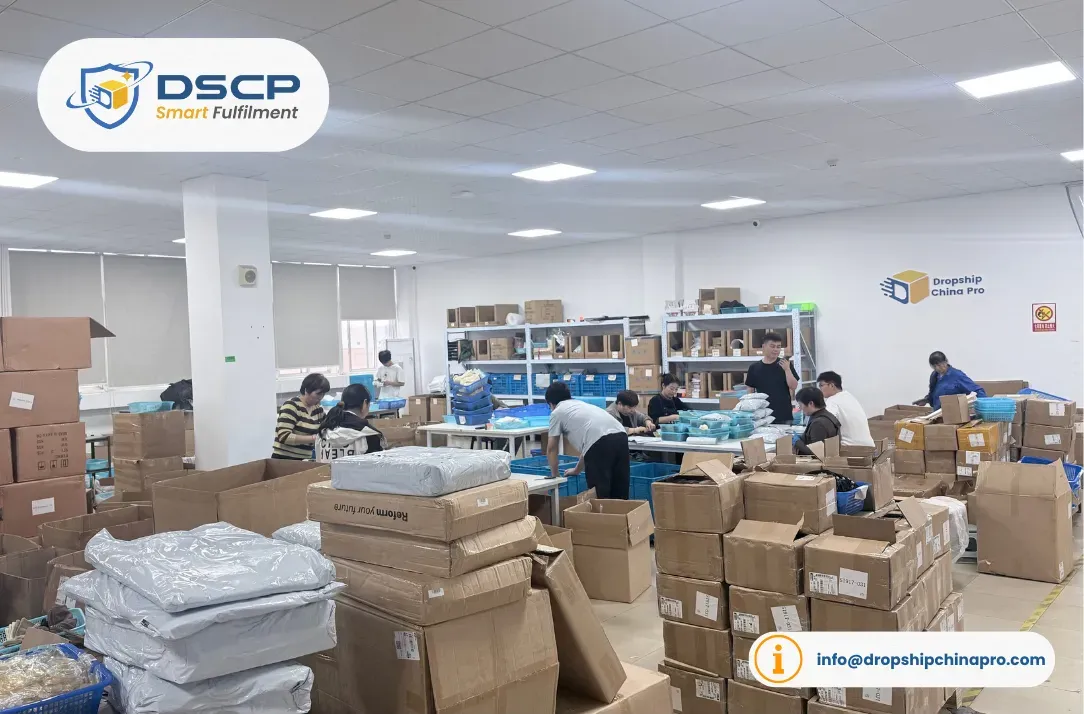
Leveraging DSCP Smart Fulfillment for Competitive Advantage
DSCP combines China sourcing with US warehouses in California and New Jersey, creating a hybrid fulfillment model that addresses common e-commerce challenges. Since 2016, DSCP has served over 1,500 active stores processing 30,000+ daily parcels.
The hybrid approach captures cost advantages of Asian manufacturing while providing domestic delivery speeds through strategically positioned US warehouses. Products undergo quality inspection before entering US inventory, preventing defects from reaching customers. Seamless integration with major e-commerce platforms including Shopify, WooCommerce, and BigCommerce automates order flow and maintains real-time inventory synchronization across all sales channels.
Conclusion
Scaling e-commerce sales requires more than attracting customers—it demands fulfillment operations capable of delivering consistent, reliable experiences that build loyalty and drive repeat purchases. Begin by honestly assessing your current fulfillment performance against the metrics discussed, identify the greatest gaps between your current state and industry best practices, then prioritize improvements based on potential impact. Many fulfillment enhancements require minimal investment while delivering measurable benefits: clearer shipping communication, streamlined returns processes, and inventory accuracy improvements can often be implemented quickly.
As your business grows, continuously evaluate whether your fulfillment model remains optimal for your scale and objectives. The right approach today may not serve you well as order volumes increase or geographic reach expands. Remember that fulfillment excellence comes from consistent attention to operational details, regular performance monitoring, and willingness to invest in improvements that enhance customer experience. The businesses that win in e-commerce don’t just sell great products—they deliver them reliably, efficiently, and in ways that exceed customer expectations.
References
- Baymard Institute. (2024). Cart abandonment rate statistics. Retrieved from Baymard Institute research on e-commerce checkout usability and shopping cart abandonment patterns.
- Grand View Research. (2024). E-commerce fulfillment services market size report, 2030. Market research analysis on global e-commerce fulfillment industry growth and projections.
- Modula. (2024). Warehouse automation ROI and efficiency statistics. Research on automated storage systems, picking productivity, and warehouse space optimization.
- Mordor Intelligence. (2024). E-commerce fulfillment market trends analysis report 2025-2030. Comprehensive market analysis covering fulfillment models, automation adoption, and industry growth rates.
- ReadyCloud. (2024). 30 order fulfillment statistics for 2024. Industry data on fulfillment costs, delivery expectations, and operational benchmarks.
- Statista. (2022). Shoppers abandoned purchase due to long shipping times 2021, by macro-region. Consumer behavior research on shipping time expectations and cart abandonment.
- U.S. Census Bureau, Department of Commerce. (2024). Quarterly retail e-commerce sales, third quarter 2024. Official government statistics on U.S. retail e-commerce sales figures.

Hi, I’m Yavuz. I help e-commerce businesses grow through strategic content and SEO. Here, I share insights on fulfillment solutions, 3PL partnerships, and digital marketing strategies based on real data and industry trends.