

The global e-commerce landscape continues its rapid evolution, with dropshipping from China emerging as one of the most accessible entry points for online entrepreneurs. China’s manufacturing dominance, combined with increasingly sophisticated logistics networks, has created unprecedented opportunities for businesses to source products efficiently without maintaining inventory. Understanding how to navigate this ecosystem effectively separates successful operations from those struggling with supplier issues and fulfillment challenges.
This comprehensive guide explores the fundamentals of working with China dropshipping suppliers, from initial supplier identification through ongoing quality management. Whether you’re launching your first online store or seeking to optimize an existing operation, mastering these relationships and processes determines long-term viability in competitive e-commerce markets.

Key Takeaways: Dropshipping from China in 2026
- China accounts for approximately 28% of global manufacturing output, providing unmatched product variety and competitive pricing.
- Dropshipping from China enables entrepreneurs to launch e-commerce businesses with minimal upfront capital investment.
- Hybrid fulfillment models combining China sourcing with US warehouses deliver both cost efficiency and fast delivery.
- Systematic supplier vetting processes reduce quality issues and fulfillment problems that plague unprepared businesses.
- Understanding shipping options, timelines and customs procedures prevents delivery delays and customer dissatisfaction.
- Professional fulfillment services eliminate common barriers, including language challenges and quality control difficulties.
Understanding Dropshipping from China: The Business Model
Dropshipping from China represents a business model where online retailers sell products sourced from Chinese manufacturers or suppliers without holding physical inventory. When customers place orders through your store, the purchase information is transmitted to your supplier, who then ships products directly to customers. This arrangement eliminates traditional retail barriers, including inventory investment, warehouse costs and fulfillment staffing.
The model’s appeal stems from remarkably low entry barriers. According to Shopify’s 2024 e-commerce research, entrepreneurs can launch dropshipping operations with initial investments under $500, compared to $25,000+ typically required for traditional retail businesses (Shopify, 2024). This accessibility has democratized e-commerce entrepreneurship, enabling individuals worldwide to build online businesses without substantial capital.
How the Dropshipping Process Works
The operational workflow follows a straightforward pattern. Customers discover products through your online store and place orders at retail prices you’ve established. Your e-commerce platform automatically or manually forwards order details to your China dropshipping supplier. The supplier then picks, packs and ships products directly to customers using their preferred shipping method.
Your profit derives from the difference between wholesale supplier costs and retail prices charged to customers. While individual product margins might seem modest, successful operations achieve profitability through volume, strategic product selection and efficient operational management. The key advantage lies in never purchasing inventory until after customer sales occur, dramatically reducing financial risk.

The China Sourcing Advantage: Why Manufacturing Matters
China’s position as the world’s manufacturing powerhouse creates unique advantages for dropshipping operations. The country produces approximately 28% of global manufacturing output, a concentration unmatched by any other nation (World Bank, 2023). This massive production capacity translates into several practical benefits for e-commerce entrepreneurs.
Product Variety and Availability
Chinese manufacturing encompasses virtually every product category imaginable. Whether selling electronics, home goods, apparel, pet supplies or niche hobby items, suppliers capable of producing or sourcing these products operate within China’s manufacturing ecosystem. This diversity enables entrepreneurs to test multiple product categories and niches without switching supplier networks.
The competitive manufacturing environment also drives continuous product innovation. Chinese factories frequently update product designs, incorporate new features and develop variations responding to market trends. This agility helps dropshippers offer current products that align with consumer preferences rather than stale inventory that fails to generate sales.
Cost Competitiveness and Margins
Manufacturing costs in China remain significantly lower than Western alternatives for most product categories. Labor cost advantages combined with established supply chains and material sourcing create pricing that enables healthy retail margins even in competitive markets. Products manufactured in China typically cost 40-60% less than equivalent items produced in the US or Europe.
These cost advantages directly impact your business viability. Lower product costs provide flexibility in pricing strategies, whether you choose to undercut competitors on price or maintain higher margins through value-added services. The savings also create room for marketing investments essential to customer acquisition in crowded online markets.
Established Logistics Infrastructure
Decades of export-focused manufacturing have created a sophisticated logistics infrastructure supporting efficient international shipping. Major Chinese cities host massive fulfillment centers, established relationships with international carriers and streamlined customs processing systems. This infrastructure evolution has progressively reduced shipping times and improved tracking reliability.
Modern logistics networks enable multiple shipping options, balancing cost and speed. Standard shipping methods deliver products to US customers in 15-30 days at minimal cost, while premium services achieve 7-10 day delivery windows. Understanding these options helps you set appropriate customer expectations while managing shipping expenses that impact overall profitability.
Sourcing Platforms Comparison
| Platform | Best For |
|---|---|
| Alibaba | Bulk orders, manufacturer relationships |
| AliExpress | Small quantities, beginner-friendly |
| Global Sources | Verified suppliers, quality products |
| DHgate | Electronics, low MOQ requirements |
| Made-in-China | Industrial products, B2B sourcing |
Finding and Evaluating China Dropshipping Suppliers
Supplier selection represents perhaps the most critical decision in dropshipping from China operations. Your supplier directly determines product quality, shipping reliability and ultimately customer satisfaction. Thorough vetting processes distinguish successful businesses from those plagued by quality issues and delivery problems.
Sourcing Platforms and Directories
Several established platforms connect international buyers with Chinese manufacturers and wholesalers. Alibaba stands as the largest, hosting millions of suppliers across virtually all product categories. The platform provides supplier verification systems, transaction protection and communication tools facilitating international business relationships.
Other platforms, including Global Sources, Made-in-China and DHgate, serve similar functions with varying focuses and supplier bases. Each platform implements its own verification standards and fee structures. Exploring multiple platforms increases your chances of finding suppliers offering optimal combinations of quality, pricing and service for your specific product needs.
Key platform features to utilize include:
- Supplier verification badges indicating completed audits
- Transaction history showing completed orders and ratings
- Product certification documentation for quality standards
- Communication systems with translation capabilities
- Secure payment processing with buyer protection
Essential Vetting Criteria
Identifying reliable suppliers requires systematic evaluation across multiple dimensions. Communication responsiveness and language proficiency indicate operational sophistication and commitment to international business. Suppliers responding quickly to inquiries with clear, professional communication typically provide better ongoing service than those demonstrating communication difficulties.
Manufacturing capabilities and quality control processes deserve careful investigation. Request detailed information about production processes, quality checkpoints and defect rates. Professional suppliers willingly provide this information and might offer factory tours or video demonstrations of operations. Reluctance to share operational details often signals potential quality issues.
Minimum order quantities (MOQs) significantly impact your ability to work with specific suppliers. Traditional manufacturers often require substantial minimum orders unsuitable for dropshipping operations. Focus on suppliers specifically supporting dropshipping models with low or no MOQs, enabling you to start with minimal inventory commitments.
Sample Order Strategy
Never commit to suppliers without ordering samples first. Sample products reveal actual quality, packaging standards and shipping processes you’ll later provide to customers. Order samples from multiple potential suppliers, comparing quality, shipping times and how products arrive to make informed selection decisions.
Evaluate samples systematically across consistent criteria:
- Product quality and construction relative to descriptions
- Packaging integrity and professional presentation
- Shipping time from order placement to delivery
- Tracking information accuracy and updates
- Condition upon arrival after international transit
Quality samples that arrive quickly with good packaging indicate suppliers likely to provide consistent positive customer experiences. Conversely, poor quality samples or extended shipping times signal potential ongoing issues that will create customer service problems.
Supplier Vetting Checklist
| Vetting Criteria | What to Look For |
|---|---|
| Verification Status | Gold supplier, trade assurance badges |
| Response Time | Under 24 hours, professional English |
| Minimum Order Qty | Low or no MOQ for dropshipping |
| Sample Orders | Willing to provide samples quickly |
| Transaction History | 100+ completed orders, 4+ star rating |
Working Successfully with Chinese Manufacturers
Establishing productive relationships with China dropshipping suppliers requires understanding cultural differences, communication approaches and business practices that differ from Western norms. These relationships determine operational smoothness and your ability to resolve issues efficiently.
Communication Best Practices
Clear communication prevents misunderstandings that create costly problems. When discussing product specifications, shipping requirements or customization requests, provide detailed written documentation rather than relying solely on verbal explanations. Written records establish mutual understanding and provide reference points if disputes arise.
Time zone differences require strategic communication planning. China operates 12-16 hours ahead of US time zones, depending on location. Schedule communications considering supplier business hours, recognizing that messages sent during your evening hours receive responses the following morning. This rhythm impacts how quickly you can resolve time-sensitive issues.
Professional fulfillment services solve many communication challenges by maintaining staff fluent in both English and Chinese. These intermediaries facilitate clear communication about requirements, resolve misunderstandings and handle complex negotiations that might prove difficult for individual entrepreneurs managing direct supplier relationships.
Quality Control Measures
Maintaining consistent product quality requires systematic monitoring rather than assuming suppliers maintain standards without oversight. Periodic sample orders verify quality hasn’t degraded over time. Some suppliers initially provide excellent products but gradually reduce quality once relationships feel established, making ongoing verification essential.
Third-party quality inspection services provide independent verification of product batches before shipping. These services conduct on-site factory inspections, verify products match specifications and identify defects before items ship to customers. While inspection services add costs, they prevent expensive problems created by defective products from reaching customers.
For businesses achieving substantial volumes, hybrid fulfillment models incorporating US-based warehouses enable quality inspection processes before products reach customers. Items ship in bulk from China to domestic warehouses where quality checks occur before individual customer fulfillment, providing an additional quality control layer impossible with direct shipping.

Shipping and Logistics: Navigating International Fulfillment
Understanding shipping options, timelines and logistics processes directly impacts customer satisfaction and operational costs. The gap between customer delivery expectations and typical shipping from China timelines creates challenges requiring strategic management.
Shipping Method Comparison
Several shipping options balance cost against delivery speed. Standard international shipping through services like ePacket, China Post or AliExpress Standard Shipping delivers products in 15-30 days at minimal costs, typically $2-5 per item. These methods suit price-sensitive customers willing to accept longer waits for lower overall costs.
Express shipping through carriers like DHL, FedEx or UPS reduces delivery times to 7-10 days but increases costs substantially, often $20-40 per package depending on weight and dimensions. Express options work well for higher-priced products where shipping costs represent smaller percentages of total purchase prices, or for customers willing to pay premium shipping fees.
Shipping method selection involves strategic tradeoffs:
- Standard shipping: Low cost, longer delivery (15-30 days), limited tracking
- Express shipping: High cost, fast delivery (7-10 days), comprehensive tracking
- Hybrid fulfillment: Moderate cost, fast delivery (2-4 days), full tracking capability
The Hybrid Fulfillment Solution
Hybrid fulfillment models address the fundamental tension between cost-effective China sourcing and fast delivery expectations. Products ship in bulk from Chinese manufacturers to warehouses located in target markets like the United States. Customer orders are then fulfilled from these domestic locations, achieving delivery speeds comparable to major retailers while maintaining China sourcing cost advantages.
DSCP Smart Fulfillment operates warehouses in Pomona, California and New Brunswick, New Jersey, strategically positioned to serve major US population centers. This infrastructure enables two to four-day delivery using standard ground shipping while products remain sourced from cost-effective Chinese manufacturers. The approach combines the best elements of international sourcing and domestic fulfillment without requiring businesses to manage complex international logistics.
Benefits of hybrid approaches include:
- Delivery times are competitive with major retailers (2-4 days)
- Reduced shipping costs compared to international express services
- Domestic tracking and customer service in familiar time zones
- Elimination of customs delays that frustrate customers
- Seamless Shopify integration, automating order routing
Customs and Import Considerations
Products shipped internationally must clear customs in destination countries. Understanding customs procedures prevents delays and unexpected fees that create customer dissatisfaction. The US maintains a de minimis threshold of $800 for duty-free imports, meaning individual shipments valued under this amount typically clear customs without additional charges.
Proper customs documentation ensures smooth processing. Accurate product descriptions, correct valuation and appropriate tariff classifications prevent holds that delay deliveries. Experienced China dropshipping suppliers understand these requirements and handle documentation properly, while inexperienced suppliers might create customs problems through inadequate or incorrect paperwork.
Hybrid fulfillment models consolidate customs clearance at the business level rather than the customer level. Products clear customs once when entering the country in bulk, streamlining processes and preventing individual customer packages from encountering clearance delays. This consolidation represents another significant advantage beyond simply faster delivery times.
Shipping Methods Comparison
| Shipping Method | Delivery Time & Cost |
|---|---|
| Standard (ePacket, China Post) | 15-30 days, $2-5 per item |
| Express (DHL, FedEx) | 7-10 days, $20-40 per package |
| Hybrid Fulfillment | 2-4 days, $4-8 per package |
| Air Freight (bulk) | 10-15 days, lower per-unit cost |
Cost Considerations: Building Profitable Operations
Understanding complete cost structures determines whether your dropshipping from China operation achieves profitability. Many entrepreneurs focus exclusively on product costs while overlooking additional expenses that erode margins and undermine business viability.
Complete Cost Structure
Product costs represent just one component of total expenses. When calculating profitability, factor in all costs, including:
- Wholesale product cost: The price charged by your supplier
- Shipping fees: International or domestic shipping, depending on fulfillment model
- Transaction fees: Payment processing charges from Stripe, PayPal or other processors
- Platform fees: Shopify, WooCommerce or marketplace commissions
- Marketing costs: Customer acquisition through advertising and promotion
- Returns and refunds: Inevitable costs from unsatisfied customers or defective products
According to recent e-commerce data, successful dropshipping operations typically achieve 15-25% net profit margins after accounting for all expenses (Oberlo, 2024). These margins require careful cost management across all categories rather than simply focusing on finding the lowest product prices.
Pricing Strategy Development
Strategic pricing balances competitiveness with profitability. Research competitor pricing for similar products to understand market ranges and customer expectations. Pricing significantly below competitors might generate initial sales, but it proves unsustainable if margins don’t support operational expenses and customer acquisition costs.
Value-based pricing approaches focus on differentiating your offering through superior service, faster shipping or better product information rather than competing solely on price. Customers willing to pay slight premiums for these advantages provide more profitable revenue than price-focused buyers constantly seeking the absolute lowest costs.
Testing different price points reveals optimal balancing points between conversion rates and profitability. Slightly higher prices might reduce conversion rates while dramatically improving per-order profitability, resulting in better overall business economics despite fewer total sales.
Startup Cost Breakdown
| Expense Category | Estimated Cost |
|---|---|
| E-commerce platform | $29-79/month (Shopify, WooCommerce) |
| Domain name | $10-15/year |
| Sample products | $50-200 (testing suppliers) |
| Marketing budget | $200-500/month (ads, content) |
| Total to start | $300-800 initial investment |
Common Pitfalls in Dropshipping from China
Understanding frequent mistakes helps you avoid problems that derail unprepared entrepreneurs. These challenges stem from predictable patterns that systematic approaches successfully mitigate.
Quality Control Failures
Perhaps the most common problem involves product quality that fails to meet customer expectations. Entrepreneurs often select suppliers based primarily on low prices without adequate quality verification, resulting in poor products that generate returns, negative reviews and long-term business damage.
The solution requires investing time and money in thorough supplier vetting through sample orders and ongoing quality monitoring. While these processes add costs and complexity, they prove far less expensive than problems created by consistent quality issues that destroy customer trust and generate negative word-of-mouth.
Unrealistic Shipping Expectations
Customers accustomed to Amazon Prime delivery speeds frequently express frustration with 15-30 day shipping times typical of standard shipping from China. Managing these expectations requires clear communication about delivery timelines during the purchase process, not just fine print in terms and conditions.
Setting accurate expectations prevents disappointment that generates negative reviews and chargeback requests. Many successful dropshippers using standard international shipping clearly state delivery windows in product descriptions, checkout processes and confirmation emails. This transparency builds trust even when delivery times exceed customer preferences.
Hybrid fulfillment models eliminate this challenge by enabling delivery speeds matching those of major retailers. The 4.9/5 Trustpilot rating achieved by DSCP Smart Fulfillment demonstrates how professional fulfillment services combining China sourcing with US warehouses create customer satisfaction through reliable, fast delivery.
Communication and Language Barriers
Direct communication with Chinese suppliers often presents challenges for English-speaking entrepreneurs. Misunderstandings about product specifications, shipping requirements or quality standards create problems that might not surface until customers receive incorrect or defective products.
Professional fulfillment services provide substantial value by handling supplier communications in both English and Chinese. These intermediaries ensure requirements are clearly understood, resolve ambiguities and manage ongoing supplier relationships so entrepreneurs can focus on marketing and business growth rather than navigating cross-cultural communication challenges.
Inadequate Financial Planning
Many entrepreneurs underestimate capital requirements for successful dropshipping operations. While the business model requires minimal inventory investment, marketing expenses necessary for customer acquisition can prove substantial. Insufficient working capital forces businesses to close before achieving the volume needed for profitability.
Financial planning should account for several months of marketing expenses before achieving consistent sales. Successful operations typically require 3-6 months of building traffic and brand awareness before reaching sustainable profitability. Businesses starting with inadequate capital often fail during this development period rather than from fundamental business model problems.
Getting Started Timeline
| Phase | Timeline |
|---|---|
| Product & niche research | 1-2 weeks |
| Supplier vetting & samples | 2-3 weeks |
| Store setup & branding | 1-2 weeks |
| Product listing & testing | 1 week |
| Ready to launch | 5-8 weeks total |
Real Success: Client Experiences with China Sourcing
Professional fulfillment partnerships transform operational challenges into competitive advantages through systematic processes and established supplier networks. These real-world examples demonstrate tangible benefits businesses achieve through strategic fulfillment approaches.
Overcoming Quality Challenges
One e-commerce entrepreneur operating across international markets initially struggled with inconsistent product quality from directly managed Chinese suppliers. Communication difficulties and time zone differences made resolving quality issues frustratingly slow, while defective products continued reaching customers and generating negative reviews.
After partnering with a professional fulfillment service, systematic quality inspection processes caught defects before shipping. When recurring issues emerged with specific products, the fulfillment partner worked directly with factories to improve production standards rather than simply processing returns. This proactive approach dramatically reduced customer complaints while improving product consistency.
“DSCP Smart Fulfillment provides professional and efficient services,” the entrepreneur noted. “Their team is responsive, easy to work with and flexible in meeting our warehousing needs. Whether it’s cross-border logistics or local delivery, they are reliable and detail-oriented. Working with them has boosted our supply chain efficiency and supported our business growth.”
The partnership enabled confident scaling from approximately 100 monthly orders to over 800 while maintaining customer satisfaction. Dedicated account management provided strategic guidance during challenging periods, demonstrating how fulfillment services contribute to business success beyond simple logistics execution.
Building Customer Trust Through Reliable Delivery
A California-based online retailer emphasized how professional fulfillment transformed customer perceptions through consistently fast delivery. Previous direct shipping from China created frequent customer service inquiries about order status and delivery timing that consumed substantial time and resources.
“My experience with DSCP has been excellent,” they shared. “Their team is always quick to reply, which gives me confidence and peace of mind. They build trust through easy and efficient communication. Their customer service feels genuinely supportive, showing how much they value long-term relationships. Overall, DSCP is reliable, professional and focused on customers.”
The shift to hybrid fulfillment with US-based warehouses eliminated delivery uncertainty that previously generated customer anxiety. Fast, trackable domestic shipping built trust that encouraged repeat purchases and positive reviews. These operational improvements directly translated into business growth through enhanced customer lifetime value and reduced acquisition costs from organic referrals.

FAQs About Dropshipping from China
Is dropshipping from China worth it?
Yes, dropshipping from China remains viable and profitable when executed strategically. The model’s low startup costs, access to diverse products and scalability make it attractive for entrepreneurs with limited capital. Success requires systematic supplier vetting, quality control processes and realistic delivery expectations. Businesses implementing hybrid fulfillment models combining China sourcing with domestic warehouses achieve the best results through competitive costs and fast delivery.
Can you dropship from China?
Absolutely. Thousands of e-commerce businesses successfully operate dropshipping models, sourcing products from Chinese manufacturers and suppliers. The process involves establishing relationships with reliable suppliers, integrating order management systems and setting up efficient logistics workflows. Professional fulfillment services simplify implementation by handling supplier relationships, quality control and shipping coordination.
What is the best website for dropshipping from China?
Alibaba represents the largest and most established platform connecting international buyers with Chinese suppliers. Other reputable platforms include Global Sources, Made-in-China and DHgate. Each offers different supplier bases and verification systems. The “best” platform depends on your specific product categories and business requirements. Exploring multiple platforms helps identify optimal suppliers for your particular needs.
How to get suppliers from China for dropshipping?
Start by researching suppliers on established platforms like Alibaba using specific product keywords. Evaluate potential suppliers based on verification status, transaction history and communication quality. Request and thoroughly examine product samples before committing to business relationships. Consider working with professional fulfillment services that maintain established supplier networks and handle vetting processes, eliminating much of the complexity individual entrepreneurs face when sourcing directly.
How much does it cost to ship from China to the USA?
Shipping costs vary significantly based on the methods selected. Standard international shipping typically costs $2-8 per item with 15-30 day delivery. Express services like DHL or FedEx charge $20-40+ per package for 7-10 day delivery. Hybrid fulfillment models shipping products in bulk to US warehouses, then fulfilling domestically, achieve $4-8 per package shipping costs with 2-4 day delivery times, providing an optimal balance of cost and speed.
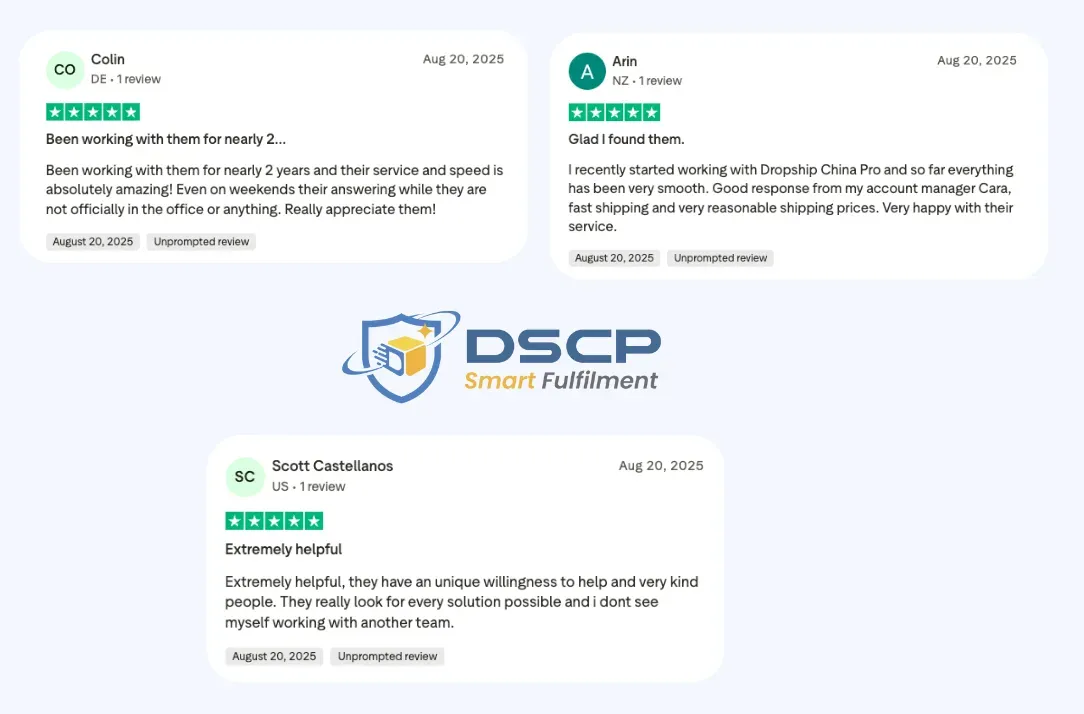
Client Success Stories: Real Experiences with China Fulfillment
Arin from New Zealand shares: “I recently started working with Dropship China Pro and so far everything has been very smooth. Good response from my account manager, Cara, fast shipping and very reasonable shipping prices. Very happy with their service.”
Colin from Germany, a long-term client, notes: “Been working with them for nearly 2 years and their service and speed are absolutely amazing! Even on weekends, they’re answering while they are not officially in the office or anything. Really appreciate them!”
Scott Castellanos from the United States emphasizes: “Extremely helpful, they have a unique willingness to help and are very kind people. They really look for every solution possible and I don’t see myself working with another team.”
All reviews from Trustpilot, verified August 2025
Ready to Start Dropshipping from China?
Dropshipping from China offers accessible entry into e-commerce entrepreneurship when approached with realistic expectations and systematic processes. The combination of cost-effective manufacturing, diverse product availability and evolving logistics infrastructure creates genuine opportunities for businesses willing to invest in proper supplier relationships and quality management.
Success requires moving beyond simply finding the cheapest products toward building reliable operations that consistently deliver quality products and positive customer experiences. Professional fulfillment partnerships eliminate many common challenges, including language barriers, quality control and shipping complexities that plague businesses attempting to manage all aspects directly.
Whether you’re launching your first online store or optimizing an existing operation, understanding the complete dropshipping from China ecosystem positions your business for sustainable growth in competitive e-commerce markets.

Conclusion
Dropshipping from China continues evolving as logistics infrastructure improves and hybrid fulfillment models emerge. The fundamental advantages of accessing China’s manufacturing capabilities while serving international markets remain compelling for entrepreneurs seeking low-barrier business opportunities. Success stems from systematic approaches to supplier selection, quality management and customer experience rather than simply pursuing the lowest product costs.
The businesses thriving in this environment recognize that operational excellence, not just product sourcing, creates sustainable competitive advantages. By combining strategic China sourcing with professional fulfillment services, quality control processes and realistic shipping strategies, e-commerce operations achieve the reliability and customer satisfaction necessary for long-term viability.
As you evaluate dropshipping from China for your business, focus on building systems and partnerships that enable consistent execution rather than seeking shortcuts promising unrealistic results. The opportunity exists for entrepreneurs willing to approach the model professionally with patience for gradual growth built on solid operational foundations.
For comprehensive dropshipping strategies beyond China sourcing, explore our complete dropshipping strategies guide.
References
- Oberlo. (2024). Dropshipping Statistics and Trends for 2024. Shopify Oberlo Research Division.
- Shopify. (2024). E-commerce Business Startup Costs Analysis. Shopify Commerce Trends Report.
- World Bank. (2023). World Development Indicators: Manufacturing Value Added by Country. World Bank Data Portal.

Hi, I’m Yavuz. I help e-commerce businesses grow through strategic content and SEO. Here, I share insights on fulfillment solutions, 3PL partnerships, and digital marketing strategies based on real data and industry trends.