
Running your e-commerce business from your garage seemed like a smart move at first. No overhead, complete control and the satisfaction of personally handling every order. But somewhere between your hundredth late-night packing session and missing another family dinner because orders needed to ship, you started wondering if there’s a better way.
The question isn’t whether successful e-commerce businesses eventually need to outsource fulfillment. Most do. The real question is, when does making that transition make financial sense for your specific situation? More importantly, what are you actually spending on DIY fulfillment once you account for every hidden cost?
This guide provides the data-driven analysis you need to make an informed decision about whether to outsource fulfillment. You’ll discover what most store owners miss when calculating their true DIY costs, understand exactly when outsourcing becomes profitable and learn what to expect during the transition. Whether you’re processing 50 orders monthly from your spare bedroom or 500 orders from a rented warehouse space, this cost breakdown will help you determine if now is the right time to make the switch.

Key Takeaways for Outsourcing Fulfillment
- Understanding outsource fulfillment economics: DIY fulfillment typically costs $8-11 per order when accounting for all expenses, while professional 3PL services average $9-10 per order with faster delivery and better quality control.
- Hidden DIY costs add up quickly: Labor time, storage space, materials, retail shipping rates and quality control issues create expenses that most sellers significantly underestimate.
- The tipping point arrives at 100-200 monthly orders: Most businesses reach the stage where outsourcing becomes more cost-effective between these volume levels, though individual circumstances vary.
- Time is your most valuable asset: Reclaiming 20-30 hours weekly by outsourcing fulfillment enables focusing on revenue-generating activities like marketing and product development.
- Quality and speed improve with professional fulfillment: Error rates drop below 1%, shipping times decrease to 2-4 days domestically and customer satisfaction increases measurably.
- Hybrid fulfillment offers the best economics: Combining international sourcing with domestic warehousing delivers fast shipping speeds while maintaining competitive product costs.
What Does It Mean to Outsource Fulfillment?
When you outsource fulfillment, you partner with a third-party logistics provider (3PL) that handles the physical operations of getting products to your customers. Instead of storing inventory, picking orders, packing boxes and coordinating shipments yourself, a fulfillment service manages these processes on your behalf.
The arrangement works through a straightforward process. You send inventory in bulk to the fulfillment center’s warehouse, where it’s received, inspected and stored. When customers place orders on your website, those orders automatically route to the fulfillment center through platform integrations. The fulfillment team then picks the correct items from inventory, packs them according to your specifications, prints shipping labels and sends packages to carriers for delivery.
Modern fulfillment services extend far beyond basic warehousing. Professional providers offer real-time inventory tracking systems that prevent overselling across multiple sales channels, quality inspection processes that catch defective products before they reach customers, custom packaging options that reinforce your brand identity and returns management services that handle the reverse logistics when customers send items back.
The key difference between DIY fulfillment and outsourcing lies in where you invest your resources. With DIY, you invest time, space and infrastructure. With outsourcing, you trade those investments for service fees while gaining access to professional systems, trained staff and established carrier relationships that deliver better outcomes than most individual businesses can achieve independently.
The True Cost of DIY Fulfillment Most Sellers Don’t Calculate
Ask a DIY fulfiller what their fulfillment costs run, and they’ll typically mention packaging materials and shipping labels. This dramatically understates reality. The true cost of self-fulfillment includes numerous expenses that remain invisible until you systematically account for them.
Complete DIY Fulfillment Cost Breakdown (200 Orders/Month)
| Cost Category | Monthly Cost |
|---|---|
| Labor (50 hours) | $1,500 |
| Storage Space | $300 |
| Materials & Supplies | $250 |
| Shipping (retail rates) | $1,600 |
| Equipment & Software | $100 |
| Error Costs (2% rate) | $80 |
| TOTAL | $3,830 ($19.15/order) |
Labor Costs: The Biggest Hidden Expense
Your time has value whether you’re actively counting it or not. Every hour spent picking, packing and shipping orders is an hour not spent on activities that grow your business. If you’re processing 200 orders monthly and each order requires 15 minutes of fulfillment time, that’s 50 hours monthly or roughly $1,500-2,000 in opportunity cost when valued at modest rates.
Many sellers hire part-time help as volumes increase, converting hidden time costs into visible payroll expenses. But hiring introduces additional costs beyond hourly wages, including payroll taxes, workers’ compensation insurance, training time and management oversight. These elements quickly push labor costs beyond what initially seemed affordable when handling orders yourself.
Storage and Facility Expenses
Storage costs start small but escalate rapidly with inventory growth. That spare bedroom could be rented for $400-600 monthly. Garage space represents similar opportunity costs. As inventory expands beyond household space, you’re looking at commercial storage units ($150-300 monthly), warehouse rentals, or shared warehouse space with associated costs for utilities, insurance and security.
Infrastructure expenses accumulate through shelving systems, packing stations, shipping scales, label printers and inventory management software. While individual items seem inexpensive, the total investment typically reaches several thousand dollars before you’ve established truly functional fulfillment operations.
Materials and Supplies
Packaging materials represent obvious costs, but many sellers underestimate total consumption. Beyond basic boxes and tape, you need bubble wrap, packing paper, branded materials if desired, shipping labels and poly mailers for softgoods. Monthly costs easily reach $200-400 for modest order volumes, with larger or fragile products requiring substantially more.
Shipping Costs Without Volume Discounts
Individual shippers pay retail rates that professional fulfillment centers avoid through volume discounts. The difference often reaches 20-40% on identical shipments. For a business shipping 200 packages monthly at $8 each retail, moving to negotiated commercial rates could save $320-640 monthly on shipping costs alone.
Quality Control and Error Costs
DIY operations typically experience error rates of 2-5%, especially during busy periods when fatigue and distraction increase mistakes. Errors require reshipping correct items, processing refunds and investing customer service time to resolve problems. Each mistake costs $15-30 in direct expenses plus the intangible cost of customer dissatisfaction that may prevent repeat purchases.
The Complete DIY Fulfillment Cost Picture
Let’s calculate realistic monthly costs for a small e-commerce store processing 200 orders:
Labor (50 hours at $30/hour opportunity cost): $1,500 Storage (spare room or rental space): $300 Materials and supplies: $250 Shipping (retail rates, average $8/package): $1,600 Equipment and software (amortized): $100 Error costs (2% error rate, 4 orders): $80
Total monthly cost: $3,830 Per-order cost: $19.15
Many sellers are shocked when seeing these complete figures. The perception of “free” DIY fulfillment evaporates when accounting for every genuine expense and opportunity cost.
The Real Numbers: When Does It Make Sense to Outsource Fulfillment?
Understanding DIY costs provides one half of the equation. The other half involves understanding what you’d actually pay to outsource fulfillment and at what volume the economics shift in favor of outsourcing.
When Should You Outsource Fulfillment?
| Monthly Order Volume | Recommendation |
|---|---|
| Under 50 orders | DIY often more economical |
| 50-100 orders | Evaluate based on time value |
| 100-200 orders | Outsourcing becomes favorable |
| 200-300 orders | Strong case for outsourcing |
| 300+ orders | Outsourcing clearly justified |
Typical 3PL Fulfillment Costs
Professional fulfillment services typically structure pricing around several components. Receiving fees cover the intake of inventory shipments, usually $0.30-0.50 per unit or flat fees per shipment. Storage fees are charged monthly based on space used, commonly $0.50-1.50 per cubic foot. Pick and pack fees apply per order fulfilled, typically $3-5 for standard orders. Shipping costs vary by package characteristics and destination, but volume discounts usually deliver 20-40% savings versus retail rates.
For our 200-order monthly example, total 3PL costs would typically run:
Receiving (monthly inventory shipment): $50 Storage (assuming 100 cubic feet): $100 Pick and pack (200 orders at $3.50): $700 Shipping (200 packages at $6 average): $1,200
Total monthly cost: $2,050 Per-order cost: $10.25
This represents nearly 50% savings versus the $19.15 per-order DIY cost, plus you reclaim 50 hours monthly for business-building activities.
The Break-Even Analysis
The point where outsourcing becomes economically favorable varies by individual circumstances, but general patterns emerge across most e-commerce operations. Businesses processing fewer than 50 orders monthly often find DIY more economical, as the fixed costs of professional fulfillment aren’t offset by sufficient volume. Between 50 and 100 monthly orders, the decision becomes situational based on product characteristics, your time value and available space.
The clear economic advantage of outsourcing typically emerges between 100 and 200 monthly orders. At these volumes, the combination of lower per-order costs, shipping rate advantages and reclaimed time creates compelling financial benefits. Above 300 monthly orders, DIY fulfillment becomes increasingly difficult to justify unless you have access to extremely low-cost labor and warehouse space.
Calculating Your Personal Break-Even Point
Your specific break-even point depends on several factors. If your opportunity cost for time runs higher than average because you could be generating significant revenue through marketing or product development, outsourcing makes sense at lower volumes. If your products are large or heavy with expensive shipping costs, the rate advantages of professional fulfillment become more valuable. If you’re experiencing rapid growth, outsourcing prevents the operational chaos that often accompanies scaling DIY operations.
Calculate your personal situation by determining your true DIY costs using the framework above, obtaining quotes from fulfillment providers for your specific circumstances and factoring in the value of time you’d reclaim for revenue-generating activities.
When Should You Outsource Fulfillment? Key Warning Signs
Beyond pure economics, several operational indicators suggest you’ve reached the point where outsourcing fulfillment becomes necessary for continued growth and sustainable operations.
Time Consumption Has Become Unsustainable
If fulfillment tasks consume more than 25% of your working hours, you’ve likely crossed the threshold where outsourcing makes strategic sense. Time spent packing boxes represents time not spent improving your website, developing new products, optimizing marketing campaigns, or analyzing business data. This opportunity cost becomes more expensive as your business grows and strategic activities become more valuable.
Quality Issues Are Increasing
Rising error rates signal that your current fulfillment process has reached capacity limits. When you’re rushing through order fulfillment to keep up with volume, mistakes increase. Wrong items shipped, incorrect quantities, poor packaging that results in damage and delayed shipments all damage customer relationships and brand reputation.
Storage Space Has Exceeded Available Capacity
When inventory overflows designated storage areas into living spaces or forces you to rent additional storage, your operational model requires reevaluation. Commercial storage solves space problems but often costs more than professional fulfillment when factoring in the inconvenience of traveling between storage locations and fulfillment operations.
Scaling Feels Impossible
The most telling sign that you should outsource fulfillment appears when growth opportunities feel threatening rather than exciting. If you’re hesitant to run promotions, concerned about wholesale opportunities, or worried about seasonal volume spikes because your fulfillment capacity can’t handle the additional orders, your operational model is constraining business potential.
Customer Complaints About Shipping Are Rising
Increasing customer inquiries about order status, complaints about shipping speeds, or negative reviews mentioning delivery problems indicate that DIY fulfillment isn’t meeting modern customer expectations. Today’s consumers expect Amazon-level shipping speeds and professional order experiences regardless of seller size.
Benefits of Outsourcing Fulfillment Beyond Cost Savings
While cost analysis provides the financial justification for outsourcing, numerous operational and strategic benefits extend beyond simple expense comparisons.
DIY vs Outsource Fulfillment Comparison
| Factor | Outsource Advantage |
|---|---|
| Order Accuracy | 99%+ vs 95-98% DIY |
| Shipping Speed | 2-4 days vs 7-14 days |
| Time Saved Weekly | 20-40 hours reclaimed |
| Shipping Discounts | 20-40% cost savings |
| Scalability | Instant without hiring |
Reclaim Time for Business Growth
The most valuable benefit of outsourcing fulfillment might be the time freedom it creates. Those 20-40 hours weekly previously devoted to picking, packing and shipping orders can redirect toward activities that genuinely grow your business. Product development, marketing optimization, customer acquisition, supplier relationship building and strategic planning all deliver far greater returns than personally packing boxes.
Access to Professional Systems and Expertise
Professional fulfillment operations maintain warehouse management systems that cost tens of thousands of dollars to implement independently. These systems provide real-time inventory tracking, prevent overselling across multiple sales channels, generate detailed reporting and integrate seamlessly with e-commerce platforms. You gain access to sophisticated technology that would be prohibitively expensive to develop or purchase for independent use.
Faster Shipping That Meets Customer Expectations
Strategic warehouse positioning enables delivery speeds that DIY operations struggle to match. Hybrid fulfillment models combine international product sourcing with domestic warehousing, delivering products to most customers within 2-4 days through standard ground shipping. This speed matches customer expectations formed by major retailers without requiring expensive air freight or premium shipping services.
Improved Order Accuracy and Quality Control
Professional fulfillment centers typically maintain order accuracy rates above 99% through systematic quality control processes. Barcode scanning verifies correct items during picking, weight verification catches quantity errors and visual inspection identifies damage before shipping. These quality control measures significantly reduce costly errors that frustrate customers and damage brand reputation.
Scalability Without Infrastructure Investment
Perhaps the most strategic benefit of outsourcing fulfillment lies in the ability to scale operations dramatically without proportional increases in fixed costs, staffing, or infrastructure. During peak seasons or successful marketing campaigns, professional fulfillment services simply allocate additional resources to handle increased volume. You avoid the complexity of hiring temporary staff, negotiating additional warehouse space, or managing the operational challenges that accompany rapid growth.

How to Choose the Right Partner When You Outsource Fulfillment
Selecting a fulfillment partner represents a significant business decision that impacts customer experience, operational efficiency and long-term scalability. Thorough evaluation prevents costly mistakes and ensures your chosen partner aligns with business needs.
Essential Capabilities to Evaluate
Begin by confirming that potential partners offer capabilities fundamental to your operations. Real-time inventory tracking prevents overselling and provides visibility into stock levels across multiple sales channels. Platform integrations should connect seamlessly with your e-commerce systems, whether Shopify, WooCommerce, Amazon, or other platforms you use.
Geographic positioning matters significantly for shipping speeds and costs. Evaluate where the fulfillment provider maintains warehouses and how those locations align with your customer distribution. Multiple warehouse locations enable zone-based shipping strategies that reduce delivery times while lowering costs.
Investigate the provider’s quality control processes. How do they verify order accuracy? What inspection procedures protect against defective products reaching customers? What systems prevent shipping errors? Clear answers to these questions indicate serious operations versus providers who merely warehouse and ship without quality safeguards.
Pricing Transparency and Hidden Costs
Request comprehensive pricing information that covers all potential charges, not just the basics. Beyond standard fees for receiving, storage, picking and packing, inquire about charges for returns processing, special packaging, account management, technology platform access and long-term storage of slow-moving inventory.
Compare pricing structures across multiple providers, but recognize that the cheapest option rarely delivers the best value. Quality control, responsive customer service, accurate order fulfillment and reliable shipping ultimately impact your bottom line more significantly than minor price differences in fulfillment fees.
Service Level Agreements and Performance Guarantees
Reputable fulfillment providers offer service level agreements that commit to specific performance standards. These should include guaranteed order accuracy rates, shipping speed commitments, maximum processing times and protocols for handling errors or exceptions. Clear performance standards provide accountability while protecting your operations from service failures.
Scalability and Growth Support
Evaluate whether potential partners can support your business through growth stages. Some providers excel with small operations but struggle as volumes increase. Others require minimum volumes that exclude emerging businesses. Ideal partners scale seamlessly from initial orders through high-volume operations without requiring migration to different services as you grow.
Common Concerns About Outsourcing Fulfillment
Despite clear benefits, many business owners hesitate to outsource fulfillment due to concerns about losing control, quality consistency and complexity. Understanding how professional services address these concerns helps make confident decisions.
Loss of Control and Quality Oversight
The concern about losing quality control represents the most common hesitation when considering outsourcing. However, professional fulfillment services actually enhance quality control through systematic processes that individual operators rarely implement. Multiple verification checkpoints, barcode scanning technology and quality inspection procedures create more reliable outcomes than manual DIY operations, especially during busy periods when fatigue increases error rates.
You maintain control over packaging specifications, branding elements and customer communication through clear guidelines provided to your fulfillment partner. Regular reporting provides visibility into operations, performance metrics track actual results and responsive account management ensures concerns receive prompt attention.
Integration Complexity and Technical Requirements
Modern fulfillment services prioritize seamless integration with major e-commerce platforms through pre-built connections that require minimal technical expertise. Once configured, orders flow automatically from your store to the fulfillment center without manual intervention. Inventory updates, tracking information and shipping confirmations synchronize automatically, eliminating the technical management that concerns many sellers.
Cost Concerns During Low-Volume Periods
Businesses with significant sales fluctuations worry about paying fulfillment fees during slow periods. Many professional providers structure pricing to accommodate seasonal businesses through flexible storage fees that scale with actual inventory levels and pay-as-you-go processing fees that only apply to orders actually fulfilled. This structure aligns costs with revenue more effectively than fixed DIY expenses like rent and staff salaries.
Customer Experience Consistency
Professional fulfillment partners understand that they represent your brand to customers. Their packaging includes your branding, shipping notifications maintain your company identity and any direct customer communication follows your guidelines. Rather than compromising customer experience, professional fulfillment typically enhances it through faster shipping, accurate orders and systematic quality control.
FAQs for Outsourcing Fulfillment
What does it mean to outsource fulfillment?
Outsourcing fulfillment means partnering with a third-party logistics (3PL) provider that handles storing inventory, picking and packing orders and shipping products to customers on your behalf. This allows business owners to focus on growth activities while professionals manage the logistics operations.
How much does it cost to outsource fulfillment?
Typical costs range from $9-12 per order, including all fees. This includes receiving charges of $0.30-0.50 per unit, storage fees of $0.50-1.50 per cubic foot monthly, pick and pack fees of $3-5 per order and discounted shipping rates. Total costs vary based on product characteristics, order volume and storage requirements.
At what order volume should I outsource fulfillment?
Most businesses find that outsourcing becomes economically favorable between 100 and 200 monthly orders. However, the right threshold depends on your time value, product characteristics, growth trajectory and available resources. Businesses experiencing rapid growth often benefit from outsourcing earlier to prevent operational bottlenecks.
Will outsourcing fulfillment slow down my shipping times?
Professional fulfillment typically accelerates shipping through strategic warehouse positioning and established carrier relationships. Hybrid fulfillment models that combine international sourcing with domestic warehousing enable 2-4 day delivery to most customers, significantly faster than direct international shipping.
How do I maintain quality control when outsourcing?
Professional fulfillment centers implement systematic quality control processes, including inventory inspection upon receipt, order verification during picking, weight verification to catch quantity errors and visual inspection before packing. These processes typically deliver higher accuracy rates than DIY operations.
Can small businesses afford to outsource fulfillment?
Yes, modern fulfillment services offer pay-as-you-go pricing models without minimum volume requirements or long-term contracts. This makes professional fulfillment accessible even to businesses processing modest order volumes, providing infrastructure and expertise that would be cost-prohibitive to develop independently.
What happens to my inventory if I want to switch providers?
Reputable fulfillment providers facilitate smooth inventory transfers if you decide to change partners. Clear procedures should cover inventory counts, transfer logistics and final billing. Discuss these policies during initial provider evaluation to ensure you’re not locked into unsatisfactory relationships.
How long does it take to set up outsourced fulfillment?
Initial setup typically requires 2-4 weeks for most businesses. This includes account configuration, platform integration, inventory transfer and process testing. Some providers offer expedited onboarding for urgent situations. The timeline depends on inventory complexity, integration requirements and provider workload.
Real Success Stories: How E-commerce Sellers Thrive After Outsourcing
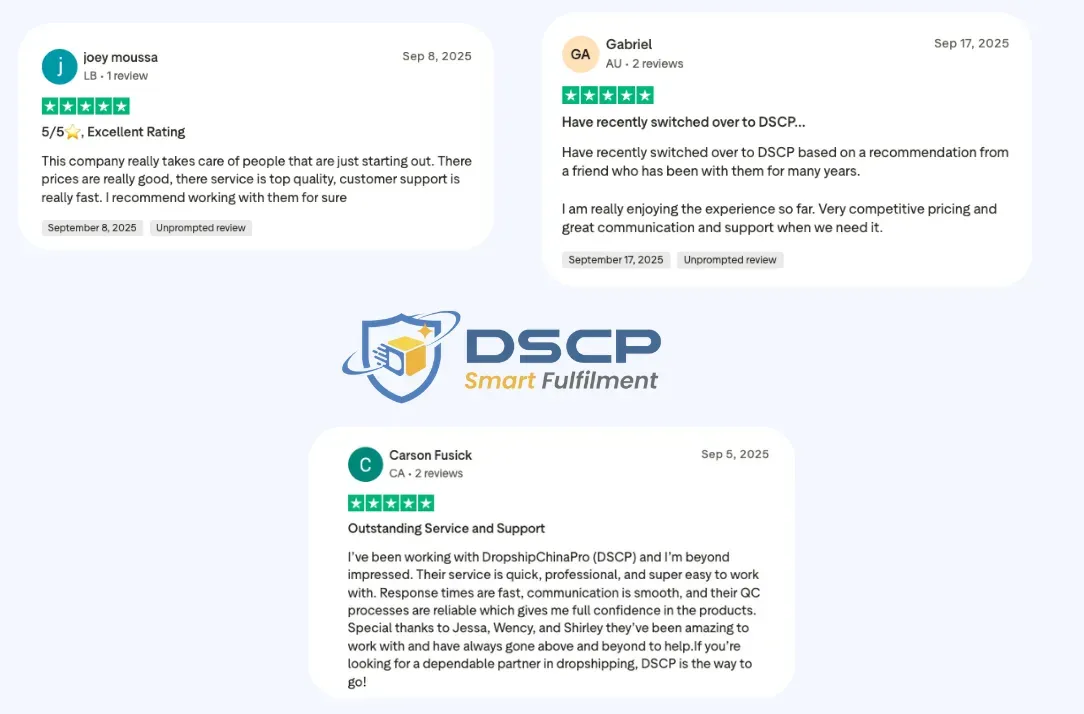
Carson from California shares his experience: “I’ve been working with DSCP and I’m beyond impressed. Their team is quick, professional and super easy to work with. Response times are fast, communication is smooth and their QC processes are reliable, which gives me full confidence in the products. If you’re looking for a dependable partner in dropshipping, DSCP is the way to go!”
Joey from Lebanon found the support particularly valuable: “This company really takes care of people who are just starting. Their prices are really good, their service is top quality, customer support is really fast. I recommend working with them for sure.”
Gabriel from Australia describes switching providers: “Have recently switched over to DSCP based on a recommendation from a friend who has been with them for many years. I am really enjoying the experience so far. Very competitive pricing and great communication and support when we need it.”
Ready to Calculate Your Outsource Fulfillment ROI?
For most businesses processing 100+ orders monthly, the economics clearly favor outsourcing when you account for all expenses and opportunity costs. Beyond financial considerations, outsourcing reclaims 20-40 hours weekly for marketing, product development and strategic planning.
DSCP Smart Fulfillment has supported e-commerce businesses since 2016 through hybrid fulfillment solutions combining cost-effective international sourcing with fast domestic shipping. With warehouses in Los Angeles and New Jersey, plus facilities throughout Asia, the service enables 2-4 day delivery to most US customers while maintaining competitive pricing.
The pay-as-you-go model eliminates traditional barriers with no minimum volume requirements or long-term contracts. Shopify sellers can get started instantly through our certified Shopify app that integrates directly with your store.
Ready to discover your specific ROI? Get a quote today to see how your costs compare and what you could gain by partnering with experienced fulfillment professionals.

Conclusion
The decision to outsource fulfillment represents one of the most significant strategic choices e-commerce businesses make. Systematic cost analysis reveals that most businesses processing 100-200+ monthly orders pay substantially more for DIY fulfillment than they realize once all expenses and opportunity costs are accounted for.
Professional fulfillment delivers lower per-order costs, shipping rate advantages, faster delivery speeds, improved order accuracy and freedom to focus on activities that genuinely grow your business. The concerns that cause hesitation typically prove less significant than anticipated, with quality control improving through professional systems and flexible pricing structures aligning costs with actual business activity.
Calculate your complete DIY expenses using the framework provided in this guide. Compare those figures against professional fulfillment pricing for your specific situation. Factor in the value of time you’d reclaim for strategic activities. The resulting analysis typically points clearly toward the right decision for your business stage and circumstances.
Your competitive advantage comes not from personally packing boxes, but from the strategic activities only you can perform for your business. Outsourcing fulfillment frees you to focus on those high-value activities that genuinely drive success.
References
- Grand View Research. (2024). E-commerce Fulfillment Services Market Size, Share & Trends Analysis Report. Retrieved from grandviewresearch.com
- Shopify. (2024). The Complete Guide to Ecommerce Order Fulfillment. Retrieved from shopify.com
- Capital One Shopping. (2025). Ecommerce Fulfillment Statistics: Industry Data & Analysis. Retrieved from capitaloneshopping.com

Hi, I’m Yavuz. I help e-commerce businesses grow through strategic content and SEO. Here, I share insights on fulfillment solutions, 3PL partnerships, and digital marketing strategies based on real data and industry trends.