

Not all ecommerce product categories perform equally, and choosing the right one can make the difference between profitable growth and constant struggle. While industry reports offer predictions and market forecasts, the most valuable insights come from real operational data: businesses actually fulfilling orders, managing inventory and navigating the practical realities of international e-commerce.
Analysis of Q4 2025 fulfillment patterns reveals clear insights into which product categories dominate online sales, why certain categories maintain consistent performance, and what fulfillment characteristics distinguish successful categories from struggling ones. These insights come directly from DSCP Smart Fulfillment’s network, which serves over 1,500 active stores across the US, Europe, and global markets, processing over 30,000 parcels daily during peak season.
With the global e-commerce fulfillment services market reaching $123.68 billion in 2024 and projected to hit $272.14 billion by 2030 (Grand View Research, 2024), selecting the right product category becomes increasingly critical for business success. The wrong choice leads to thin margins, high return rates and fulfillment challenges that erode profitability. The right choice creates sustainable competitive advantages through favorable economics and operational efficiency.
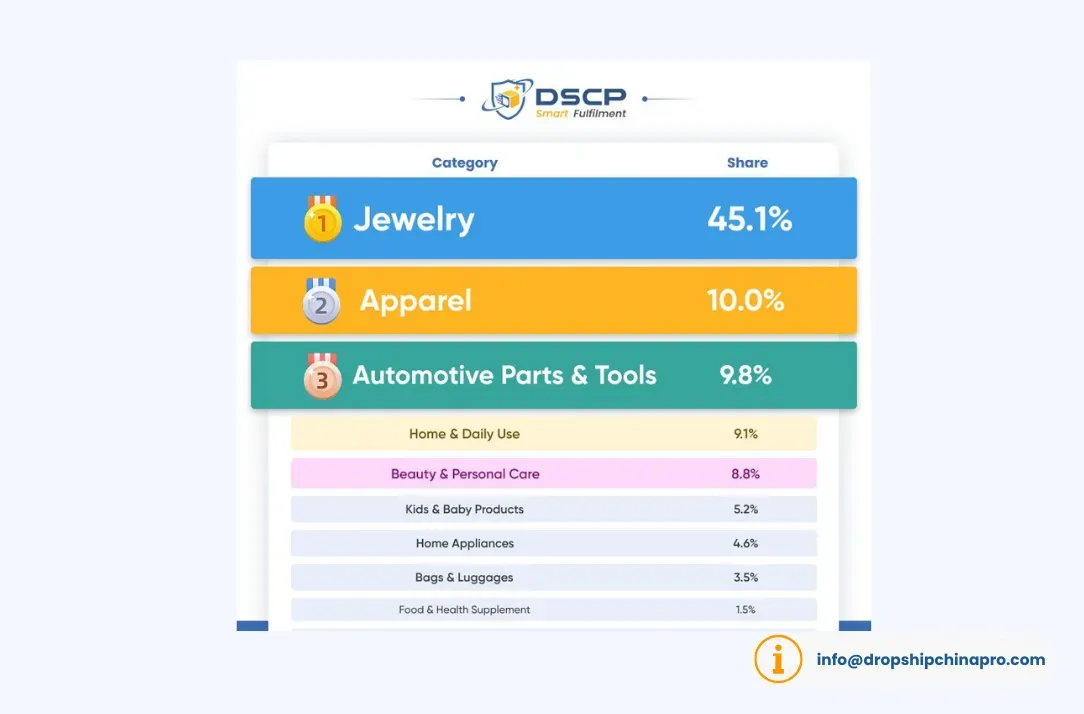
Key Takeaways: Product Category Performance in 2026
- Data-Driven Category Insights: Jewelry dominates at 45.1% of Q4 orders due to favorable shipping economics, high perceived value and customer tolerance for reasonable delivery times.
- Weight-to-Value Ratios Matter: Categories with high value and low shipping weight (jewelry, apparel, accessories) significantly outperform heavier products where shipping costs erode margins.
- Personalization Creates Differentiation: Customizable products within any category demonstrate 30-40% higher average order values and stronger customer loyalty than generic alternatives.
- Fulfillment Complexity Varies: Beauty and food products require specialized carriers for sensitive goods, while jewelry and apparel ship through standard logistics networks at lower costs.
- Seasonal Patterns Influence Strategy: Some categories spike during holidays (jewelry, home decor) while others maintain year-round consistency (pet supplies, automotive parts).
- Quality Control Requirements Differ: Categories like jewelry and beauty demand rigorous inspection processes, while automotive parts and fitness products require less intensive quality verification.
- US Warehouse Positioning Advantages: High-volume categories justify front-stock inventory in domestic warehouses, enabling 2-4 day delivery that drives customer satisfaction and repeat purchases.
What Q4 2025 Fulfillment Data Reveals About Category Performance
Peak shopping season provides the most reliable window into genuine market demand. Q4 2025 data represents actual purchasing behavior during the year’s highest-volume period, when customer preferences and spending patterns reveal themselves most clearly.
The analysis encompasses orders fulfilled through DSCP’s global network spanning warehouses in Hangzhou and Dongguan, China, plus facilities in Los Angeles, California and New Brunswick, New Jersey. This hybrid infrastructure processes over 30,000 parcels daily during peak periods, serving e-commerce businesses from emerging startups handling five to ten orders daily through established operations managing thousands of monthly shipments.
Geographic distribution reflects modern e-commerce patterns, with 40% of shipments going to US customers, 40% to European markets and 20% to other global regions. This distribution provides insights into category performance across different consumer markets with varying expectations, regulations and competitive dynamics.
How This Data Differs From Industry Reports
This analysis examines actual fulfillment operations rather than market surveys or consumer intention studies. Each insight represents real purchases, real inventory movement and real shipping transactions. The categories reflect products businesses chose to sell, customers chose to buy and fulfillment operations successfully delivered.
Order composition reveals patterns about multi-product purchases, average order values and customer buying behaviors across different categories. Processing times, shipping methods and quality control touchpoints provide operational intelligence about what each category actually requires to fulfill successfully.

Top 5 Product Categories Dominating E-commerce in 2026
Jewelry and Accessories Lead at 45.1% of Orders
Jewelry’s dominance reflects several converging advantages that make it nearly ideal for e-commerce fulfillment. Products typically weigh under 200 grams, resulting in minimal shipping costs relative to selling prices. Perceived value runs high, with customers willing to pay $35-65 for items with substantially lower product costs, creating healthy profit margins that sustain marketing investments.
Q4 timing amplifies jewelry performance through holiday gift-giving and early Valentine’s Day shopping. Fulfillment data shows nearly 50% of orders during peak season come from jewelry categories, demonstrating how seasonal demand concentrates in this segment.
Analysis of top-performing jewelry businesses reveals three common success patterns:
- Customization creates emotional value: Personalized jewelry with names, dates or custom designs generates stronger customer connections than generic pieces. This emotional investment leads to higher customer satisfaction, lower return rates and increased repeat purchases over time.
- Strategic material selection optimizes costs: Successful sellers choose materials offering genuine quality perception at accessible price points. For example, microfiber provides authentic leather texture and feel at significantly lower costs than genuine leather, while offering superior durability and comfort compared to PU leather alternatives.
- Quality improvements reduce returns: Business-friendly process upgrades dramatically decrease after-sales issues. Replacing traditional plating with PVD (Physical Vapor Deposition) plating improves color durability and wear resistance by at least 85%, virtually eliminating common customer complaints about tarnishing or color fading.
The fulfillment profile for jewelry requires attention to quality control, as defects or damage generate high return rates and damage brand reputation. However, customers demonstrate remarkable patience with delivery times for jewelry purchases. When buying emotionally meaningful personalized items, they accept 8-12 day shipping timeframes that would generate complaints for generic products.
Apparel Claims 10% Through Size and Style Variety
Apparel represents 10% of Q4 fulfillment volume, with the category’s breadth spanning everything from fast fashion basics to specialized athletic wear and customizable garments. Success in apparel requires careful attention to several critical factors:
- Accurate sizing information: Detailed size charts with measurements reduce return rates significantly
- High-quality product photography: Multiple angles and lifestyle images set proper expectations
- Clear fabric descriptions: Transparency about materials prevents disappointment
- Consistent quality control: Batch inspections ensure items match descriptions
The challenge with apparel fulfillment centers on return rates, which typically run higher than most categories due to fit concerns and style preferences that don’t translate perfectly through online photos. However, the category’s volume potential and repeat purchase patterns make it attractive for businesses that solve the sizing and quality consistency challenges.
Customizable apparel, particularly items featuring personalization like names or custom designs, performs substantially better than generic apparel. These personalized products reduce return rates while justifying higher prices and creating differentiation in crowded markets.
Automotive Parts and Tools Capture 9.8% Despite Weight Challenges
Automotive parts and tools represent 9.8% of fulfillment volume, demonstrating that heavier products can succeed when margins justify shipping costs. Key advantages of this category include:
- Higher average order values: Customers often purchase multiple related items together
- Consistent year-round demand: Less seasonal volatility than gift-driven categories
- Lower return rates: Careful research before purchase reduces impulse returns
- Professional customer base: Both mechanics and DIY enthusiasts value quality and accuracy
This category exhibits different seasonal patterns than jewelry or apparel, with steady demand from both professional mechanics and DIY enthusiasts. The customer base typically researches purchases carefully, leading to lower return rates than categories driven by impulse purchases or style preferences.
Quality expectations run high in automotive products, as functional failures create safety concerns and liability issues. However, quality control requirements are more straightforward than categories like beauty or food products, focusing on correct parts matching and damage-free condition rather than complex product testing.

Home and Daily Use Products Maintain 9.1% Through Essential Appeal
Home and daily use items represent 9.1% of orders, reflecting consistent demand for products people need regularly. This category includes organizational products, cleaning tools, small appliances and everyday household items that solve practical problems.
The essential nature of these products creates less seasonal volatility than gift-driven categories. Customers buying home products typically prioritize functionality over aesthetics, leading to purchasing decisions based on practical features and price points rather than emotional factors.
Fulfillment for home products requires attention to packaging, as many items are somewhat fragile despite not being considered luxury goods. Shipping costs vary considerably based on product dimensions and weight, making product selection within this broad category important for maintaining profitable unit economics.
Beauty and Personal Care Represents 8.8% With Specialized Requirements
Beauty and personal care products represent 8.8% of fulfillment volume despite requiring more complex fulfillment processes than most categories. These products often qualify as sensitive goods requiring specialized carriers, increasing shipping costs and complexity compared to standard items.
Regulatory considerations add complexity, particularly for products containing liquids, powders or active ingredients that face restrictions in international shipping. However, beauty products generate strong repeat purchase patterns, as customers who find products they like reorder consistently, building valuable lifetime customer value.
The category demonstrates impressive growth potential as beauty consumers increasingly shift online purchases beyond just makeup into skincare, haircare and personal care items. Success requires careful supplier vetting to ensure product safety, quality consistency and accurate ingredient listings that meet regulatory requirements in destination markets.
Top Product Categories by Order Volume
| Product Category | Q4 Order Share |
|---|---|
| Jewelry & Accessories | 45.1% |
| Apparel | 10.0% |
| Automotive Parts & Tools | 9.8% |
| Home & Daily Use | 9.1% |
| Beauty & Personal Care | 8.8% |
Why These Categories Dominate: The Fulfillment Advantage
Category performance reflects more than consumer demand. Successful categories share characteristics that enable efficient, profitable fulfillment aligned with customer expectations and operational realities.
Shipping Economics Drive Long-Term Viability
The correlation between category success and favorable shipping economics appears clearly in fulfillment data. Top-performing categories share these traits:
- High value-to-weight ratios: Jewelry, apparel and accessories feature high selling prices relative to shipping costs
- Compact packaging: Products ship economically without dimensional weight penalties
- Low damage risk: Durable items require less protective packaging and generate fewer claims
- Standard carrier compatibility: Items ship through regular logistics networks without specialized handling
A $50 jewelry item might cost $4-6 to ship internationally, while a $50 home decor item weighing several pounds could cost $15-20, fundamentally changing the profit equation. Dimensional weight pricing by carriers amplifies these differences, as low-density items occupying significant box volume trigger charges that far exceed actual weight-based pricing.
Customer Expectations Align With Fulfillment Capabilities
Categories performing best feature delivery expectation alignment with realistic fulfillment timeframes. Jewelry customers accept and even expect several days for production and shipping, particularly for personalized items. This patience allows for international fulfillment at reasonable costs while maintaining customer satisfaction.
Conversely, categories where customers demand next-day delivery create challenges for businesses without substantial domestic inventory investments. Electronics and certain personal care items face these heightened expectations that require premium fulfillment approaches.
Quality Control Complexity Affects Operational Efficiency
Categories requiring intensive quality control processes increase operational costs and processing times. Beauty products need verification of proper packaging, accurate labeling and product integrity. Food supplements require even more rigorous inspection, given the health and safety implications.
Jewelry and apparel require quality checks focused on accurate descriptions, damage-free condition and proper sizing or specifications. While still important, these checks process more quickly than categories requiring detailed safety or functionality verification.
Category Shipping Economics
| Category | Shipping Profile |
|---|---|
| Jewelry | Light weight, low cost, high value |
| Apparel | Light to medium, compact packaging |
| Automotive | Heavy weight, high margins compensate |
| Beauty | Sensitive goods, specialized carriers |
| Home Products | Variable weight, fragile handling |
Emerging Opportunities in Lower-Volume Categories
While the top five categories dominate order volume, several smaller categories show characteristics that make them attractive for specific business strategies.
Pet Supplies Build Recurring Revenue at 0.2%
Despite representing only 0.2% of Q4 orders, pet products demonstrate extremely valuable characteristics. Pet owners display remarkable loyalty to products that work well for their animals, creating high repurchase rates that build customer lifetime value. Consumable pet products like treats, supplements and grooming supplies generate predictable reorder patterns.
The category features moderate shipping weights for most products and reasonable customer delivery expectations. Pet owners plan purchases rather than expecting instant gratification, providing flexibility in fulfillment approaches. As the pet product market continues expanding, with over 67% of US households owning pets (American Pet Products Association, 2024), this category merits consideration despite its current small volume representation.
Fitness Products Spike Seasonally at 0.5%
Fitness products at 0.5% of annual Q4 volume don’t reflect the category’s true potential. New Year’s resolutions drive massive January spikes in fitness product demand that dwarf holiday season performance. Businesses positioning inventory in late December for January delivery capture this predictable surge.
The category includes products from resistance bands and yoga mats to more substantial equipment. Focusing on compact, lightweight fitness items avoids the shipping challenges of heavier equipment while serving the growing home fitness market. Return rates require attention, as sizing issues with fitness apparel and functionality questions with equipment drive returns higher than categories like jewelry.
Food and Health Supplements Show 1.5% Despite Complexity
Food and health supplements represent 1.5% of Q4 volume despite fulfillment complexity. Products in this category typically require specialized carriers, face regulatory scrutiny and carry higher risk profiles than standard goods.
However, supplements demonstrate exceptional repeat purchase patterns as customers consume products monthly and reorder consistently. A customer who purchases a supplement once might reorder 10-12 times annually, creating lifetime values that justify higher customer acquisition costs. Businesses willing to navigate the category’s regulatory and logistical complexity can build highly profitable recurring revenue streams.
Quality Control Requirements
| Category | QC Complexity |
|---|---|
| Jewelry & Accessories | High (defects impact brand) |
| Apparel | High (sizing, fabric quality) |
| Beauty & Personal Care | Very High (safety, regulations) |
| Automotive Parts | Medium (functionality checks) |
| Home Products | Medium (damage prevention) |
How to Choose the Right Product Category for Your Business
Category selection should balance market opportunity with your specific capabilities, resources and risk tolerance. No single category suits every business, but systematic evaluation identifies optimal fits.
Assess Your Fulfillment Model and Resources
Your current fulfillment approach constrains or enables certain categories. Businesses shipping exclusively from China need to focus on categories where customers accept longer delivery times. Jewelry, customizable products and hobby items typically work well with this model. Categories demanding rapid delivery require domestic inventory positioning or hybrid fulfillment approaches.
Available capital influences category choices significantly:
- Low capital requirements: Jewelry and accessories (high value, small footprint, modest inventory investment)
- Medium capital requirements: Apparel and beauty products (moderate inventory costs, standard fulfillment)
- High capital requirements: Home goods and furniture (larger sizes, higher per-unit costs, more storage space)
Evaluate Profit Margins Against Operational Complexity
Calculate complete costs including product sourcing, international shipping to your warehouse, domestic storage, pick and pack fees, shipping to customers, payment processing and return handling. Many categories appear profitable until full cost accounting reveals margins insufficient to support sustainable growth.
Categories requiring specialized carriers, intensive quality control or managing high return rates need higher gross margins to remain profitable after all costs. Jewelry succeeds partly because 40-60% gross margins absorb operational costs while leaving healthy net profits. Categories with 20-30% gross margins struggle when operational realities consume most margin.
Consider Your Competitive Advantages
Enter categories where you possess specific advantages over competitors. This might include supplier relationships providing better pricing or quality, expertise enabling superior product curation or content creation, technology providing operational efficiency or unique marketing access to target customers.
Avoid competing purely on price in commoditized categories unless you possess structural cost advantages through volume, exclusive supplier arrangements or operational superiority. Differentiation through specialization, expertise, service quality or community building creates defensible positions that price-focused competitors can’t easily replicate.
Match Categories to Customer Acquisition Channels
Different product categories perform better through different marketing channels. Visually appealing products like jewelry and home decor excel on Instagram and Pinterest, where images drive discovery. Technical products like automotive parts and tools perform well through search engine marketing, where customers research specific solutions.
Consider which marketing channels you understand and can execute effectively, then choose categories that align with those strengths. A business with strong social media capabilities and visual content creation skills should favor categories that showcase well visually. A business with strong SEO and content marketing capabilities might focus on categories where informational content drives purchase decisions.
Capital Requirements by Category
| Category | Startup Capital Need |
|---|---|
| Jewelry & Accessories | Low ($500-$1,500) |
| Apparel | Medium ($1,500-$5,000) |
| Beauty Products | Medium ($2,000-$5,000) |
| Automotive Parts | Medium-High ($3,000-$7,000) |
| Home & Furniture | High ($5,000-$15,000) |
Strategic Fulfillment Approaches by Category
Fulfillment strategy should adapt to category characteristics rather than applying one-size-fits-all approaches across all products.
High-Volume Categories Justify US Warehouse Investment
Jewelry and apparel volumes in the data support strategic inventory positioning in US warehouses for businesses serving American customers. Processing 54,000+ jewelry orders quarterly creates enough volume to justify front-stock inventory that enables 2-4 day delivery speeds that dramatically improve customer satisfaction.
The hybrid fulfillment model maintains cost-effective sourcing from China while providing domestic delivery speeds. Products ship in bulk containers from Chinese suppliers to US warehouses at far lower per-unit costs than individual parcel shipping. Orders are then fulfilled domestically at competitive rates while meeting customer delivery expectations that drive positive reviews and repeat purchases.
Lower-Volume Categories Work Well With Direct Fulfillment
Categories representing smaller order volumes often work better with direct-from-China fulfillment that avoids inventory risk and storage costs. Home decor at 0.4% and educational products at 0.4% don’t generate sufficient volume to justify domestic inventory investment for most businesses. Direct fulfillment provides flexibility and capital efficiency for these slower-moving products.
The trade-off involves longer delivery times that customers must accept. Clear communication during the purchase process about realistic shipping timeframes prevents disappointment and reduces customer service inquiries. Many customers accept extended delivery times when properly informed, particularly for unique or specialized products unavailable through mainstream retailers.
Seasonal Categories Require Timing and Planning
Categories with pronounced seasonal patterns, like fitness products, need inventory positioning before demand spikes arrive. Waiting until January to order fitness products for New Year’s resolution buyers means missing the peak. Strategic businesses position inventory in December, ready for the surge in early January orders.
Similarly, Valentine’s Day creates massive February jewelry demand. Businesses position popular jewelry items in US warehouses during January, ensuring two-day delivery capability for Valentine’s orders placed throughout early February. This planning requires forecasting, inventory investment and risk acceptance, but the rewards through captured seasonal sales justify the approach.

What Our Clients Say About DSCP Smart Fulfillment
Real experiences from businesses using strategic fulfillment partnerships reveal the practical impact these relationships create.
Purna from India shares the operational advantages: “Working with DSCP Smart Fulfillment has been a great experience. Their team is professional, reliable and always goes the extra mile to ensure smooth operations. Orders are processed quickly, tracking is accurate and communication is clear at every step. What I appreciate most is their attention to detail and proactive approach. Issues are handled before they even become problems.”
Stan from Bulgaria emphasizes reliability: “Extremely professional and organized. I’ve worked with other companies, but this one is one of the best!”
Long-term partnership value comes through in Laurence Toinel‘s experience from Mauritius: “I have been working with them since 2021 for my website. I sell lingerie and I am on Shopify. They are reliable, respond very quickly and are honest. Orders are shipped the same day. The only issue we have is that when we are assigned a new contact person, we have to explain everything again. But otherwise, I recommend this company.”
These testimonials reflect consistent themes around operational reliability, proactive communication and professional service that distinguish effective fulfillment partnerships from purely transactional vendor relationships.
FAQs About E-commerce Product Categories
What are the most profitable product categories for e-commerce?
The most profitable ecommerce product categories combine high perceived value with low shipping costs and minimal return rates. Based on Q4 2025 fulfillment data, jewelry leads at 45.1% of volume due to excellent profit margins (typically 40-60%), light shipping weights and customer acceptance of 8-12 day delivery times. Apparel at 10% and automotive parts at 9.8% also demonstrate strong profitability when managing sizing accuracy and quality control effectively.
What product should I sell online in 2026?
Product selection should align with your capabilities and competitive advantages rather than following generic recommendations. Q4 2025 data reveals jewelry, apparel and automotive parts dominate volume, but emerging categories like pet supplies and fitness products offer opportunities with repeat purchase potential. Focus on categories where you can differentiate through expertise, quality or service rather than competing purely on price. Evaluate based on shipping economics, return rates and alignment with your marketing strengths.
Which product category is best for dropshipping?
Jewelry and accessories work exceptionally well for dropshipping due to light shipping weight, high value-to-weight ratios and customer tolerance for 8-12 day delivery times, particularly for personalized items. Apparel performs well when businesses provide accurate sizing information and maintain quality consistency. Avoid categories requiring specialized carriers, intensive quality control or demanding next-day delivery. The best categories combine reasonable customer delivery expectations with favorable shipping economics.
What products are in high demand right now?
Based on Q4 2025 fulfillment data, jewelry maintains the highest demand at 45.1% of orders, driven by gift-giving occasions and personalization trends. Apparel follows at 10%, with automotive parts capturing 9.8% through year-round demand. Home products represent 9.1% as consumers invest in organizational items, while beauty and personal care at 8.8% continues growing. Fitness products spike dramatically in January despite modest Q4 representation, making them ideal for New Year launches.
How do I choose products to sell in my e-commerce store?
Evaluate multiple factors beyond trending items. Analyze fulfillment characteristics, including shipping weights, costs and customer delivery expectations. Assess your competitive advantages, such as supplier relationships, marketing expertise or specialized knowledge. Calculate complete costs, including sourcing, shipping, storage, fulfillment fees, returns and payment processing to verify profit potential. Research competition intensity and identify specific differentiation strategies through quality, service or expertise. Start with categories where you possess genuine advantages rather than entering crowded markets without clear differentiation.
What makes a product category good for e-commerce fulfillment?
Categories ideal for e-commerce fulfillment share several key characteristics. High value-to-weight ratios minimize shipping costs relative to product prices. Low return rates reduce operational burdens and protect margins. Customer delivery expectations align with realistic fulfillment timeframes. Quality control requirements are straightforward without requiring specialized testing. Repeat purchase potential builds customer lifetime value that justifies acquisition costs. Products create differentiation opportunities through personalization or expertise rather than forcing pure price competition.

Ready to Scale Your E-commerce Business With Strategic Fulfillment?
Choosing the right product categories creates the foundation for e-commerce success, but executing fulfillment effectively determines whether you capitalize on that potential. Whether you’re processing 100 orders monthly or scaling toward thousands, strategic fulfillment partnerships provide infrastructure, expertise and reliability that enable focusing on growth rather than operational challenges.
DSCP Smart Fulfillment has supported over 1,500 active stores since 2016, maintaining a 4.9 out of 5 Trustpilot rating through commitment to quality, reliability and proactive service. With capacity exceeding 8,000 orders daily and 99.2% on-time dispatch rates, the service scales from emerging businesses to established operations.
Discover how hybrid fulfillment, combining China sourcing with US warehouse positioning, can transform your delivery speeds and customer satisfaction. Contact us to explore fulfillment strategies aligned with your product categories and growth objectives.
Conclusion: Turning Category Data Into Business Strategy
Product category selection represents one of the most consequential decisions e-commerce businesses make, influencing everything from profit margins and operational complexity to customer satisfaction and growth potential. Analysis of Q4 2025 fulfillment data reveals clear patterns about which categories dominate sales, why certain products perform consistently and what fulfillment characteristics separate successful categories from struggling ones.
Jewelry’s 45.1% market share reflects favorable shipping economics, high perceived value and customer patience with reasonable delivery times. Success in top categories requires understanding their unique characteristics: customization opportunities, strategic material selection and quality improvements that reduce returns. Businesses thriving in 2026’s competitive environment make informed decisions about product categories based on operational data rather than pursuing trends without understanding fulfillment realities.
Start with the category analysis provided here, evaluate options against your specific situation and implement systematically rather than attempting everything simultaneously. Your path to sustainable e-commerce profitability begins with choosing categories where you can compete effectively while delivering customer experiences that drive loyalty and growth.
References
- American Pet Products Association. (2024). Pet Industry Market Size & Ownership Statistics. Retrieved from americanpetproducts.org
- Grand View Research. (2024). E-commerce Fulfillment Service Market Size & Analysis Report, 2024-2030. Retrieved from grandviewresearch.com
- Statista. (2024). Global E-commerce Market Projections 2025.

Hi, I’m Yavuz. I help e-commerce businesses grow through strategic content and SEO. Here, I share insights on fulfillment solutions, 3PL partnerships, and digital marketing strategies based on real data and industry trends.