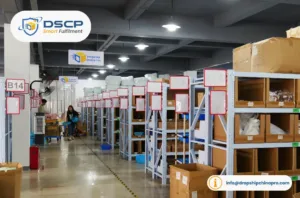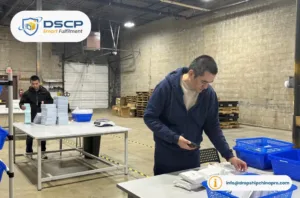

The e-commerce landscape has transformed how businesses handle logistics, with fulfillment centers becoming essential for competitive success. A fulfillment center is a specialized facility designed to store inventory, process orders, and ship products directly to customers with speed and accuracy.
Unlike traditional warehouses that focus on long-term storage, fulfillment centers prioritize rapid order processing and customer satisfaction. Understanding how these facilities work and whether your business needs one can significantly impact your operational efficiency, delivery speed, and bottom line.
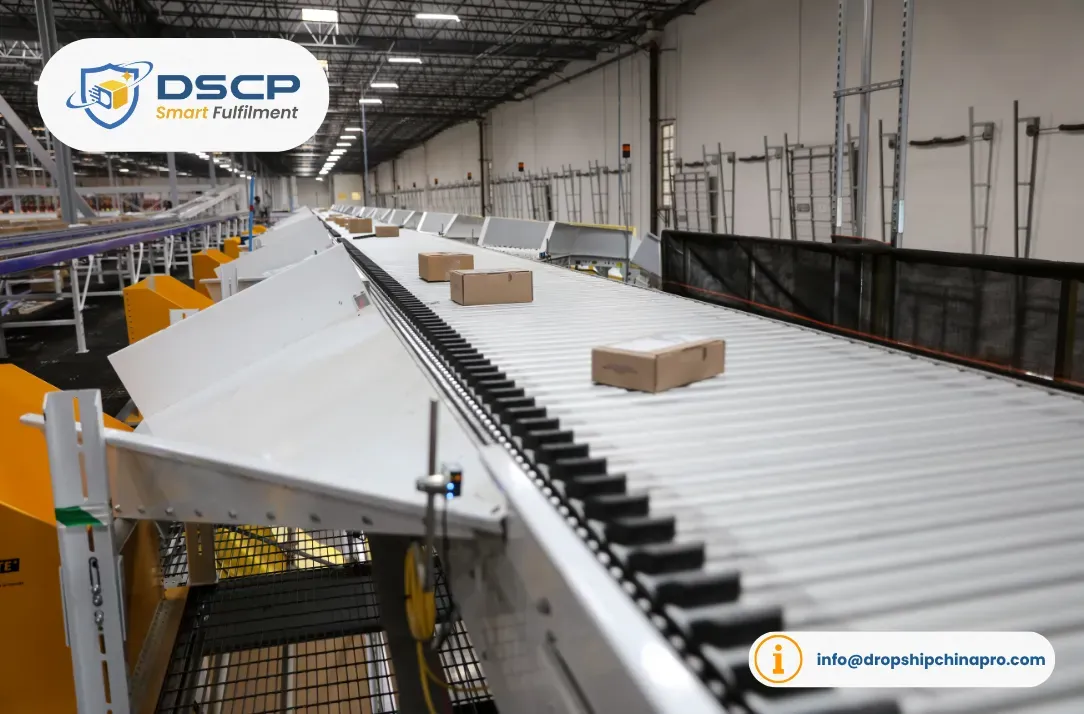
Key Takeaways for Fulfillment Center
- Definition of Fulfillment Centers: Fulfillment centers are specialized facilities that store inventory, process orders, and ship products directly to customers rapidly and accurately.
- Difference from Traditional Warehouses: Unlike traditional warehouses that focus on bulk storage and wholesale distribution, fulfillment centers prioritize fast individual order processing and direct-to-consumer shipping.
- Growing Industry Significance: The global third-party logistics market is booming, driven by e-commerce growth, with over 68% of retailers using 3PL services to meet delivery expectations.
- Five-Step Fulfillment Process: Fulfillment centers manage receiving and storage, order picking, packing with quality control, shipping coordination, and returns processing using sophisticated technology.
- Types of Fulfillment Centers: Options include third-party logistics (3PL) providers for shared cost advantage, in-house centers for full control, and Amazon FBA centers specialized for Amazon marketplace sellers.
- Indicators for Using a Fulfillment Center: Businesses should consider outsourcing when monthly orders exceed 100-200, fulfillment consumes over 10 hours weekly, geographic shipping challenges arise, storage limits restrict growth, or seasonal demand spikes create stress.
- Benefits of Fulfillment Centers: Advantages include faster delivery times, lower shipping costs through bulk rates, scalable operations for growth, and allowing businesses to focus on core activities.
- Typical Fulfillment Center Costs: Fees include per-order pick & pack charges ($2.50–$5.00), storage fees ($0.50–$2.00 per cubic foot), shipping costs with discounts, plus occasional setup, receiving, and return handling fees.
- Choosing the Right Provider: Key factors are e-commerce platform integrations, multiple geographic locations for shipping efficiency, advanced inventory management technology, and reliable customer support.
- Comparison to Other Models: Fulfillment centers provide better control, speed, and multi-channel capabilities compared to dropshipping or Amazon FBA, making them ideal for businesses seeking flexible, scalable fulfillment solutions.
What is a Fulfillment Center?
A fulfillment center is a third-party facility that manages the entire order fulfillment process for e-commerce businesses. These specialized operations handle receiving inventory from suppliers, storing products, picking and packing orders when customers purchase, and coordinating shipping through various carriers. The primary goal is to move products quickly from storage to customers while maintaining accuracy and quality.
Modern fulfillment centers integrate sophisticated technology platforms that connect directly with e-commerce stores, enabling automated order processing and real-time inventory tracking. When a customer places an order online, the fulfillment center receives the order details automatically, locates the product in the warehouse, packages it according to specifications, and ships it using the most efficient carrier route.
The facility operates as a logistics hub that eliminates the need for businesses to manage warehousing, staffing, and shipping operations internally. This enables e-commerce sellers to focus on product development, marketing, and customer service while professional logistics teams handle the operational complexities of order fulfillment.
How Fulfillment Centers Differ from Traditional Warehouses
Traditional warehouses primarily function as storage facilities where goods remain for extended periods before distribution to retailers or other businesses. These operations focus on bulk storage, long-term inventory management, and wholesale distribution patterns. In contrast, fulfillment centers emphasize speed, individual order processing, and direct-to-consumer shipping.
Fulfillment centers process orders within 24-48 hours of receipt, while traditional warehouses may hold inventory for weeks or months. The layout and operational procedures differ significantly—fulfillment centers organize products for rapid picking and packing, using technology like barcode scanning and warehouse management systems to maintain accuracy and efficiency.
The staffing and expertise requirements also differ substantially. Fulfillment center teams specialize in e-commerce operations, understanding platform integrations, carrier requirements, and customer service expectations. Traditional warehouse operations focus on inventory control, bulk handling, and B2B distribution logistics.
The key distinctions include processing speed (24-48 hours versus days to weeks), technology focus (e-commerce integration versus basic inventory systems), order types (individual customer orders versus bulk B2B shipments), and storage duration (high turnover versus extended storage periods). These fundamental differences make fulfillment centers specifically designed for the demands of modern e-commerce operations.
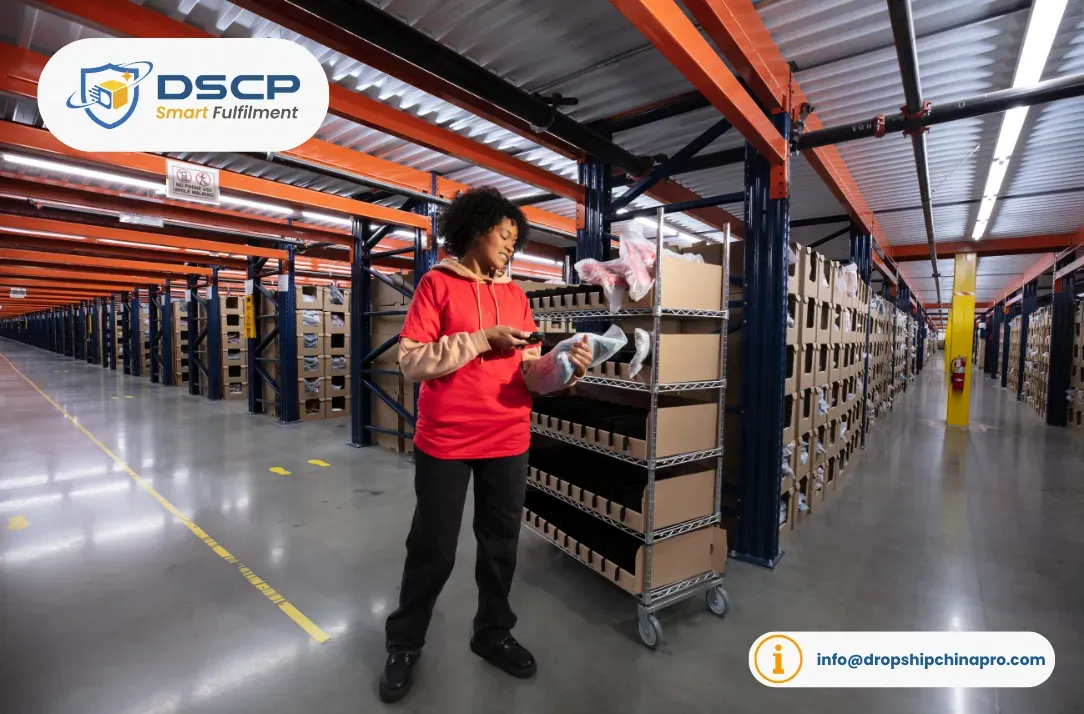
Fulfillment Center Industry: Key Statistics & Trends
The fulfillment center market has experienced substantial growth driven by e-commerce expansion and changing consumer expectations. According to recent industry analysis, the global third-party logistics market reached $1.13 trillion in 2023 and is projected to grow at a compound annual growth rate of 8.7% through 2030 (Grand View Research, 2024). This growth reflects increasing adoption of professional fulfillment services by businesses of all sizes.
E-commerce fulfillment operations have become increasingly sophisticated, with 68% of retailers now utilizing some form of third-party fulfillment services to meet customer delivery expectations (Statista, 2024). The shift toward outsourced fulfillment reflects recognition that professional logistics providers deliver better performance and economics than most businesses can achieve independently.
Customer delivery expectations continue to drive operational requirements, with 61% of online shoppers expecting delivery within 2-3 days for standard shipping (National Retail Federation, 2024). This demand for speed has made geographic distribution through multiple fulfillment centers essential for competitive e-commerce operations. Businesses utilizing strategically positioned fulfillment facilities report average delivery time reductions of 30-40% compared to single-location operations.
Cost efficiency improvements represent another significant benefit, with businesses reporting 15-25% reductions in total fulfillment costs when transitioning from self-managed operations to professional fulfillment services (Supply Chain Dive, 2024). These savings result from economies of scale, carrier relationship advantages, and operational expertise that third-party providers bring to fulfillment operations.
| Fulfillment Step | Key Activity |
|---|---|
| Receiving & Storage | Inventory inspection, cataloging, and storage placement |
| Order Picking | Accurate item selection using barcode scanning |
| Packing & Quality Check | Packaging orders and final accuracy verification |
| Shipping | Carrier selection and shipment coordination |
| Returns Management | Processing returns and restocking sellable items |
How Does a Fulfillment Center Work?
Understanding the operational flow within a fulfillment center helps businesses evaluate whether these services align with their needs. The process begins when inventory arrives from manufacturers or suppliers and continues through customer delivery and returns management. Each step involves specialized procedures and technology systems designed to maintain accuracy while maximizing efficiency.
The 5-Step Fulfillment Process
- Receiving & Inventory Storage
Products arrive at the fulfillment center from suppliers, where receiving teams verify quantities, inspect quality, and catalog items in the warehouse management system. Each product receives unique identifiers through barcode or RFID technology, enabling accurate tracking throughout the facility. Storage locations are assigned based on product velocity, with fast-moving items positioned for quick access during order processing.
The receiving process includes quality verification protocols that identify damaged goods, incorrect items, or packaging issues before products enter available inventory. This upfront quality control prevents customer dissatisfaction and reduces return rates by ensuring only acceptable merchandise ships to customers.
- Order Processing & Picking
When customers place orders through e-commerce platforms, the fulfillment center receives order details automatically through integrated systems. The warehouse management system analyzes each order, determines optimal picking routes, and assigns orders to warehouse staff through handheld devices or displays.
Picking accuracy is maintained through scanning verification, with workers confirming each item selection before moving to the next product. Advanced facilities use zone picking, batch picking, or automated systems to maximize efficiency while maintaining the accuracy rates exceeding 99.5% that customers expect.
- Packing & Quality Control
Selected products move to packing stations where trained staff place items in appropriate packaging materials, add cushioning for protection, and include any promotional materials or documentation. Packing procedures balance protection requirements with dimensional weight considerations that impact shipping costs.
Quality control checks at the packing stage verify order accuracy, ensure proper packaging, and confirm that the correct shipping labels are applied. This final verification prevents costly shipping errors and maintains customer satisfaction through accurate order fulfillment.
- Shipping & Carrier Selection
Packed orders are sorted by carrier and service level, with the fulfillment center coordinating pickup schedules and ensuring orders meet carrier requirements. Professional facilities maintain relationships with multiple carriers, enabling optimization of shipping costs and delivery speeds based on destination zones and package characteristics.
Tracking information is automatically transmitted to customers through integrated systems, providing transparency throughout the delivery process. This communication reduces customer service inquiries while managing delivery expectations effectively.
- Returns Management
Returns processing represents a critical component of modern fulfillment center operations, with facilities implementing systematic approaches to inspect returned products, determine disposition, and restore sellable items to available inventory quickly. Professional returns management minimizes losses while maintaining positive customer experiences.
Returned products are inspected for condition, with sellable items restocked, damaged goods identified for disposal or refurbishment, and detailed return reason codes captured for analysis. This data helps businesses identify quality issues, reduce future returns, and optimize product offerings.
| Fulfillment Model | Best For |
|---|---|
| 3PL Fulfillment Centers | Growing businesses needing scalable, multi-location support |
| In-House Fulfillment | Large stable volume businesses with strict control needs |
| Amazon FBA | Amazon marketplace sellers seeking Prime eligibility |
| Dropshipping | Entrepreneurs minimizing inventory and upfront cost |
| Hybrid Models | Businesses balancing cost, speed, and inventory risks |
Types of Fulfillment Centers
Different fulfillment center models serve varying business needs, from small startups to established brands with complex requirements. Understanding these options helps businesses select approaches that align with their operational requirements, budget constraints, and growth objectives.
Third-Party Logistics (3PL) Fulfillment Centers
Third-party logistics providers operate fulfillment centers that serve multiple clients simultaneously, creating economies of scale that benefit all customers. These facilities offer professional fulfillment expertise, established carrier relationships, and sophisticated technology platforms without requiring clients to invest in infrastructure or develop operational capabilities independently.
3PL fulfillment centers provide flexibility to scale operations up or down based on demand fluctuations, making them particularly valuable for businesses experiencing growth or seasonal volume variations. The shared-cost model distributes facility, technology, and management expenses across multiple clients, often delivering better economics than businesses can achieve independently.
Professional 3PL providers bring years of experience optimizing fulfillment operations, implementing best practices, and solving complex logistics challenges. This expertise translates to higher accuracy rates, faster processing times, and better customer experiences than most businesses achieve through self-managed fulfillment.
In-House Fulfillment Centers
Some businesses operate their own fulfillment centers to maintain complete control over operations, quality standards, and customer interactions. This approach requires significant capital investment in facilities, technology systems, equipment, and trained staff, making it viable primarily for businesses with substantial order volumes and stable operations.
In-house fulfillment provides direct oversight of all operational aspects, enabling immediate response to issues and complete flexibility in procedures and packaging. However, this control comes with corresponding responsibilities for facility management, staffing challenges, technology maintenance, and carrier relationship management.
The break-even point for in-house fulfillment typically occurs at 1,000+ orders daily, where economies of scale begin offsetting the fixed costs of operating dedicated facilities. Below this threshold, most businesses achieve better economics and performance through third-party fulfillment services. Further reading for Self Fulfillment vs 3PL.
Amazon FBA Fulfillment Centers
Amazon operates a specialized fulfillment center network exclusively for sellers using its marketplace. The Fulfillment by Amazon (FBA) program stores products in Amazon facilities, processes orders when customers purchase, and handles shipping and customer service. This integration with Amazon’s massive logistics network provides access to Prime shipping eligibility and simplified operations for Amazon-focused sellers.
However, FBA exclusively serves Amazon marketplace sales, limiting its value for businesses selling across multiple channels. Additionally, strict requirements, inventory limits, and fee structures can create challenges for businesses seeking operational flexibility or multi-channel fulfillment capabilities beyond the Amazon ecosystem.
Real-World Example: How Fulfillment Centers Transform Operations
Consider the experience of a mid-sized Shopify store selling home décor products that was processing approximately 200-300 orders monthly from their garage operation. The owner spent 20+ hours weekly managing fulfillment—receiving inventory shipments, organizing storage in limited space, picking and packing orders each evening, and coordinating daily carrier pickups. During their holiday season, order volume spiked to 800+ monthly orders, creating overwhelming operational stress.
After transitioning to a fulfillment center with facilities in both New Jersey and California, the business experienced transformative results within the first three months. Delivery times to East Coast customers dropped from 5-7 days to 2-3 days, while West Coast deliveries that previously took 6-8 days now arrive within 3-4 days. Customer satisfaction scores improved by 34%, and cart abandonment rates decreased by 22% once customers saw the faster delivery options at checkout.
The financial impact proved equally significant. While the business now paid pick and pack fees averaging $3.20 per order plus storage costs of approximately $320 monthly, they eliminated garage rental expenses, reduced shipping costs by 28% through the fulfillment center’s carrier relationships, and most importantly, freed 20+ weekly hours for business development. The owner redirected this time toward marketing initiatives and product sourcing, resulting in 47% revenue growth over six months.
During the following holiday season, the fulfillment center seamlessly accommodated order volumes exceeding 1,200 monthly without requiring any additional effort or stress from the business owner. The scalability that previously seemed impossible with self-managed operations became a competitive advantage. The hybrid fulfillment model also enabled the business to maintain fast-moving inventory domestically while shipping slower-moving specialty items directly from overseas suppliers, optimizing both cash flow and customer delivery expectations.
This real-world transformation illustrates how fulfillment centers deliver value beyond simple cost calculations—they enable growth, reduce operational stress, improve customer satisfaction, and free entrepreneurs to focus on strategic activities that drive business success rather than daily operational tasks.
| Signs You Need a Fulfillment Center | Why It Matters |
|---|---|
| 100+ Orders Monthly | Order volume creates operational burden |
| 10+ Hours Weekly on Fulfillment | Time could be spent growing business |
| Shipping Challenges Due to Geography | High costs and slow delivery reduce sales |
| Limited Storage Space | Restricts inventory growth and variety |
| Seasonal Volume Spikes | Overwhelms self-managed fulfillment capacity |
Do You Need a Fulfillment Center?
Determining whether your business needs a fulfillment center requires an honest assessment of current operations, growth objectives, and resource constraints. Many businesses reach inflection points where self-fulfillment becomes unsustainable, creating opportunities for professional fulfillment services to deliver operational and strategic benefits.
5 Signs It’s Time to Outsource Your Fulfillment
- Order Volume Exceeds 100-200 Monthly
When order processing consumes significant daily time and attention, businesses lose focus on growth activities like marketing, product development, and customer relationship building. Most businesses find that processing 100+ orders monthly creates an operational burden that justifies professional fulfillment services.
The time spent receiving inventory, organizing storage, picking and packing orders, coordinating shipments, and managing carrier pickups accumulates quickly. At 100+ orders monthly, this typically represents 15-20+ hours weekly that could be redirected toward revenue-generating activities.
- Fulfillment Tasks Consume 10+ Hours Weekly
If fulfillment operations require more than 10 hours of weekly attention from you or your team, the opportunity cost likely exceeds the expense of professional fulfillment services. This time investment prevents focus on strategic activities that drive business growth and competitive positioning.
Calculate the value of time spent on fulfillment by considering what you could accomplish with those hours redirected toward marketing, product development, or customer acquisition. For most businesses, this opportunity cost quickly justifies outsourcing fulfillment to professional providers.
- Geographic Expansion Creates Shipping Challenges
When significant portions of your customer base are located far from your fulfillment location, shipping costs increase and delivery times extend beyond competitive expectations. Customers in distant regions may experience 5-7 day delivery times and high shipping charges that create conversion barriers and competitive disadvantages.
Professional fulfillment centers with multiple geographic locations enable strategic inventory positioning that reduces shipping distances, lowers costs, and improves delivery speeds. This geographic distribution capability is difficult and expensive to replicate independently.
- Storage Space Limitations Restrict Growth
Running out of inventory storage space creates operational constraints that limit product selection, prevent volume purchasing advantages, and restrict growth potential. Expanding storage capacity through leasing larger facilities or securing additional warehouse space represents significant fixed cost commitments.
Fulfillment centers provide flexible storage capacity that scales with your business without requiring long-term facility commitments or upfront infrastructure investments. This flexibility enables inventory expansion while maintaining operational agility.
- Seasonal Fluctuations Create Operational Stress
Businesses experiencing significant seasonal demand variations face challenges managing temporary staffing, facility capacity, and operational workload during peak periods. The stress of handling 3-4x normal order volumes during holidays or promotional events can overwhelm self-managed fulfillment operations.
Professional fulfillment services accommodate volume fluctuations without requiring clients to manage temporary staffing or capacity expansion. This scalability enables confident promotional planning and seasonal preparation without operational concerns.
When to Keep Fulfillment In-House
Despite the numerous advantages of professional fulfillment services, certain situations justify maintaining in-house operations. Businesses with highly specialized products requiring unique handling procedures, complex customization requirements, or sensitive quality considerations may benefit from direct operational control.
Very small businesses processing fewer than 50 orders monthly may find that self-fulfillment remains cost-effective while they establish operations and refine product offerings. The learning experience of managing fulfillment personally helps entrepreneurs understand logistics complexities and customer requirements before transitioning to professional services.
Companies with sufficient scale to achieve operational efficiency—typically 1,000+ daily orders—and stable demand patterns may find that in-house fulfillment delivers acceptable economics while maintaining complete operational control. However, this requires significant management expertise, capital investment, and ongoing operational attention.

Benefits of Using a Fulfillment Center
Professional fulfillment centers deliver multiple advantages that impact both operational performance and strategic capabilities. Understanding these benefits helps businesses evaluate whether outsourced fulfillment aligns with their objectives and priorities.
Faster Shipping & Delivery Times
Strategic positioning of fulfillment centers near major population centers reduces shipping distances and transit times significantly. Businesses utilizing multi-location fulfillment networks can offer 1-3 day ground shipping to most customers, meeting competitive delivery expectations without premium air shipping expenses.
Faster delivery directly impacts customer satisfaction, conversion rates, and repeat purchase behavior. Research indicates that 24% of customers abandon purchases when delivery times exceed expectations, while 96% of shoppers consider delivery speed important to their loyalty (National Retail Federation, 2024). Professional fulfillment services enable competitive delivery performance that drives business results.
Geographic distribution through multiple fulfillment centers also provides inventory redundancy that maintains operational continuity during facility disruptions, carrier issues, or regional challenges. This resilience protects customer experiences and revenue during unexpected operational difficulties.
Lower Shipping Costs Through Bulk Rates
Professional fulfillment centers negotiate carrier rates based on aggregate shipping volumes across all clients, accessing discounts that individual businesses cannot achieve independently. These carrier relationships deliver 15-30% savings on shipping costs compared to retail carrier rates, directly improving profit margins or enabling competitive shipping offers.
Bulk rate advantages extend beyond basic discounts to include priority service, flexible pickup schedules, and dedicated account management that resolves shipping issues quickly. These relationships become particularly valuable during peak seasons when carrier capacity constraints create challenges for businesses without established partnerships.
Scalability for Growth & Seasonal Peaks
Professional fulfillment services accommodate business growth without requiring facility expansion, equipment purchases, or staffing increases from clients. This operational scalability eliminates growth barriers while maintaining consistent fulfillment performance as order volumes increase.
Seasonal demand fluctuations that create stress in self-managed operations are absorbed smoothly by professional fulfillment centers experienced with volume variations. This capability enables confident promotional planning, seasonal inventory investment, and marketing initiatives without operational capacity concerns.
Focus on Core Business Activities
Outsourcing fulfillment operations frees management attention and resources for strategic activities that drive business growth. Marketing development, product sourcing, customer relationship building, and market expansion initiatives receive proper attention when fulfillment operations no longer consume daily focus.
The strategic benefit of redirected attention often exceeds direct operational cost savings from professional fulfillment services. Business owners report that mental bandwidth freed from fulfillment operations enables creative thinking, strategic planning, and growth initiatives that were previously neglected.
Fulfillment Center Costs: What to Expect
Understanding fulfillment center costs helps businesses evaluate whether professional services align with their budget constraints and performance expectations. Total costs include multiple components that vary based on product characteristics, order volumes, and service requirements.
Common Fee Structures
Pick & Pack Fees cover the labor and systems required to locate products, verify selections, and package orders for shipment. These fees typically range from $2.50 to $5.00 per order, with variations based on order complexity, item count, and special handling requirements. Simple single-item orders cost less than complex multi-item orders requiring selections from multiple warehouse locations.
Storage Fees compensate for the space your inventory occupies within the fulfillment center facility. Costs typically range from $0.50 to $2.00 per cubic foot monthly, though some providers charge by pallet or bin. Products requiring climate-controlled storage, hazardous materials handling, or special security command premium pricing.
Shipping Costs represent the actual carrier charges plus any markup the fulfillment center applies. Professional providers typically pass through discounted carrier rates with modest markups, delivering net savings compared to retail shipping rates. Understanding dimensional weight pricing becomes crucial, as carriers charge based on package size and weight, whichever is greater.
Additional Charges to consider include receiving fees when shipments arrive (typically $20-$50 per hour of labor), return processing fees ($2-$8 per returned item), and monthly account minimums that some providers require ($200-$500). Setup fees for account establishment and system integration may range from $0-$500, depending on complexity.

How to Choose the Right Fulfillment Center
Selecting an appropriate fulfillment center partner requires careful evaluation of capabilities, costs, and alignment with your business requirements. The decision significantly impacts operational performance, customer satisfaction, and long-term growth potential.
Key Features to Look For
E-commerce Platform Integrations enable seamless order flow from your store to the fulfillment center without manual intervention. Native integrations with Shopify, WooCommerce, BigCommerce, and other platforms provide real-time inventory synchronization, automated order processing, and tracking information updates. Verify that prospective providers offer tested integrations with your specific platforms before committing.
Geographic Location Strategy determines delivery speeds and shipping costs to your customer base. Evaluate provider locations relative to your customer distribution, considering whether single-location or multi-location fulfillment better serves your needs. East Coast facilities optimize coverage for Northeast customers, while West Coast locations serve Pacific markets efficiently. Central US positioning offers balanced coverage but may not provide optimal performance for coastal customers.
Technology & Inventory Management capabilities directly impact operational accuracy, visibility, and control. Professional fulfillment centers should provide real-time inventory tracking, automated low-stock alerts, detailed reporting, and performance analytics. Warehouse management systems with barcode scanning, RFID tracking, and quality verification processes maintain the accuracy that customers expect.
Customer Support Quality becomes crucial when issues arise or when questions require immediate answers. Dedicated account managers with direct phone access provide superior support compared to impersonal ticket systems. Evaluate provider responsiveness, technical expertise, and availability during your business hours to ensure adequate support access.
Questions to Ask Before Signing Up
Before committing to a fulfillment center partnership, clarify important operational and contractual details:
- What are the complete fee structures, including any hidden charges or seasonal surcharges?
- What monthly minimums or contractual commitments are required?
- How quickly can you process and ship orders after receipt?
- What carrier options and shipping services are available?
- How do you handle order accuracy issues, shipping errors, or customer complaints?
- What technology integrations are available with my e-commerce platforms?
- Can you accommodate custom packaging, branded materials, or special handling requirements?
- What insurance coverage protects my inventory while in your facility?
- How do you manage inventory receiving, quality inspection, and discrepancy resolution?
- What performance metrics and reporting will I receive regularly?
Fulfillment Center vs Other Solutions
Understanding how fulfillment centers compare to alternative approaches helps businesses make informed decisions about their logistics strategies. Each model offers distinct advantages and limitations that align differently with various business situations.
Fulfillment Center vs Dropshipping
Dropshipping eliminates inventory investment and storage requirements by shipping products directly from suppliers to customers when orders are placed. This model minimizes upfront capital requirements and eliminates fulfillment operations, making it attractive for entrepreneurs testing product markets or operating with limited resources.
However, dropshipping sacrifices control over fulfillment speed, quality, packaging, and customer experience. Shipping times often extend to 2-4 weeks for international suppliers, while quality control and order accuracy depend entirely on supplier performance. Returns processing becomes complicated, and profit margins remain limited by supplier pricing structures.
Fulfillment centers require inventory investment but provide complete control over quality, packaging, branding, and delivery speeds. This approach enables competitive delivery times, consistent customer experiences, and higher profit margins through volume purchasing. Hybrid models combining dropshipping for slow-moving products with fulfillment center inventory for fast movers offer balanced approaches that optimize cash flow and customer experience.
Fulfillment Center vs Amazon FBA
Amazon FBA provides access to Amazon’s massive fulfillment infrastructure and Prime shipping eligibility, which can boost marketplace visibility and conversion rates. The program handles storage, picking, packing, shipping, and customer service for Amazon orders, simplifying operations for Amazon-focused sellers.
However, FBA exclusively serves Amazon marketplace sales, providing no value for businesses selling through other channels. Strict requirements for packaging, labeling, and inventory management create compliance challenges, while long-term storage fees and inventory limits can restrict operational flexibility. Additionally, commingled inventory practices and limited branding opportunities may not align with businesses focused on brand development.
Independent fulfillment centers serve all sales channels—your website, marketplaces, wholesale customers, and retail partnerships—through unified inventory pools. This multi-channel capability provides operational flexibility and brand control that FBA cannot match, though it requires managing fulfillment relationships rather than relying on Amazon’s automated systems.
Getting Started with a Fulfillment Center
Transitioning to professional fulfillment center services requires systematic planning and execution to ensure smooth operations and maintain customer satisfaction throughout the change process.
The Onboarding Process Explained
Fulfillment center onboarding typically requires 2-6 weeks, depending on inventory complexity, integration requirements, and provider procedures. The process begins with account configuration and system integration setup, establishing user access, configuring settings, and testing order flow between your e-commerce platforms and the fulfillment system.
Inventory cataloging creates product records in the fulfillment system, including SKU mapping, physical dimensions, storage requirements, and handling specifications. Detailed product information ensures accurate processing and enables optimal storage positioning within the facility.
Physical inventory transfer coordinates shipment of products from current locations to the fulfillment center, with receiving teams verifying quantities and conditions upon arrival. Careful planning prevents inventory gaps that could disrupt customer orders during the transition period.
What to Prepare Before Switching
Successful transitions require thorough preparation before engaging fulfillment center services. Create complete product catalogs with accurate dimensions, weights, and SKU information that fulfillment teams need for processing. Clean, organized inventory data prevents receiving delays and operational confusion.
Document any special handling requirements, packaging specifications, or quality considerations that fulfillment teams should understand. Clear communication about product characteristics prevents fulfillment errors and ensures appropriate treatment of sensitive items.
Prepare your customers for any potential changes in packaging, shipping times, or carrier selection that may result from the fulfillment transition. Proactive communication manages expectations and prevents confusion when customers notice different shipping patterns or package appearances.
Test system integrations thoroughly before activating live order flow to the fulfillment center. Verify that orders transmit correctly, inventory levels synchronize accurately, and tracking information flows back to customers appropriately. This testing prevents operational disruptions and customer service issues.
FAQs for Fulfillment Center
What is a fulfillment center?
A fulfillment center is a specialized warehouse that stores inventory and handles the complete order process for e-commerce businesses. It receives products from suppliers, stores them efficiently, picks and packs customer orders, and coordinates shipping—all within 24-48 hours. Unlike traditional warehouses focused on long-term storage, fulfillment centers prioritize speed and accuracy, using technology like warehouse management systems to maintain 99.5%+ accuracy rates while enabling businesses to outsource their entire logistics operation.
What is a package from a fulfillment center?
A package from a fulfillment center is your online order that was processed and shipped by a third-party logistics facility on behalf of the retailer. The shipping label may show the fulfillment center’s address instead of the store’s business address. Inside is the product you ordered, professionally packed with protective materials. This system allows online retailers to provide fast, accurate shipping without managing their own warehouses.
What is the difference between Amazon warehouse and fulfillment center?
Amazon FBA fulfillment centers exclusively serve Amazon marketplace sellers and only handle Amazon orders, though they provide Prime shipping eligibility. Independent fulfillment centers serve all sales channels—your website, multiple marketplaces, wholesale, and retail—through unified inventory. Independent centers typically offer more personalized service, flexible pricing, custom branding options, and fewer inventory restrictions, while Amazon FBA provides standardized processes with strict requirements and potential long-term storage fees.
How much are fulfillment center fees?
Fulfillment center fees typically include pick and pack ($2.50-$5.00 per order), storage ($0.50-$2.00 per cubic foot monthly), and shipping (discounted carrier rates). Additional charges may include receiving fees ($20-$50 per hour), return processing ($2-$8 per item), and monthly minimums ($200-$500). Total costs average $5-$12 per order for most businesses, often less than self-fulfillment when considering facility, labor, and technology expenses.
What does fulfillment mean in delivery?
Fulfillment encompasses the entire process of getting a product from warehouse to customer after an order is placed. This includes receiving inventory, storing products, processing orders, picking items, packing securely, generating labels, coordinating carrier pickup, and tracking delivery. While delivery is just the final transportation step, fulfillment covers all logistics activities that make that delivery possible. Fulfillment centers manage this complete chain to ensure speed, accuracy, and customer satisfaction.
Is DSCP a fulfillment center?
Yes, DSCP Smart Fulfillment operates as a hybrid fulfillment provider with fulfillment center facilities in New Jersey and California. These warehouses handle traditional fulfillment—storing inventory, processing orders, and shipping domestically within 2-4 days. DSCP also offers direct-from-China shipping for businesses wanting to minimize inventory investment. This flexible model allows e-commerce sellers to start lean and scale to faster US-based fulfillment as they grow, combining overseas sourcing advantages with domestic delivery speed.
Why are they called fulfillment centers?
They’re called “fulfillment centers” because their primary purpose is fulfilling customer orders quickly, not just storing products. The name distinguishes these facilities from traditional warehouses by emphasizing the active process of completing customer purchases. When someone orders online, the fulfillment center fulfills that promise through picking, packing, and shipping. This terminology emerged with e-commerce growth, reflecting the operational focus on rapid order completion and individual customer shipments rather than bulk storage and wholesale distribution.
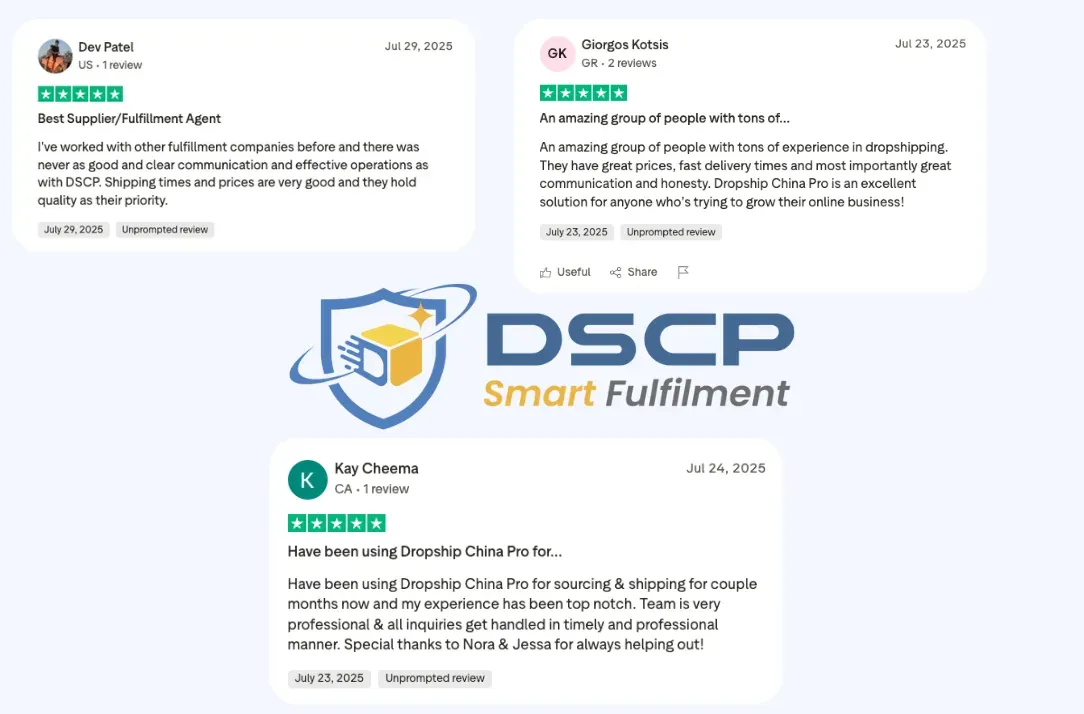
What Our Clients Say About Our Fulfillment Services
As Dev explains about his fulfillment experience: “I’ve worked with other fulfillment companies before and there was never as good and clear communication and effective operations as with DSCP. Shipping times and prices are very good and they hold quality as their priority.”
Dev’s experience highlights what distinguishes exceptional fulfillment center operations from standard providers: clear communication that keeps clients informed, effective operations that deliver consistent results, and a genuine commitment to quality over simply processing orders. When businesses find fulfillment partners who prioritize transparency and reliability, they establish foundations for sustainable growth and customer satisfaction.
As Kay shares regarding her fulfillment partnership: “Have been using Dropship China Pro for sourcing & shipping for couple months now and my experience has been top notch. Team is very professional & all inquiries get handled in timely and professional manner. Special thanks to Nora & Jessa for always helping out!”
Kay’s testimonial demonstrates the value of dedicated account management and responsive support that professional fulfillment centers provide. When fulfillment partners respond promptly to inquiries, handle challenges professionally, and assign named team members who understand your business, operational complications transform into manageable situations. This personalized approach creates the trust and reliability that enables e-commerce businesses to scale confidently.
As Giorgos describes his fulfillment journey: “An amazing group of people with tons of experience in dropshipping. They have great prices, fast delivery times and most importantly great communication and honesty. Dropship China Pro is an excellent solution for anyone who’s trying to grow their online business!”
Giorgos’s experience reflects the core principles that define successful fulfillment center partnerships: deep industry expertise, competitive pricing without sacrificing service quality, reliable delivery performance, and honest communication that builds long-term relationships. When businesses partner with fulfillment providers who combine operational excellence with genuine commitment to client success, they gain more than logistics services—they gain growth partners who understand e-commerce challenges and deliver solutions that drive results.
These testimonials illustrate what makes professional fulfillment services transformative for e-commerce operations: dedicated support teams, transparent communication, quality-focused operations, and the expertise to solve complex logistics challenges while maintaining competitive pricing and fast delivery times.
Experience Fulfillment That Powers Growth
The challenge many e-commerce businesses face is clear: managing fulfillment internally consumes time, increases costs, and limits growth potential. Professional fulfillment center services transform these operational burdens into competitive advantages through efficient logistics, strategic positioning, and expert management.
Why Leading E-Commerce Sellers Choose Strategic Fulfillment:
- Cost-effective product sourcing from verified suppliers with comprehensive quality guarantees
- Strategic US warehouse locations in New Jersey and California for optimal customer coverage
- Comprehensive quality control throughout all processes to protect brand reputation
- POD fulfillment capabilities that scale seamlessly with business growth
- Worldwide delivery options that enable global market expansion
- Dedicated account management with professionals who understand e-commerce operations
- Hybrid fulfillment models combining international sourcing with domestic delivery speed
Your Success Story Starts Here
Businesses partnering with experienced fulfillment providers report faster delivery times, reduced operational costs, and freedom to focus on growth activities like marketing and product development. With proven expertise spanning multiple years and facilities handling thousands of daily orders, the right partnership transforms fulfillment from operational burden to strategic advantage.
DSCP operates as a hybrid dropshipping and US 3PL provider, helping businesses start lean with direct-from-China shipping and graduate to 2-4 day domestic delivery from Los Angeles and New Jersey warehouses—all on one flexible, pay-as-you-go platform.
Ready to optimize your fulfillment operations? Contact our team to discover how strategic product sourcing, quality control, and US fulfillment center locations can accelerate your e-commerce growth.
Conclusion
Fulfillment centers have become essential infrastructure for competitive e-commerce operations, enabling businesses to meet customer delivery expectations while maintaining operational efficiency and cost control. Understanding how these facilities work, when businesses need them, and how to select appropriate providers empowers informed decision-making about logistics strategies.
The choice between self-managed fulfillment, third-party services, or hybrid approaches depends on specific business circumstances, growth objectives, and operational capabilities. Success with any model requires careful evaluation, clear expectations, and ongoing optimization to achieve desired performance and business results.
As e-commerce continues evolving, professional fulfillment center services will remain critical to competitive success. Businesses that implement strategic fulfillment approaches position themselves for sustainable growth while delivering customer experiences that build loyalty and drive repeat purchases. Whether you’re processing 100 orders monthly or scaling toward 10,000 daily, the right fulfillment strategy becomes a competitive advantage that enables focus on what matters most—growing your business.
For comprehensive guidance on selecting and implementing US fulfillment solutions, explore our detailed guide: US Fulfillment Warehouse: The Complete Guide for E-commerce Sellers.
References
- Grand View Research. (2024). Third Party Logistics Market Size, Share & Trends Analysis Report. Retrieved from Link to Resource 1
- National Retail Federation. (2024). Consumer View: Shipping & Delivery Survey. Retrieved from https://nrf.com
- Statista. (2024). E-commerce Logistics and Fulfillment Services Worldwide.
- Supply Chain Dive. (2024). Fulfillment Cost Analysis: 3PL vs In-House Operations.

Hi, I’m Yavuz. I help e-commerce businesses grow through strategic content. Here, I share insights on fulfillment solutions, 3PL partnerships, and digital marketing strategies based on real data and industry trends.