
The promise of Alibaba dropshipping sounds almost too good to be true: source products directly from Chinese manufacturers at wholesale prices, sell them online without holding inventory and build a profitable e-commerce business with minimal upfront investment. Thousands of entrepreneurs launch Alibaba dropshipping stores every month, attracted by success stories and YouTube tutorials showing the apparent simplicity of this business model.
However, the reality of operating a successful Alibaba dropshipping business involves challenges that rarely make it into promotional content. From minimum order quantities that aren’t actually dropship-friendly to quality control issues that damage your brand reputation, the gap between expectation and reality can be substantial. According to industry data, the global dropshipping market is projected to reach $476.1 billion by 2026 (Grand View Research, 2024), yet many individual sellers struggle to achieve sustainable profitability.
This guide examines what actually happens when you attempt to build a dropshipping business using Alibaba suppliers, the hidden challenges that emerge at scale and when businesses should consider hybrid fulfillment models that combine international sourcing with domestic warehouses.
Key Takeaways: The Reality of Alibaba Dropshipping
- Alibaba suppliers often require minimum order quantities incompatible with true dropshipping models.
- Quality control becomes increasingly difficult as order volumes scale beyond 100-200 monthly orders.
- Shipping times from China to the US typically range from 15 to 30 days, creating challenges for customer satisfaction.
- Communication barriers with suppliers can lead to order errors, fulfillment delays and customer service problems.
- Hybrid fulfillment models using domestic warehouses enable competitive shipping speeds while maintaining international sourcing economics.
- Professional quality inspection catches product issues before they reach customers, protecting brand reputation.
- The transition from direct Alibaba sourcing to fulfillment partnerships typically occurs between 100 and 500 monthly orders.
What is Alibaba Dropshipping?
Alibaba dropshipping involves sourcing products directly from manufacturers and suppliers on Alibaba.com, then selling these items through your online store without maintaining physical inventory. When customers place orders, you forward those orders to your Alibaba supplier, who ships products directly to customers. You profit from the difference between your retail price and the supplier’s wholesale cost plus shipping fees.
The model appeals to entrepreneurs because it eliminates traditional e-commerce barriers. You don’t need to invest thousands in inventory upfront, rent warehouse space or manage complex logistics operations. Theoretically, you can launch a product catalog with hundreds of items without purchasing any inventory, testing products to identify what sells before committing capital to stock.
Alibaba.com functions primarily as a business-to-business marketplace connecting retailers with manufacturers and wholesale suppliers. The platform hosts millions of suppliers offering virtually every product category imaginable, from electronics and fashion to home goods and industrial equipment. This vast selection enables finding suppliers for almost any niche, though the abundance of options also creates decision paralysis and makes supplier vetting more critical.

How Alibaba Dropshipping Actually Works
The operational process appears straightforward on paper, but involves multiple steps where problems can emerge:
- Product research: Use Alibaba’s search tools to find suppliers, filtering by verification status and reviews
- Supplier vetting: Contact suppliers to discuss dropshipping arrangements, pricing and fulfillment procedures
- Integration setup: Connect your online store with order management systems that route orders to suppliers
- Order processing: Forward customer orders (manually or automatically) to suppliers with shipping information
- Fulfillment: Suppliers ship products directly to customers and provide tracking information
Many suppliers on Alibaba are not set up for dropshipping operations. They’re manufacturers accustomed to wholesale orders where buyers purchase hundreds or thousands of units at a time. This creates the first major disconnect: suppliers advertising dropshipping capabilities may have very different definitions of what that means compared to your operational needs.
This process works smoothly when everything goes right. However, the complexity increases substantially when managing multiple suppliers, dealing with inventory discrepancies, handling customer service issues for products you’ve never physically seen or coordinating returns and exchanges across international borders.
The Hidden Challenges No One Discusses
Common Alibaba Dropshipping Challenges
| Challenge | Business Impact |
|---|---|
| High MOQs (100+ units) | Capital tied up in inventory |
| No Quality Control | 20-30% return rate increase |
| Long Shipping Times | Low repeat purchase rates |
| Communication Delays | Order fulfillment errors |
| No Brand Control | Generic packaging, no loyalty |
Minimum Order Quantities That Aren’t Really Dropship-Friendly
The term “dropshipping” on Alibaba often means something very different from what e-commerce sellers need. While suppliers may advertise dropshipping services, their minimum order quantities frequently range from 50 to 500 units per product. This is technically dropshipping in that they’ll ship directly to customers, but it requires maintaining substantial inventory rather than the one-unit-at-a-time model that makes dropshipping attractive.
According to discussions on Reddit’s r/dropshipping community, sellers consistently report that Alibaba suppliers requesting MOQs of 100+ units were their primary barrier to entry. One thread from December 2020 noted that finding true single-unit dropship suppliers on Alibaba “requires messaging 50+ suppliers to find even one willing to work that way, and when you do find them, their prices are often 40-60% higher than wholesale pricing” (Reddit, 2020).
This MOQ reality means you’re often choosing between maintaining inventory (requiring upfront capital investment) or paying significantly inflated per-unit costs that compress profit margins to unsustainable levels. Neither option matches the idealized dropshipping model promoted in introductory content.
Typical Alibaba Supplier MOQ Requirements
| Supplier Type | Typical MOQ |
|---|---|
| Factory Direct | 500-1,000+ units |
| Trading Company | 100-500 units |
| “Dropship” Supplier | 50-100 units |
| True Single-Unit | 1 unit (rare, 40-60% markup) |
| Fulfillment Partner | No minimum required |
Quality Control Becomes Your Biggest Liability
When suppliers ship directly to customers, you lose visibility into product quality until customer complaints arrive. This blind spot creates serious risks as your business scales. At 10-20 orders monthly, you might personally inspect samples and manage occasional quality issues. At 200-500 monthly orders, quality problems become systematic crises that damage your brand reputation and generate overwhelming customer service burdens.
Quality issues manifest in multiple ways:
- Products differing from photos or descriptions
- Inconsistent manufacturing quality across different production batches
- Inadequate packaging leading to shipping damage
- Missing accessories or components
Each issue requires customer service resources to resolve, often resulting in refunds, replacements or negative reviews that deter future customers.
Professional sellers emphasize that quality control inspection before products ship to customers is non-negotiable for businesses serious about growth. However, implementing quality control when suppliers ship directly to customers is practically impossible unless you’re physically present in China or employ third-party inspection services that add costs and complexity.
Communication Barriers Create Costly Mistakes
Language differences, time zone gaps and cultural communication styles contribute to misunderstandings that result in order errors and fulfillment delays. A supplier might confirm they understand your specifications, then deliver products that don’t match your requirements because subtle details were lost in translation. Response times of 12-24 hours mean simple questions take days to resolve, delaying order processing and frustrating customers awaiting updates.
These communication challenges intensify during peak seasons when suppliers juggle hundreds of clients. Messages go unanswered for days, order confirmations arrive late and special requests get overlooked. The responsive service you experienced during initial relationship-building often deteriorates once you become an established customer with ongoing orders, rather than a prospective client being actively courted.
Shipping Times That Kill Customer Satisfaction
Standard shipping from China to the US ranges from 15 to 30 days, with delays extending to 45+ days during peak seasons or logistical disruptions. Modern consumers expect delivery within 3-7 days, shaped by Amazon Prime and domestic e-commerce standards. The gap between customer expectations and the Alibaba dropshipping reality creates constant tension.
You can offer expedited shipping through carriers like DHL or FedEx, but costs often equal or exceed product costs, eliminating profit margins. Even expedited shipping from China typically requires 5-10 days, slower than customers expect. This fundamental mismatch between what customers want and what direct China shipping can provide forces difficult choices: absorb shipping costs and sacrifice profitability or charge customers for shipping and sacrifice conversion rates.
Industry data shows that delivery times averaging above 7-10 days significantly reduce repeat purchase rates and customer lifetime value (Shopify, 2024). When customers wait 20+ days for products they could receive faster elsewhere, they rarely return for subsequent purchases, regardless of your pricing or product selection.
Shipping Time Comparison
| Fulfillment Method | Average Delivery Time |
|---|---|
| Direct China Shipping | 15-30 days |
| China Express Shipping | 5-10 days |
| Hybrid Fulfillment (US) | 2-4 days |
| Amazon Prime Standard | 2 days |
The Scaling Ceiling Most Dropshippers Hit
Direct Alibaba dropshipping works reasonably well for businesses processing 50-100 monthly orders. The challenges remain manageable, quality issues can be handled individually and customer service demands stay within reasonable bounds. However, growth beyond this threshold creates systematic problems that can’t be solved through incremental improvements.
At 200-500 monthly orders, the accumulated friction from communication delays, quality inconsistencies, shipping uncertainties and customer service burdens begins consuming more time and resources than the business generates. Many sellers describe reaching a ceiling where increasing order volume actually decreases profitability because operational challenges scale faster than revenue.
This pattern appears consistently across entrepreneur communities. A Reddit discussion on r/dropshipping highlighted that sellers frequently report hitting operational walls between 100-300 monthly orders, with one experienced seller noting “the model that got you to $5K/month won’t get you to $20K/month” (Reddit, 2025). The transition point typically occurs somewhere between 100-500 monthly orders, depending on product categories, price points and individual operational efficiency.
Scaling Milestones and Solutions
| Monthly Order Volume | Recommended Approach |
|---|---|
| 0-50 orders | Direct Alibaba dropshipping |
| 50-100 orders | Test hybrid fulfillment |
| 100-300 orders | Transition to 3PL partner |
| 300-500 orders | Full hybrid fulfillment model |
| 500+ orders | Multi-warehouse strategy |
When You Need More Than Direct Alibaba Sourcing
Several signals indicate it’s time to evolve beyond direct Alibaba dropshipping toward professional fulfillment partnerships:
- Operational time drain: You’re spending more time managing supplier relationships, quality issues and customer service problems than growing your business
- Review quality decline: Negative reviews mentioning shipping times or product quality begin accumulating, increasing customer acquisition costs
- Available working capital: You’ve achieved consistent sales volumes and accumulated capital for inventory investment
- Customer feedback patterns: Shipping speed complaints appear consistently in reviews, support inquiries and abandoned cart data
- Volume threshold: You’re processing 100-500+ monthly orders and feeling operational strain
The most telling signal comes when you analyze customer feedback. If shipping speed complaints appear consistently, your fulfillment approach is directly limiting business performance. At this point, the cost of maintaining the status quo exceeds the investment required to upgrade your fulfillment capabilities.
How Hybrid Fulfillment Solves Alibaba’s Limitations
Hybrid fulfillment models address the core challenges of direct Alibaba dropshipping while preserving the economic advantages of international sourcing. These systems ship products in bulk from Chinese manufacturers to domestic warehouses positioned near customer populations, then fulfill individual orders from local facilities.
This approach delivers several critical benefits:
- Faster delivery: Shipping times drop from 15-30 days to 2-4 days, meeting customer expectations
- Quality control: Inspection occurs before products reach customers, catching issues early
- Inventory reliability: Systematic management provides predictable fulfillment timelines
- Simplified communication: Work with one fulfillment partner instead of multiple Chinese suppliers
- Reduced administrative burden: Streamlined operations accelerate problem resolution
Communication complexity also decreases substantially. Rather than coordinating with multiple Chinese suppliers across time zones and language barriers, you work with a single fulfillment partner operating in your timezone with native language support.

The Dropship China Pro Advantage
DSCP operates a hybrid fulfillment model specifically designed for e-commerce businesses transitioning from direct China sourcing to professional fulfillment. With warehouses in both China (Hangzhou and Dongguan) and the US (Los Angeles and New Brunswick), the service enables maintaining cost-effective sourcing while delivering competitive domestic shipping speeds.
The infrastructure supports businesses from 5 to 500 orders daily without volume minimums or long-term commitments. This pay-as-you-go accessibility means emerging businesses can leverage professional fulfillment from early stages rather than waiting to achieve substantial scale. The service integrates with Shopify and WooCommerce through dedicated apps, automating order routing and inventory synchronization that eliminates manual processes.
Comprehensive quality inspection throughout the fulfillment process catches product issues before they reach customers. Factory quality checks ensure products meet specified standards, while warehouse receiving inspections identify shipping damage or discrepancies. This systematic quality control protects brand reputation while reducing customer service burdens from product problems.
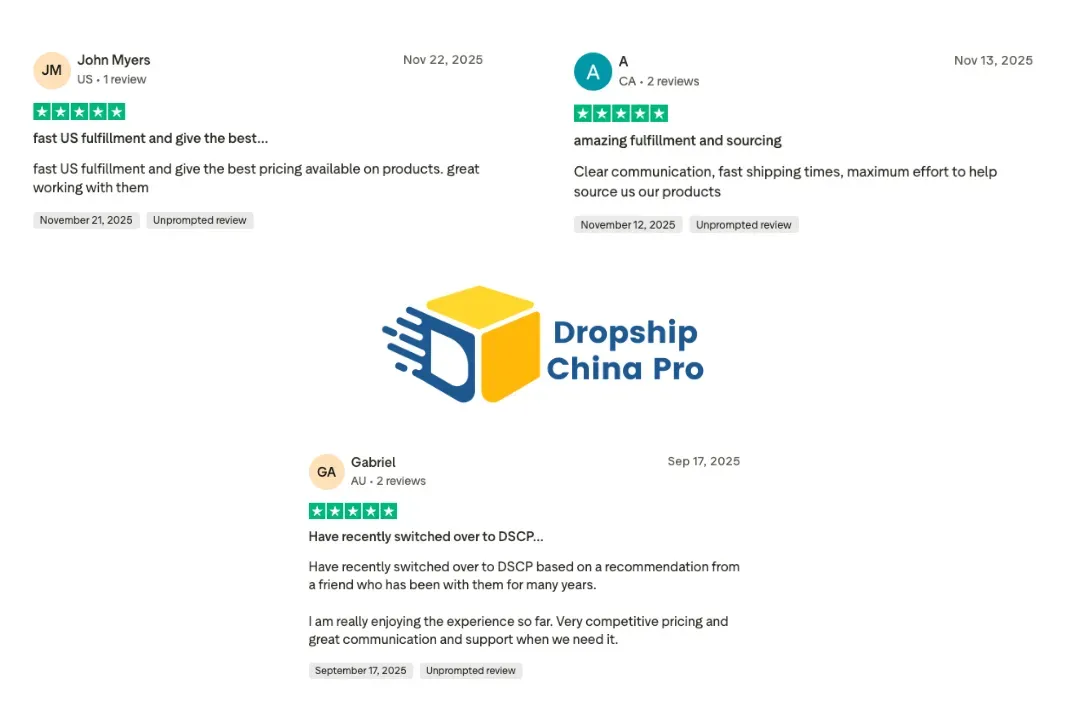
With experience supporting e-commerce sellers since 2016, DSCP has developed expertise in the specific challenges that emerging businesses face. The service processes over 30,000 parcels daily while maintaining a 99.2% on-time dispatch rate and 4.9 out of 5 Trustpilot rating, demonstrating operational consistency at scale.
Real Results: How Sellers Transformed Their Operations
Businesses that successfully transition from direct Alibaba sourcing to professional fulfillment often describe transformative impacts on their operations and customer satisfaction. Gabriel from Australia switched to DSCP based on a referral from a friend who had worked with the service for many years. He emphasizes the value of competitive pricing combined with strong communication and support when needed, highlighting how responsive service creates confidence even during challenging situations.
Another seller praised the clear communication, fast shipping times and maximum effort to help source products that align with customer needs. This proactive approach to product sourcing represents a significant upgrade from traditional supplier relationships, where you’re entirely responsible for identifying products and negotiating terms without strategic guidance.
John Myers from the US specifically notes the fast fulfillment capabilities and competitive pricing on products as standout features. The combination of domestic shipping speeds with internationally competitive costs addresses the fundamental challenge that makes direct Alibaba dropshipping difficult for businesses serving US customers who expect rapid delivery.
These experiences illustrate how professional fulfillment partnerships enable focusing on business growth rather than constantly managing operational challenges. When quality control, inventory management and shipping logistics are handled systematically by experienced teams, business owners can invest time in marketing, product selection and customer experience improvements that actually build long-term value.
Frequently Asked Questions About Alibaba Dropshipping
Is Alibaba good for dropshipping?
Alibaba can work for dropshipping, but it’s designed primarily for wholesale buyers rather than true dropshippers. The platform excels at connecting businesses with manufacturers for bulk orders. However, finding suppliers willing to fulfill individual orders without minimum quantities requires extensive research and often involves paying significantly higher per-unit costs. Most successful Alibaba dropshippers either transition to maintaining inventory or partner with fulfillment services that handle individual order fulfillment while preserving sourcing economics.
Is $100 enough for dropshipping?
While $100 can technically start a dropshipping business, realistic startup costs typically range from $500 to $2,000 for a sustainable operation. You’ll need an e-commerce platform subscription ($29-79 monthly), a domain name and hosting, product samples for quality verification, an initial marketing budget and business registration fees. Starting with minimal capital often leads to cutting corners on quality control, professional website design or marketing that ultimately costs more through poor conversion rates and customer dissatisfaction.
Do I need an LLC to buy from Alibaba?
You don’t legally require an LLC to purchase from Alibaba, as the platform accepts individual buyers. However, establishing a formal business entity provides important protections and benefits, including liability protection for personal assets, tax advantages through business expense deductions, professional credibility with suppliers and payment processors and easier access to business banking and payment processing services. Most serious e-commerce sellers establish LLCs or similar structures within their first few months of operation.
Can I make $10,000 per month dropshipping?
Making $10,000 monthly through dropshipping is achievable but requires substantial effort, strategic planning and often significant marketing investment. With typical profit margins ranging from 15-20% after all expenses, you’d need approximately $50,000-65,000 in monthly revenue to reach $10,000 profit (AppScenic, 2024). This usually requires selling hundreds of orders monthly, effective marketing strategies and excellent operational execution. Most successful dropshippers who reach this level have transitioned from pure dropshipping to hybrid inventory models that improve margins and customer satisfaction.
Ready to Upgrade Your Fulfillment?
If you’re hitting the scaling ceiling with direct Alibaba sourcing, hybrid fulfillment can transform your operations. DSCP combines international sourcing economics with domestic warehousing, delivering 2-4 day shipping across the US while maintaining competitive costs.
With seamless Shopify and WooCommerce integration, the transition is straightforward. Get a quote today to discover how professional fulfillment addresses the challenges limiting your growth.
Conclusion
Alibaba dropshipping offers a legitimate path into e-commerce entrepreneurship, but success requires understanding the model’s limitations and knowing when to evolve your approach. The hidden challenges around minimum order quantities, quality control, shipping times and communication barriers become increasingly problematic as businesses scale beyond initial order volumes.
The most successful e-commerce sellers recognize that Alibaba represents a powerful sourcing tool rather than a complete fulfillment solution. By combining international manufacturing economics with domestic fulfillment capabilities, hybrid models deliver the operational performance that drives customer satisfaction while maintaining the cost structures that enable profitability.
Whether you’re just starting your Alibaba sourcing journey or hitting the scaling ceiling that signals it’s time for operational evolution, understanding these realities positions you to make informed decisions about your fulfillment strategy. The gap between expectation and reality doesn’t mean Alibaba dropshipping can’t work; it means success requires strategic thinking, realistic expectations and willingness to adapt your approach as your business grows.
References
- AppScenic. (2024). 30+ Dropshipping Statistics You Need to Know in 2025. Retrieved from appscenic.com
- Grand View Research. (2024). Dropshipping Market Size, Share & Trends Analysis Report. Retrieved from grandviewresearch.com
- Reddit. (2020). Has anyone here done dropshipping from Alibaba? r/dropshipping. Retrieved from reddit.com/r/dropshipping
- Reddit. (2025). Alibaba dropshipping scaling challenges discussion. r/dropshipping. Retrieved from reddit.com/r/dropshipping
- Shopify. (2024). E-commerce Fulfillment Costs Analysis. Retrieved from shopify.com/fulfillment-costs

Hi, I’m Yavuz. I help e-commerce businesses grow through strategic content. Here, I share insights on fulfillment solutions, 3PL partnerships, and digital marketing strategies based on real data and industry trends.