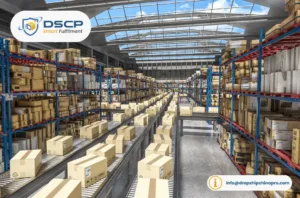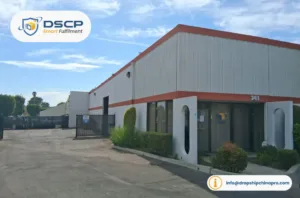

Fast delivery isn’t a luxury anymore; it’s the baseline expectation that determines whether customers buy from you or your competitors. When customers wait 2-3 weeks for products, they leave negative reviews, abandon carts, and never return. Managing fulfillment in-house drains time and money that should be spent growing your business. Ecommerce fulfillment USA services solve this problem. By storing inventory in US warehouses and partnering with experienced 3PL providers, businesses deliver orders in 2-3 days while cutting operational costs. The US ecommerce fulfillment market reached $123.68 billion in 2024 and is growing at 14.2% annually (Grand View Research, 2024).
This guide covers how US-based fulfillment works, why warehouse location matters, and how the hybrid fulfillment model transforms growing ecommerce businesses.
Key Takeaways for Ecommerce Fulfillment USA
- Bi-coastal warehouses in New Jersey and California enable 2-day delivery to 95%+ of US customers
- Strategic fulfillment reduces shipping costs by 15-30% through zone optimization
- Hybrid fulfillment combines China sourcing with US delivery speed, ideal for 100-2,000 orders/month
- Modern 3PLs offer pay-as-you-go pricing with no minimums
- Domestic fulfillment boosts satisfaction through faster delivery and easier returns
- 69% of shoppers won’t return if delivery takes longer than expected (Project44, 2024)
What is Ecommerce Fulfillment in the USA?
Ecommerce fulfillment USA refers to warehousing, processing, packing, and shipping orders from US-based facilities. When customers order from your store, fulfillment centers handle everything from picking products off shelves to coordinating delivery.
The process works like this:
- Products arrive at the warehouse and get inspected and stored
- Your online store sends orders electronically to the fulfillment center
- Warehouse staff pick, pack, and ship items same-day
- Customers receive tracking information automatically
- Orders arrive in 2-5 business days via USPS, UPS, or FedEx
The key difference? US fulfillment delivers in 2-5 days versus 12-25 days from overseas. This speed dramatically improves customer satisfaction, repeat purchases, and competitive positioning.
US Fulfillment vs International Shipping Comparison
| Fulfillment Model | Average Delivery Time |
|---|---|
| US Fulfillment | 2-4 business days |
| Direct China Shipping | 12-25 business days |
| Hybrid Fulfillment | 2-4 days (US stock) / 12-25 days (direct) |
Why US-Based Fulfillment Transforms Your Business
Delivery Speed That Wins Customers
Modern consumers expect Amazon-level speed. Research shows 69% of shoppers won’t return if delivery exceeds two days past the expected date (Project44, 2024). US fulfillment centers positioned on both coasts enable 2-day ground shipping to most American customers.
Fast delivery creates a competitive advantage:
- Higher conversion rates at checkout
- Better product reviews
- Increased repeat purchase rates
- Lower cart abandonment
Lower Shipping Costs
Domestic fulfillment costs less than you’d think. Ground shipping within the US runs significantly cheaper than international shipping. Zone-based pricing means shorter distances equal lower costs.
Businesses using multi-location fulfillment report a 15% average shipping cost reduction (Pitney Bowes, 2024). Position inventory closer to customers, minimize shipping zones, and save money while delivering faster.
Better Customer Experience
US-based operations provide the reliability that international shipping cannot match. Customers get accurate tracking, easy returns, and familiar carriers. This builds trust that drives repeat business.
Returns become simple with domestic fulfillment. No international return shipping, no customs hassles—just prepaid domestic labels that make the process painless.
Bi-Coastal Warehouse Coverage
| Warehouse Location | Primary Coverage Area |
|---|---|
| New Jersey (East Coast) | Northeast, Mid-Atlantic, Southeast US |
| California (West Coast) | West Coast, Southwest, Mountain West |
| Combined Coverage | 95%+ of US in 2-day ground delivery |
The Bi-Coastal Advantage: Strategic Warehouse Positioning
Why Two Locations Beat One
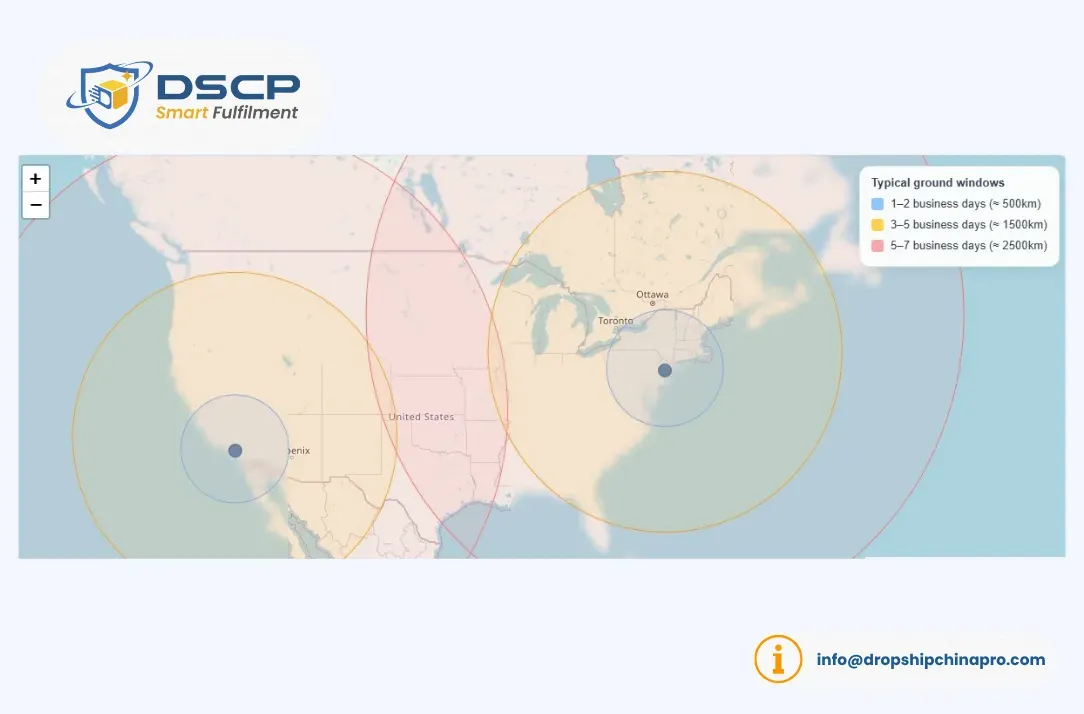
The United States spans 2,800 miles coast to coast. A single East Coast warehouse delivers quickly to New York but takes 5-7 days to reach Los Angeles. West Coast facilities face the opposite problem.
Bi-coastal fulfillment solves geography through strategic positioning. Warehouses on both coasts enable 2-day ground shipping to virtually all US addresses without expensive air freight.
New Jersey: East Coast Hub
A fulfillment center in the New Brunswick, NJ area provides:
- Next-day delivery to NYC, Philadelphia, Boston, Washington, DC, Baltimore
- Access to 50+ million potential customers
- Major interstate highways and port facilities
- Efficient inbound and outbound operations
California: West Coast Operations
Pomona, CA fulfillment centers offer:
- Next-day delivery throughout California
- 2-3 day reach to the Pacific Northwest and Southwest
- Fast processing for Asia-sourced inventory
- Quick distribution from West Coast ports
Combined Coverage Creates Competitive Advantage
Together, bi-coastal positioning provides remarkable coverage. New Jersey reaches the Midwest in 2-3 days and serves Eastern customers next-day. California covers the West Coast next-day and reaches the Midwest similarly. Nearly all US addresses receive delivery within 2-4 business days using cost-effective ground shipping.
This strategy reduces average shipping distance per package by 40% versus single-location operations, directly cutting costs while improving delivery speed.
Understanding the Hybrid Fulfillment Model
What Hybrid Fulfillment Means
Hybrid fulfillment combines international sourcing with domestic delivery. Manufacture products overseas at competitive costs, ship bulk inventory to US warehouses, then fulfill customer orders domestically in 2-4 days.
This model delivers the best of both worlds: low manufacturing costs plus fast delivery.
When Hybrid Fulfillment Makes Sense
Hybrid works best for businesses in the growth sweet spot:
- Processing 100-2,000 orders monthly
- Currently dropshipping with long delivery times
- Want to improve customer experience without a huge capital investment
- Need to maintain competitive product pricing
How It Works
- Manufacturing: Products made to your specs at overseas factories
- Quality Control: Inspections verify standards before shipping
- Bulk Shipping: Ocean freight moves inventory to US warehouses (wholesale rates)
- US Storage: Products received, inspected again, cataloged in warehouse system
- Fast Fulfillment: Orders ship domestically in 2-4 business days
Key Business Benefits
Strategic inventory positioning: Keep best-sellers in US warehouses for immediate fulfillment. Store slower-moving items overseas to minimize holding costs.
Scalability: Start with modest US inventory and expand as orders grow—no need to switch providers or rebuild operations.
Competitive advantage: Match Amazon delivery speeds while maintaining overseas manufacturing economics.
For detailed implementation strategies and cost optimization, check out our comprehensive guide on hybrid fulfillment.
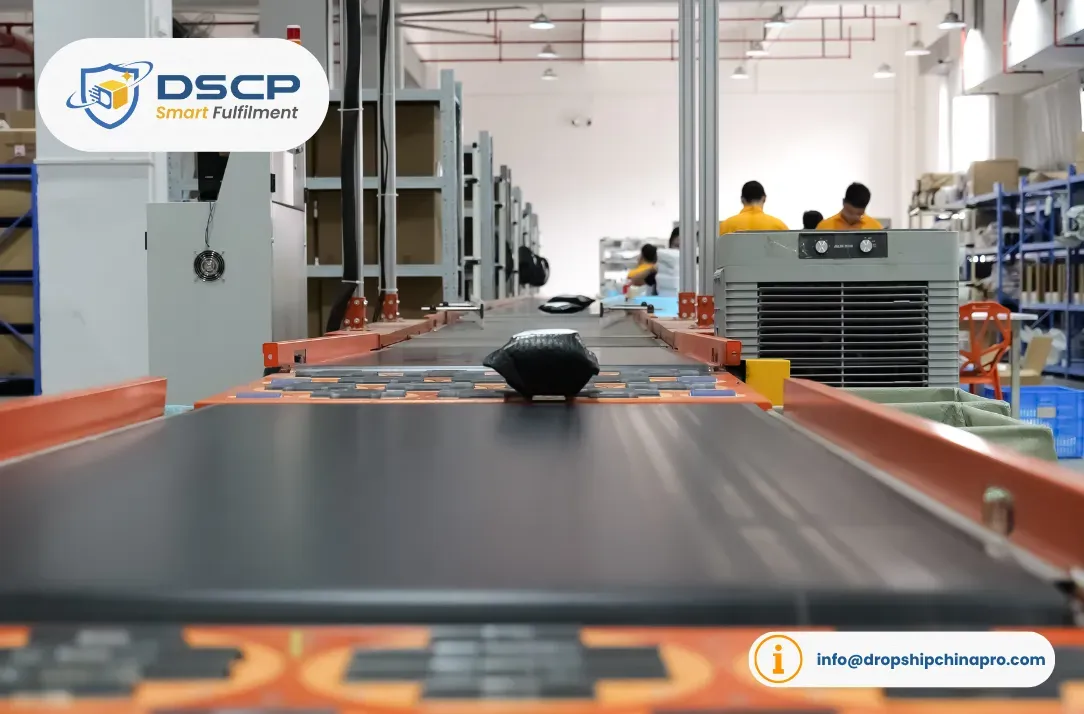
Essential Features of Quality US Fulfillment Services
Real-Time Inventory Tracking
Modern warehouse management systems provide live visibility across all locations. Quality providers integrate with Shopify, WooCommerce, and BigCommerce so your store always shows accurate stock levels.
Key capabilities:
- Automated low-stock alerts
- Multi-location inventory tracking
- Demand forecasting tools
- Prevention of overselling
Same-Day Order Processing
Professional fulfillment centers process orders received by early afternoon the same day. Barcode scanning at multiple checkpoints ensures 99%+ accuracy rates, preventing costly errors that damage customer relationships.
Quality Control Standards
Quality checks happen at multiple stages:
- Incoming inventory inspection
- Pre-packing verification
- Final accuracy check before sealing
These protocols protect your brand by ensuring customers receive correct, undamaged products.
Efficient Returns Management
Average return rates hit 20.4% in 2024 (NRF, 2024). US-based fulfillment simplifies returns with domestic processing, quick inspection, and fast restocking. Quality providers track return patterns to identify improvement opportunities.
Scalability Without Commitments
Modern 3PL providers offer pay-as-you-go pricing with no minimums. Scale up during peak seasons, scale down during slow periods—you only pay for space and services actually used.
Providers handling 30,000+ daily parcels demonstrate the infrastructure to accommodate your growth without forcing you to switch partners.
Typical US Fulfillment Cost Breakdown
| Fee Type | Typical Range |
|---|---|
| Storage Fees | $0.50-$2.00 per cubic ft/month |
| Pick & Pack | $2-$8 per order |
| Setup Fees | $200-$600 (one-time) |
| Shipping Costs | Carrier rates (pass-through) |
Understanding US Fulfillment Costs
Transparent Pricing Structure
Professional fulfillment typically includes:
- Storage fees: $0.50-$2.00 per cubic foot monthly
- Pick and pack: $2-$8 per order (varies by complexity)
- Shipping: Pass-through carrier rates (often with volume discounts)
Watch for Hidden Fees
Some providers charge extras that aren’t immediately obvious:
- Setup fees ($200-$600)
- Monthly minimums
- Receiving fees for incoming inventory
- Long-term storage fees (inventory sitting 90+ days)
Request comprehensive fee schedules upfront to compare providers accurately.
Understanding ROI
Professional fulfillment costs money but delivers value. Faster delivery improves conversion rates, reduces cart abandonment, and increases repeat purchases—often exceeding fulfillment expenses.
Plus, outsourcing frees your time for revenue-generating activities like marketing and product development. Many businesses find 3PL services cost less than self-fulfillment when all factors are considered.

Choosing Your US Fulfillment Partner
Critical Evaluation Criteria
Geographic coverage: Bi-coastal positioning enables 2-day delivery nationwide. Single-location warehouses can’t match this reach.
Technology integration: Look for pre-built integrations with your ecommerce platform (Shopify, WooCommerce, etc.) or robust APIs for custom connections.
Experience level: Providers serving businesses of your size understand specific needs better than those focused on enterprises or tiny startups.
Proven track record: Check Trustpilot ratings and client testimonials for reliability indicators.
Essential Questions to Ask
- Where are your fulfillment centers located, and what’s your 2-day delivery coverage?
- What’s your integration timeline and what support do you provide?
- Can you provide complete pricing, including all potential fees?
- What are your accuracy rates, and how do you handle errors?
- Do I get a dedicated account manager or general support?
Red Flags to Avoid
- High monthly minimums or required long-term contracts
- Vague or incomplete pricing information
- Poor communication and responsiveness during the sales process
- Limited platform integration capabilities
- No clear error-handling procedures
Hybrid Fulfillment Impact (John’s Case Study)
| Metric | Before → After |
|---|---|
| Delivery Time | 18 days → 3 days |
| Store Rating | 3.8 stars → 4.6 stars |
| Repeat Purchase Rate | 12% → 34% |
| Monthly Orders | 200 → 680 |
| Cart Abandonment | 71% → 54% |
Real Success Story: From Dropshipping to Domestic Dominance
John ran a Shopify store selling home and kitchen accessories, processing 150-200 orders monthly through dropshipping from China. Delivery times averaged 12-18 days. His store rating was 3.8 stars, repeat purchases were just 12%, and cart abandonment hit 71%.
The Strategic Shift
John implemented hybrid fulfillment, moving his top 20 SKUs (75% of orders) to US warehouses in California and New Jersey. Slower items stayed in China. The transition took three weeks from planning to operational fulfillment.
Results After 6 Months
- Delivery time: 18 days → 3 days
- Store rating: 3.8 → 4.6 stars
- Repeat purchases: 12% → 34%
- Monthly orders: 200 → 680
- Cart abandonment: 71% → 54%
Key insight: “The 2-day shipping badge transformed my conversion rate. Customers trust domestic fulfillment. Better reviews brought more customers, who had great experiences and left more positive reviews.”

FAQs for Ecommerce Fulfillment USA
What is ecommerce fulfillment USA?
Ecommerce fulfillment USA refers to warehousing, order processing, packing, and shipping from US-based facilities. It enables online stores to offer 2-4 day domestic delivery while outsourcing logistics operations to specialized providers.
How does US-based fulfillment work?
Products are stored in US warehouses, typically in California and New Jersey, for bi-coastal coverage. When customers order, the nearest warehouse picks, packs, and ships items via domestic carriers, delivering in 2-4 business days.
What are the main benefits of US fulfillment?
Key benefits include 2-day delivery speeds, 15-30% lower shipping costs through zone optimization, easier returns management, better customer trust, and simplified regulatory compliance compared to international shipping.
How much does ecommerce fulfillment cost in the USA?
Typical costs include storage ($0.50-$2.00 per cubic foot monthly), pick and pack ($2-$8 per order), and shipping based on carrier rates. Many providers offer pay-as-you-go pricing with no minimums.
What’s the difference between dropshipping and US fulfillment?
Dropshipping ships individual orders from suppliers (often overseas), taking 12-25 days. US fulfillment stores bulk inventory domestically, enabling 2-5 day delivery, better quality control, and branded packaging.
Do I need high order volume for US fulfillment?
Modern 3PL providers serve businesses starting around 100 orders monthly with flexible pricing and no minimums. Hybrid fulfillment is ideal for growing stores transitioning from dropshipping.
Why does bi-coastal fulfillment matter?
Warehouses on the East and West coasts enable 2-day ground shipping to 95%+ of US addresses. This geographic distribution reduces shipping costs by 15-30% versus single-location operations while dramatically improving delivery speeds.
Getting Started with US Fulfillment
Planning Your Transition
Start by analyzing sales data to identify best-selling products—these should move to US fulfillment first for maximum customer impact. Calculate 60-90 days of inventory for your top SKUs to balance avoiding stockouts against minimizing tied-up capital.
Gather technical requirements:
- Ecommerce platform credentials
- Shipping carrier account information
- Product catalog with dimensions and weights
- Special packaging requirements
Implementation Timeline
Most businesses go live in 3-4 weeks:
- Week 1-2: System integration and inventory planning
- Week 2-3: Bulk shipping to warehouses (ocean freight from Asia takes 2-3 weeks)
- Week 3-4: Receiving, verification, and testing
What Our Clients Say
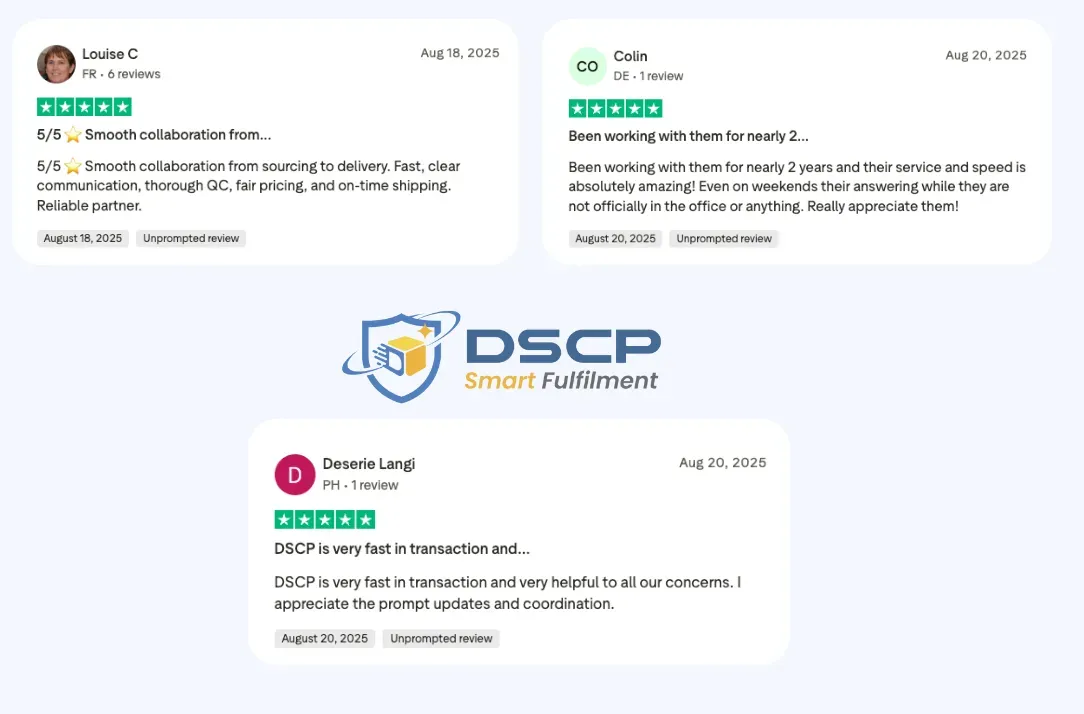
Louise C from France shares: “Smooth collaboration from sourcing to delivery. Fast, clear communication, thorough QC, fair pricing, and on-time shipping. Reliable partner.”
Deserie Langi from the Philippines notes: “DSCP is very fast in transactions and very helpful to all our concerns. I appreciate the prompt updates and coordination.”
Colin from Germany reflects on his experience: “Been working with them for nearly 2 years and their service and speed are absolutely amazing! Even on weekends, their answering while they are not officially in the office or anything. Really appreciate them!”
Taking the First Step
Quality fulfillment partners ask questions about your operations, understand your goals, and honestly assess fit. The right provider becomes a strategic partner, not just a vendor.
Ready to explore how US fulfillment could benefit your business? The transition from dropshipping to domestic fulfillment marks a critical growth inflection point for most ecommerce stores.
Conclusion
Ecommerce fulfillment USA has evolved from a luxury to a necessity for competitive online businesses. Bi-coastal warehouse positioning, modern technology integration, and flexible pay-as-you-go pricing make professional fulfillment accessible to growing businesses. The hybrid fulfillment model delivers the best of both worlds—overseas manufacturing costs plus domestic delivery speeds—making it ideal for stores processing 100-2,000 orders monthly.
Consumer expectations for 2-day delivery have reshaped ecommerce across all categories. Domestic fulfillment infrastructure is no longer optional—it’s essential for competitive positioning. For businesses ready to scale, partnering with experienced 3PL providers offering bi-coastal coverage transforms fulfillment from an operational burden into a strategic advantage.
DSCP Smart Fulfillment provides comprehensive ecommerce fulfillment services with strategically positioned warehouses in New Jersey and California, enabling 2-day delivery to 95%+ of US addresses. Our hybrid fulfillment model combines efficient China sourcing with domestic delivery speeds. With seven years of experience, 30,000+ daily parcel capacity, and a 4.9 Trustpilot rating, we help ecommerce businesses scale efficiently while maintaining exceptional customer experiences.
References
- Grand View Research. (2024). E-commerce Fulfillment Service Market Size & Analysis Report, 2024-2030. Retrieved from grandviewresearch.com
- National Retail Federation. (2024). Consumer Returns in the Retail Industry Report.
- Pitney Bowes. (2024). Parcel Shipping Index Annual Report.
- Project44. (2024). Global Supply Chain Visibility and Delivery Performance Report.

Hi, I’m Yavuz. I help e-commerce businesses grow through strategic content and SEO. Here, I share insights on fulfillment solutions, 3PL partnerships, and digital marketing strategies based on real data and industry trends.