

A major military escalation in the Middle East is sending shockwaves through global supply chains. On February 28, 2026, coordinated strikes by the US and Israel on Iran triggered widespread disruption across the world’s most critical shipping corridors. Within days, major ocean carriers suspended Suez Canal transits, airlines halted flights across the Gulf, and emergency surcharges began landing in shipper inboxes worldwide.
For e-commerce businesses that source products from China and ship internationally, the situation is developing fast. This post breaks down what is happening, why it matters and what you should realistically expect in the coming weeks.
Key Takeaways
- Ocean carriers including Maersk, Hapag-Lloyd, CMA CGM and MSC have suspended Suez Canal transits and are rerouting vessels via the Cape of Good Hope, adding 10 to 15 days to transit times.
- Air cargo capacity on the Asia-Europe corridor has dropped by an estimated 26%, with approximately 25% of China-Europe air freight normally routed through Middle East hubs (Metro Global, 2026).
- Emergency Conflict Surcharges of $2,000 to $4,000 per container are already in effect from major carriers.
- Brent crude oil rose above $82 per barrel on March 2, 2026, up from roughly $70-75 before the conflict escalated (World Economic Forum, 2026). Analysts warn prices could reach $100 or higher if disruption continues.
- The US is expected to feel the effects last, with equipment imbalance and trade diversion potentially becoming visible four to six weeks after the initial disruption (Global Cold Chain Alliance, 2026).
What Triggered This Disruption?
The conflict escalated sharply on February 28, 2026, following joint military strikes on Iran. Iran’s retaliatory response spread across the region, closing or severely restricting airspace above the Gulf and triggering immediate reactions from shipping lines and airlines.
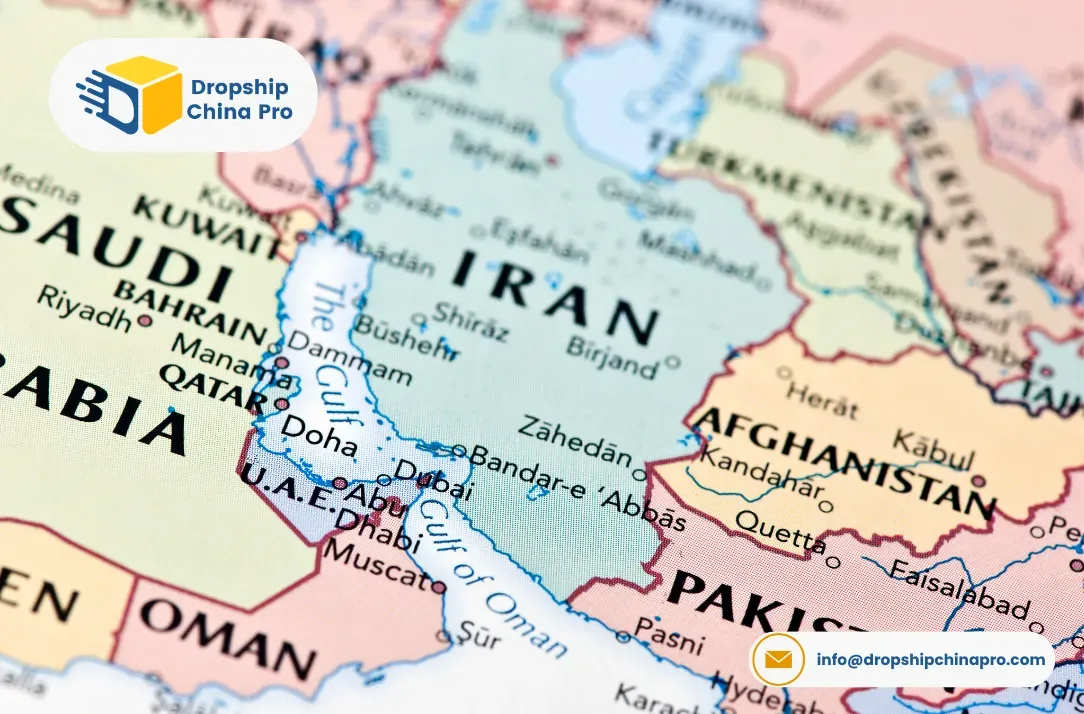
Two maritime chokepoints are at the center of the crisis:
The Strait of Hormuz handles approximately 20% of the world’s daily oil supply. Iran’s Revolutionary Guard Corps issued notices restricting vessel passage, prompting carriers to either shelter vessels or divert them entirely. At the peak of the initial disruption, nearly 140 container vessels were reported to be trapped or sheltered inside the Middle East Gulf (Alphaliner, cited in Scan Global Logistics, 2026).
The Suez Canal and Bab-el-Mandeb Strait, which had been gradually recovering after years of Houthi-related disruptions, are now suspended again. Any plans for a large-scale return of container shipping to the Red Sea in 2026 have effectively been shelved (Xeneta chief analyst Peter Sand, Supply Chain Dive, 2026).
The combined effect is that the two main maritime corridors connecting Asia, Europe and the rest of the world are simultaneously disrupted.
Air Cargo Capacity Impact by Route
| Route | Capacity Impact |
|---|---|
| Global (overall) | Down ~12% immediately, stabilising around 8% |
| China to Europe | Down ~26%; ~25% normally transits Middle East hubs |
| South Asia to Europe | Down ~39% in available cargo tonne kilometres |
| China to North America | Spot rates up ~2%; impact expected to grow |
How Air Freight Is Being Hit
For e-commerce businesses that rely on air freight from China, the impact is immediate and significant.
The Gulf region is not just a conflict zone. It is one of the most important air cargo transit hubs in the world. Emirates SkyCargo, Qatar Airways Cargo and Etihad Cargo together account for roughly 13% of global air cargo capacity, and their hubs serve as key transfer points between Asia and Europe (Scan Global Logistics, 2026).
When military operations forced airspace closures across Iran, Iraq, Israel, Qatar, Bahrain, Kuwait and the UAE, the effect rippled outward almost instantly. According to Aviation Business News (2026), airspace closures and flight cancellations withdrew around 12% of global air cargo capacity from the market immediately. By the first week of March, capacity on the Asia-Europe air corridor had dropped by an estimated 26% (The Loadstar, 2026).
What This Means for China-Europe Shipments
Approximately a quarter of all China-Europe air cargo capacity normally transits through Middle East hubs (Metro Global, 2026; Freightos). When those hubs go offline, there is no simple replacement. Airlines are being forced to reroute freighters via Central Asia, adding flight time and fuel costs. According to Dimerco (2026), Asia-Europe lanes are already adding roughly one to three hours of flight time per journey due to airspace avoidance, which reduces available cargo payload on long-haul aircraft.
DSCP’s logistics partner YunExpress has confirmed that many transit flights through the Middle East have been directly suspended. The result is reduced capacity to Europe and higher costs on remaining routes. The situation is still developing and the full impact on the market remains uncertain.
Early spot rate data tells part of the story. As of the first week of March 2026, spot rates from China to Northern Europe had already increased by 7%, while rates to North America rose around 2% (Metro Global, 2026).
Emergency Surcharges by Carrier
| Carrier | Surcharge (per container) |
|---|---|
| CMA CGM | $2,000 (20′) / $3,000 (40′) / $4,000 (reefer) |
| Hapag-Lloyd | $1,500 per TEU (war risk surcharge) |
| MSC | End of Voyage declared — cargo offloaded at diversion port |
| Maersk | Strait of Hormuz suspended — rerouting via Cape of Good Hope |
Ocean Freight: Rerouting, Surcharges and Trapped Vessels
While air freight is the most immediate concern for e-commerce parcels, ocean freight disruption has its own serious consequences, particularly for larger shipments and restocking.
Cape of Good Hope Rerouting
Ships that would normally pass through the Suez Canal and Bab-el-Mandeb are now being rerouted around the southern tip of Africa. Maersk, CMA CGM and Hapag-Lloyd have all confirmed this systematic route change (Mathez Freight, 2026). The detour adds 10 to 15 days to transit times and significantly reduces available shipping capacity by keeping vessels at sea longer.
Emergency Surcharges Already in Effect
Multiple major carriers introduced emergency fees from March 2, 2026 onward:
- CMA CGM introduced an Emergency Conflict Surcharge of $2,000 per 20-foot container, $3,000 per 40-foot container and up to $4,000 for refrigerated or special equipment.
- Hapag-Lloyd introduced a War Risk Surcharge of $1,500 per TEU, with higher rates for reefer and special equipment (The National, 2026).
- Several carriers including MSC, ONE, PIL, HMM and COSCO have temporarily suspended new booking acceptance for all traffic to or from the Persian Gulf (Mathez Freight, 2026).
Major P&I insurance clubs including Gard, Skuld and NorthStandard announced the termination of war-risk cover for ships operating in the Persian Gulf, effective around March 5, 2026, adding further cost pressure to already strained routes (Global Cold Chain Alliance, 2026).
The Oil Price Factor
Beyond the direct disruption to shipping routes, a second and arguably more far-reaching concern is building: surging oil prices and their downstream effect on freight rates, inflation and consumer costs across the globe.
The numbers have escalated rapidly. Brent crude rose above $82 per barrel in the first days of March, up from roughly $70-75 before the conflict began (World Economic Forum, 2026). By March 9, Reuters was reporting Brent had soared a further 27% in a single session to $117.58 per barrel, with US crude up 28% to $116.51 — the largest single-day oil price gain since at least 1988, on top of a 28% rise the previous week (Reuters, 2026).
Helima Croft, head of global commodity strategy at RBC Capital Markets, described the situation to Reuters as “the worst oil supply shock since the 1970s.” With no tankers daring to cross the Strait of Hormuz and no clear end to hostilities in sight, markets are now pricing in a potentially prolonged period of elevated energy costs.
The implications for shipping are direct. Higher oil prices feed into jet fuel and bunker fuel costs, which are among the largest operating expenses for airlines and ocean carriers. Any sustained increase will translate into structurally higher freight rates over time, beyond the emergency surcharges already in effect.
China is not insulated from this. As a major oil importer, China was already seeing consumer prices rise 1.3% year on year in February 2026 before the current oil spike took hold (Reuters, 2026). For e-commerce businesses sourcing products from Chinese manufacturers and suppliers, input costs and production economics could shift if energy prices remain at current levels.
Global financial markets are reacting accordingly. Share markets across Asia nosedived on March 9, with Japan’s Nikkei falling 7%, South Korea’s market dropping 8.2% and European stock futures sliding over 3% (Reuters, 2026). Central banks including the US Federal Reserve and the European Central Bank now face a difficult balancing act between supporting growth and managing energy-driven inflation.
For e-commerce businesses, this means the cost pressure extends well beyond surcharges on individual shipments. If oil prices remain elevated, the knock-on effects on freight rates, product costs and consumer purchasing power could shape the trading environment for months.

Who Is Affected and When
The disruption is spreading outward in waves, and the timing of impact varies by region.
Europe and Asia are feeling the effects first and most acutely. The Asia-Europe corridor is directly in the path of both the air freight hub closures and the ocean route disruptions. Spot rates to Northern Europe from China have already moved (Metro Global, 2026).
Africa is being impacted quickly as well, since a large share of imports from China route through disrupted hubs. The Global Cold Chain Alliance (2026) notes that Africa faces immediate freight rate increases as the network adjusts to reduced capacity.
The United States and South America are expected to feel the effects later. The Global Cold Chain Alliance (2026) projects that equipment imbalance and trade diversion could become visible in North America within four to six weeks of the initial disruption. This does not mean US-bound shipments are safe from impact; it means the timeline is slightly more extended.
Major retailers including Walmart, Target and Amazon have already flagged that higher shipping rates and fuel costs are forcing price adjustments on select products as a result of the disruption (yourNEWS, 2026).
What E-Commerce Businesses Should Do Right Now
Freight forwarder DSV has outlined several practical recommendations for shippers navigating this situation (Supply Chain Dive, 2026):
- Share updated shipment forecasts with logistics partners to support capacity planning.
- Confirm bookings early to secure available space before capacity tightens further.
- Build safety stock assessments that account for potential congestion and delays.
- Evaluate alternative routing options where feasible, particularly for time-sensitive cargo.
- Stay in close contact with your fulfillment partner for shipment-specific guidance.
For businesses using dropshipping or China-based fulfillment, this is also a moment to reconsider how dependent your supply chain is on a single corridor. Suppliers and logistics partners who have diversified carrier relationships and warehouse networks are in a stronger position to absorb disruptions like this one.
A Note on What We Don’t Know Yet
It is worth being direct: a great deal remains uncertain. The situation is still developing as of the time of writing. Carriers are adjusting day by day. Some Gulf hubs are seeing a gradual, limited resumption of flights, but nothing close to normal operations. The duration of the conflict, the extent of oil infrastructure damage and the pace of insurance reinstatement will all shape how severe and prolonged the impact on shipping becomes.
What is clear is that this is not a short-term blip. As logistics platform Flexport noted on February 28, 2026: “In the near term, businesses should prepare for longer lead times, tight capacity, elevated rates and continued volatility across both ocean and air networks.”
Frequently Asked Questions
Is it still possible to ship from China to Europe right now?
Yes, but with significant limitations. Air cargo capacity on the China-Europe corridor is down roughly 26%, and ocean routes via the Suez Canal are suspended by major carriers. Shipments are still moving, but expect longer transit times, reduced space availability and higher costs than normal. Booking early and confirming with your logistics partner before dispatching is strongly advised.
How much have shipping costs increased because of the conflict?
Ocean carriers have introduced Emergency Conflict Surcharges ranging from $2,000 to $4,000 per container, depending on size and equipment type. Hapag-Lloyd has added a War Risk Surcharge of $1,500 per TEU on top of standard rates. Air freight spot rates from China to Northern Europe have already risen around 7%, with further increases likely if the disruption continues.
Will the disruption affect shipping to the US?
Yes, though the timeline is slightly more delayed. The Global Cold Chain Alliance projects that equipment imbalance and trade diversion could become visible in North America within four to six weeks of the initial disruption. Major US retailers including Walmart and Amazon have already flagged higher logistics costs as a result of the conflict.
How long will these shipping delays last?
That is difficult to predict with certainty. As RBC Capital Markets’ Helima Croft told Reuters, there is currently no clear definition of what resolution looks like, making it hard to forecast whether this will be a multi-week or multi-month disruption. Most carriers and logistics providers are taking the situation day by day and adjusting as conditions change.
What can I do to protect my business during this disruption?
The most practical steps are: confirm bookings early to secure available space, update your shipment forecasts and share them with your logistics partner, build additional buffer time into your delivery estimates and consider holding more safety stock where possible. Businesses with diversified carrier relationships and multiple fulfillment options are better positioned to absorb disruptions like this one.

Managing Your Supply Chain Through the Disruption
Managing shipping timelines and supplier relationships during periods like this is one of the core challenges of running an e-commerce business. If you source products from China and want to understand your fulfillment options, you can learn more about how Dropship China Pro works.
Conclusion
The Middle East conflict that escalated at the end of February 2026 is one of the most significant supply chain disruptions since the COVID-19 pandemic. Ocean routes through the Strait of Hormuz and the Suez Canal are suspended. Air cargo capacity on Asia-Europe is down by roughly a quarter. Emergency surcharges are already in effect. And rising oil prices are adding a second layer of cost pressure that could affect freight rates globally for months.
For e-commerce businesses sourcing from China, the most important things right now are communication with your logistics partners, early booking confirmation and realistic expectations on delivery timelines. The situation will continue to evolve, and we will publish updates here as the picture becomes clearer.
References
- Aviation Business News. (2026, March 6). Middle East conflict is the latest macro-event testing the global logistics market. aviationbusinessnews.com
- CNBC. (2026, March 2). The Strait of Hormuz crisis explained: What it means for global shipping. cnbc.com
- Global Cold Chain Alliance. (2026, March 4). Middle East conflict disruption updates and situation report. gcca.org
- Mathez Freight. (2026, March 4). Crisis in the Middle East 2026: impact on freight transport and advice for shippers. mathezfreight.com
- Metro Global. (2026, March 6). Middle East disruption ripples through global supply chains. metro.global
- Reuters. (2026, March 9). Shares skid as oil surge threatens inflation shock. reuters.com
- Scan Global Logistics. (2026, March 4). Important notice: Update on the ongoing Middle East security situation. scangl.com
- Supply Chain Dive. (2026, March 2). Iran conflict disrupts ocean, air cargo networks. supplychaindive.com
- The Loadstar. (2026, March 2). Air cargo chaos: capacity on Asia-Europe drops 26%. theloadstar.com
- The National. (2026, March 2). Strait of Hormuz escalation rattles global shipping with war levies and insurance cover cuts. thenationalnews.com
- World Economic Forum. (2026, March). Middle East conflict hits shipping, oil prices and other international trade news. weforum.org

Hi, I’m Yavuz. I help e-commerce businesses grow through strategic content and SEO. Here, I share insights on fulfillment solutions, 3PL partnerships, and digital marketing strategies based on real data and industry trends.