Payment gateways are the backbone of every online store. Without one, you simply cannot collect money from your customers, no matter how well your products sell or how strong your marketing is. But with hundreds of options available worldwide, choosing the right gateway for your Shopify dropshipping business is not always straightforward.
This guide walks you through the most important factors to consider before making a decision and presents seven payment gateways that consistently perform well for Shopify dropshippers in 2026. The goal is not to hand you a one-size-fits-all answer, because that does not exist in payments. The goal is to give you enough context to choose the right fit for your store, your customers and the markets you sell into.
Key Takeaways
- There is no single best payment gateway for every Shopify dropshipping store. The right choice depends on your location, your customers’ location and your monthly volume.
- Shopify Payments eliminates Shopify’s additional transaction fee, making it the most cost-efficient option for stores in supported countries.
- PayPal and Stripe are the most widely recognized third-party gateways and work well as primary or backup options.
- Klarna and Amazon Pay address checkout conversion by offering buyers payment flexibility and familiarity.
- Airwallex and Alipay Global serve specific use cases: cross-border scaling and Chinese payment networks, respectively.
- Running two gateways simultaneously reduces risk. If one pauses payouts, the other keeps your store operational.
What Is a Payment Gateway?
Before comparing options, it helps to understand what a payment gateway actually does. When a customer clicks the checkout button on your Shopify store and enters their card details, a payment gateway steps in to handle the rest.
Here is what happens in those few seconds:
- The customer’s browser encrypts the payment information using SSL and sends it to the gateway’s server
- The gateway forwards the transaction data to the payment processor used by your acquiring bank
- The processor sends the data to the relevant card network, Visa, Mastercard or American Express, for example
- The card network routes the request to the customer’s issuing bank for authorization
- The issuing bank approves or declines the transaction and sends a response back through the same chain
- The gateway receives the response and notifies both the merchant and the customer, typically within 3 to 5 seconds
- Settlement, the actual movement of funds into your bank account, follows within 1 to 3 business days in most cases
The entire flow is invisible to the customer. They experience a fast, secure checkout. What you experience, depending on which gateway you choose, is a specific fee structure, a particular payout schedule and a defined level of fraud protection.
For dropshippers, two additional factors matter beyond the standard e-commerce considerations. First, your chargeback rate. Because dropshipping typically involves longer shipping times than domestic fulfilment, dispute rates tend to be higher. A gateway that handles chargebacks poorly, or that freezes accounts at the first sign of elevated disputes, can disrupt your entire cash flow. Second, your customers’ geography. If you sell globally, you need a gateway that supports multiple currencies and is recognized by buyers in your target markets.
Shopify Transaction Fees by Plan (Third-Party vs Shopify Payments)
| Shopify Plan | Shopify Payments Rate | Third-Party Gateway Rate | Extra Shopify Fee |
|---|---|---|---|
| Basic | 2.9% + $0.30 | Gateway rate applies | +2% |
| Shopify | 2.6% + $0.30 | Gateway rate applies | +1% |
| Advanced | 2.4% + $0.30 | Gateway rate applies | +0.5% |
| Shopify Plus | Custom / negotiated | Gateway rate applies | +0.15% (waivable) |
What to Look for Before Choosing
Geographic Coverage
Start with where your customers are. A gateway that works well in the United States may not be available, trusted or even recognized in Southeast Asia or Latin America. Shopify now integrates with over 100 payment gateways worldwide, covering credit cards, digital wallets and local payment options across various regions. That breadth means you have options, but it also means you need to narrow them down based on where your traffic actually comes from.
Fee Structure
Most gateways charge a percentage of the transaction plus a fixed amount per sale. The standard rate across major processors sits at around 2.9% + $0.30 for US domestic transactions. What varies is how each gateway handles international cards, currency conversion, chargebacks and refunds. These additional costs can significantly change the effective rate on cross-border orders.
Pay attention to monthly fees as well. Some processors charge a flat monthly subscription with lower per-transaction rates, which can work out cheaper at higher volumes. Others are purely pay-as-you-go, which is more forgiving when you are starting or when sales are variable.
Checkout Experience
Some gateways keep the customer on your store throughout the entire checkout. Others redirect buyers to an external page before returning them to your confirmation screen. Redirect-based checkouts, such as PayPal, can increase brand trust for certain buyers but may slightly disrupt the checkout flow. On-site processing generally provides a more seamless branded experience. Neither approach is universally better. Knowing what your audience prefers matters more than the technical distinction.
Setup Time and Approval Requirements
Setup time varies considerably between providers. Some gateways can be connected to your Shopify store in under an hour. Others, particularly those targeting enterprise or high-volume merchants, require business verification, documentation review and a waiting period of several days. If you are launching quickly, this is a factor worth checking before you commit.
Chargeback Handling
This is especially relevant for dropshippers. Most major processors will flag your account if disputes exceed 0.75% to 1% of your transactions. In the past 12 months, several stores faced payout reviews once dispute rates crossed 0.9% to 1%, with payouts delayed for 7 to 14 days while documents were reviewed. Keeping your dispute rate low through reliable shipping and clear product descriptions is the most effective defence, but choosing a gateway with fair review processes also reduces the risk of unnecessary account holds.
Our 7 Best Payment Gateways for Shopify Dropshippers
Gateway Comparison at a Glance
| Gateway | Standard US Fee | Countries | Best For |
|---|---|---|---|
| Shopify Payments | 2.4–2.9% + $0.30 | 20+ | Simplicity, no extra Shopify fee |
| PayPal | 2.9% + $0.30 | 200+ | Global reach, buyer trust |
| Stripe | 2.9% + $0.30 | 45+ | Customisation, developer tools |
| Klarna | Per transaction (no monthly fee) | US, UK, Europe+ | BNPL, higher-ticket products |
| Amazon Pay | 2.9% + $0.30 | 18 | US/Germany, checkout trust |
| Airwallex | Varies by market | 60+ currencies | Multi-market, cross-border scaling |
| Alipay Global | Varies by market | 12 currencies | Chinese buyers, Asia-Pacific markets |
1. Shopify Payments
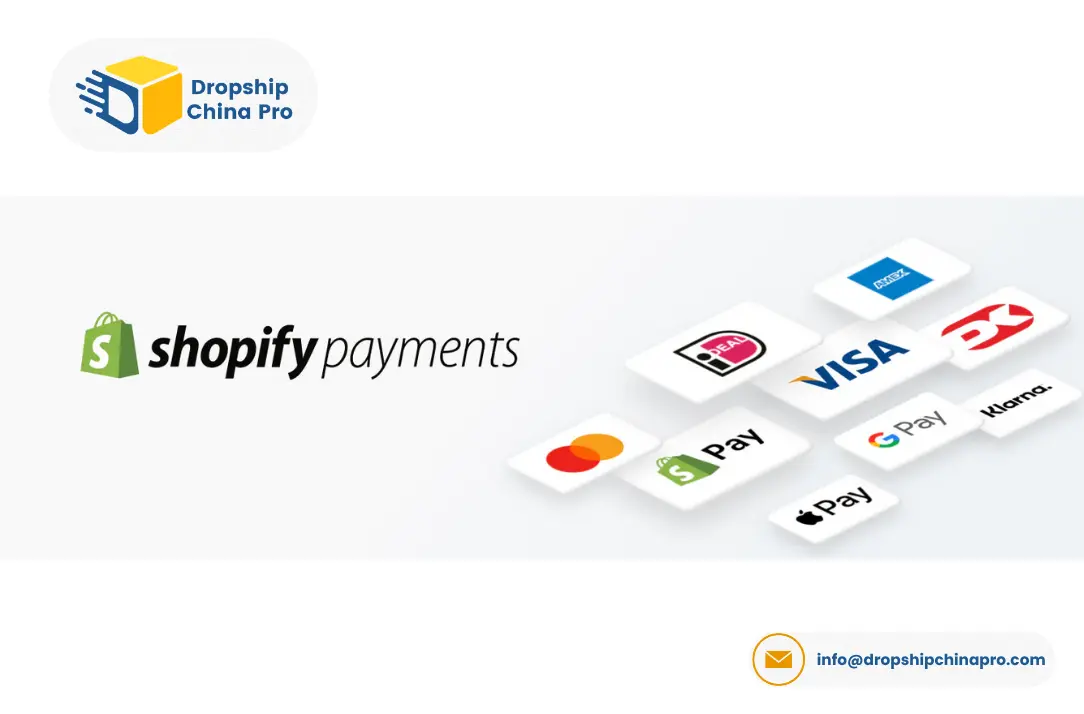
For most Shopify dropshippers operating in supported countries, Shopify Payments is the logical starting point. It is built directly into the platform, which means there is no external setup, no third-party dashboard to manage and, most importantly, no additional Shopify transaction fee on top of your processing costs.
That last point matters more than it first appears. Shopify charges an additional transaction fee of 0.5% to 2% when you use a third-party gateway, depending on your plan. Shopify Payments waives this entirely. For a store processing $20,000 per month, eliminating even a 1% additional fee saves $200 every month.
The fee structure scales with your Shopify plan:
- Basic Shopify: 2.9% + $0.30 per transaction
- Shopify: 2.6% + $0.30 per transaction
- Advanced Shopify: 2.4% + $0.30 per transaction
Shopify Payments also includes built-in fraud analysis, order and payout management in a single dashboard and support for Apple Pay, Google Pay and Shop Pay at checkout.
The limitation is geographic. In countries where Shopify Payments is available, you generally cannot connect a separate Stripe account because Shopify Payments already uses Stripe’s infrastructure. If your business is registered outside of a supported country, you will need one of the third-party options below.
Best for: Dropshippers registered in the US, UK, Canada, Australia or other supported markets who want a streamlined, low-cost setup inside one dashboard.
2. PayPal

PayPal is the most widely recognized payment brand in the world, and that recognition translates directly into checkout trust. Customers who might hesitate to enter their card details on an unfamiliar store are often more willing to complete a purchase when they see the PayPal option at checkout.
PayPal is an accepted payment gateway in more than 203 countries and supports all prominent credit cards, including Visa, Mastercard, American Express and Citibank. For dropshippers targeting international markets, that coverage is hard to match.
The standard transaction fee matches Stripe at 2.9% + $0.30 for US transactions. The chargeback fee, at $20 per dispute, is higher than Stripe’s $15. PayPal also redirects customers to its own checkout page before returning them to your store, which introduces a small amount of friction. Despite that, conversion rates on PayPal-enabled checkouts remain competitive in most markets because of buyer familiarity.
One operational note worth knowing: PayPal can hold funds for new accounts or accounts showing unusual transaction patterns, similar to other processors. Running PayPal as a secondary gateway alongside your primary processor is a common risk management approach.
Best for: Stores selling internationally who want a trusted, recognizable payment option, particularly as a secondary gateway alongside Shopify Payments or Stripe.
3. Stripe

Stripe is the developer’s payment processor of choice, and its flexibility makes it one of the most versatile options for growing dropshipping stores. It supports over 135 currencies, integrates directly with Shopify, WooCommerce and most major platforms and provides access to payment methods including Apple Pay, Google Pay, Klarna, Afterpay and ACH bank transfers.
The standard US rate is 2.9% + $0.30 per transaction, with an additional 1.5% for international cards and 1% for currency conversion. Stripe’s built-in fraud detection tool, Stripe Radar, uses machine learning to flag suspicious transactions in real time, which helps keep chargeback rates manageable.
For a detailed breakdown of Stripe’s fees, account policies and the specific risks it carries for dropshipping businesses, see our full guide: Is Stripe a Good Payment Processor for Dropshipping in 2026?
Best for: Stores that need customization, multi-currency support or advanced developer integrations, particularly those selling to customers in the US and Europe.
4. Klarna

Klarna sits in a different category from the previous three gateways. Rather than processing standard card payments, Klarna offers buy now, pay later functionality, giving customers the option to split their purchase into interest-free instalments or defer payment entirely.
For dropshippers, this has a measurable effect on conversion. Sellers who integrate Klarna have reported increases in order volumes as buyers who would otherwise hesitate on higher-ticket items are more willing to complete the purchase when payment is spread out. Klarna also pays the merchant upfront regardless of whether the customer completes their instalments on time. The credit risk stays with Klarna.
Klarna charges no monthly fee and operates on a per-transaction basis. The exact rate varies by market and volume, but there is no joining fee. Klarna integrates with Shopify and is available across the US, UK, most of Europe and a growing number of other markets.
It works best as a complementary gateway rather than a primary one, particularly for stores with an average order value above $50, where customers are more likely to respond to flexible payment terms.
Best for: Stores selling higher-value products to customers in the US, UK or Europe who want to increase conversion by offering payment flexibility.
5. Amazon Pay
Amazon Pay allows customers to use their existing Amazon account details to complete checkout on your Shopify store. For markets where Amazon is dominant, particularly the United States and Germany, this removes a significant barrier at checkout. Customers do not need to enter new card details or create an account. They simply authorize the payment using credentials they already trust.
The transaction fee is 2.9% + $0.30 for domestic US payments, with an additional 1.5% for cross-border transactions. There is no monthly fee.
What makes Amazon Pay particularly valuable for dropshippers is buyer trust. Customers associate Amazon with reliable delivery and straightforward returns. Offering Amazon Pay on your store implicitly signals a comparable level of legitimacy, which can lift conversion rates on stores that do not yet have strong brand recognition of their own.
Amazon Pay integrates directly with Shopify and is available in 18 countries, including the US, UK, Germany, France, Italy, Spain and Japan.
Best for: Dropshippers targeting customers in the US or Germany, or any store whose audience is likely to have active Amazon accounts and responds well to familiar brand signals at checkout.
6. Airwallex
Airwallex is a newer option compared to the legacy processors on this list, but it has become an increasingly relevant choice for dropshippers operating at scale across multiple markets. It was built specifically for cross-border commerce and handles multi-currency payments with considerably lower conversion fees than Stripe or PayPal.
Airwallex allows merchants to collect, hold and payout in over 60 currencies without converting everything back to a base currency after each transaction. For dropshippers sourcing from China and selling to customers across the US, Europe and Asia simultaneously, this significantly reduces the friction and cost of managing multi-currency revenue.
It integrates with Shopify and supports major cards, digital wallets and local payment methods across various regions. Pricing is transparent and available on the Airwallex website, with rates varying by market and transaction type.
Airwallex is not necessarily the right first gateway for a new store. Its strengths become most apparent at higher volumes and in multi-market operations where currency management and international transfer costs start to add up.
Best for: Established dropshipping stores processing high volumes across multiple international markets that want to reduce currency conversion costs and manage global payouts efficiently.
7. Alipay Global
Alipay is the dominant payment platform in China, with hundreds of millions of active users. Alipay Global extends that reach to international merchants, allowing Shopify dropshippers to accept payments from Chinese consumers directly.
For most Western-facing dropshipping stores, Alipay is not a primary concern. But for sellers who actively target Chinese buyers or who operate in markets with a large Chinese-speaking population, such as Singapore, Hong Kong, Malaysia and Australia, adding Alipay to your checkout can meaningfully increase conversion among an audience that is less likely to use Visa or Mastercard as their default payment method.
Alipay Global integrates with Shopify and supports 12 major currencies, including USD, GBP, EUR, AUD, CAD and JPY. The setup process is more involved than the plug-and-play options above, but the access it provides to a distinct customer segment makes it worth the effort for the right kind of store.
Best for: Dropshippers selling to Chinese consumers or operating in markets with large Chinese-speaking populations who want to offer a locally familiar payment option.
How to Choose the Right Combination
The question most dropshippers eventually ask is not which gateway to use, but which combination. Offering multiple payment options increases conversion, and a common starting setup is Shopify Payments combined with PayPal and Klarna. Running a primary and a secondary gateway also provides operational resilience. If your primary processor pauses payouts or requests additional documentation, your secondary gateway keeps sales flowing while you resolve the issue.
A practical framework based on the store stage:
- New store, supported country: Start with Shopify Payments and add PayPal as a secondary option
- New store, unsupported country: Use Stripe as your primary gateway and PayPal as a secondary
- Scaling store with international customers: Add Klarna for BNPL conversion and consider Airwallex for multi-currency efficiency
- Store targeting Chinese buyers: Add Alipay Global as a supplementary gateway for that specific segment
For a deeper look at how Stripe specifically works within this setup, see our full comparison: Is Stripe a Good Payment Processor for Dropshipping in 2026?
The Link Between Payments and Fulfillment
One point that rarely appears in payment gateway comparisons is the relationship between fulfillment performance and payment processor stability. Chargebacks are the primary reason payment accounts get reviewed or suspended, and the majority of dropshipping chargebacks come from one source: delayed or missing orders.
If your supplier ships slowly, uses untracked shipping methods or has inconsistent product quality, your chargeback rate will reflect that, and your payment processor will eventually respond. The fix is not switching gateways. It is fixing the supply chain.
Dropship China Pro works with e-commerce sellers to source products from vetted suppliers in China and fulfill orders through warehouse partnerships across the US and other regions. Faster, trackable shipping reduces disputes at the source. You can connect your Shopify store directly through our Shopify app to streamline the entire process.
If you are also evaluating Shopify’s own payment tools alongside these gateways, our guide to mastering Shopify Payments strategies covers that side of the setup in detail.
Frequently Asked Questions
What is the best payment gateway for Shopify dropshipping in 2026?
There is no single best gateway for every store. Shopify Payments is the most cost-efficient option for dropshippers registered in supported countries because it eliminates Shopify’s additional transaction fee. For stores outside supported countries, Stripe is the strongest starting point. Adding PayPal as a secondary gateway is a widely recommended approach regardless of which primary processor you use.
Do I need more than one payment gateway on my Shopify store?
Running two gateways is strongly advisable for any store processing meaningful volume. If your primary processor pauses payouts for a review, your secondary gateway keeps sales running while the issue is resolved. A common setup is a card processor such as Shopify Payments or Stripe paired with PayPal as a secondary option.
Does Shopify charge extra fees for using third-party payment gateways?
Yes. Shopify adds a transaction fee of 0.5% to 2% on top of your gateway’s processing fee whenever you use a third-party provider. The exact rate depends on your Shopify plan. Using Shopify Payments waives this fee entirely, which is one of the main reasons it is the default recommendation for eligible stores.
Which payment gateways work best for selling to international customers?
PayPal covers over 203 countries and is the broadest option for international reach. Airwallex is particularly strong for stores managing revenue across multiple currencies, as it reduces conversion costs on cross-border transactions. Alipay Global is the right addition for stores actively targeting customers in China or Chinese-speaking markets.
How do chargebacks affect my payment gateway account?
Most processors, including Stripe and Shopify Payments, will flag your account if your dispute rate exceeds approximately 0.75% to 1% of transactions. Elevated chargeback rates can result in payout holds or account suspension. For dropshippers, the most effective way to keep dispute rates low is to work with a fulfillment partner that provides fast, trackable shipping and consistent product quality.

Conclusion
Choosing the right payment gateway for your Shopify dropshipping store comes down to three things: where your customers are, how your store is registered and what level of flexibility you need as you grow. There is no wrong answer in this list, only better and worse fits for your specific situation.
Start simple. Add a second gateway once your first is stable. Review your fees and chargeback rates regularly as your volume grows. And remember that the reliability of your fulfillment, not the sophistication of your payment stack, is what keeps your processor account in good standing for the long term.
References
- Shopify. (2026). Shopify Payments overview. www.shopify.com/payments
- CJ Dropshipping. (2026). Best Shopify payment methods for dropshippers in 2026.
- Dropispy. (2026). Best payment gateways for dropshipping in 2026.
- Statrys. (2026). 11 best payment gateways for Shopify in 2026. statrys.com
- LitExtension. (2026). 10 best Shopify payment gateways 2026.
- BuckyDrop. (2026). Best Shopify payment methods for dropshippers in 2026.

Hi, I’m Yavuz. I help e-commerce businesses grow through strategic content. Here, I share insights on fulfillment solutions, 3PL partnerships, and digital marketing strategies based on real data and industry trends.