Product sourcing is one of the most consequential decisions a dropshipping business makes. The difference between stores that scale profitably and those that stall often comes down to a single factor: how well they manage their supply chain from the start.
This guide walks through what product sourcing actually involves, the steps required to do it well and the three supplier types available to dropshippers, so you can make informed decisions that support long-term growth.
Key Takeaways for the Product Sourcing for Dropshipping
- Product sourcing covers the full process from identifying products through supplier negotiation, quality control and fulfillment logistics.
- Market research and product research must come before you contact any supplier.
- Profit margin viability must be confirmed before committing to a product, factoring in all costs, including shipping and packaging.
- The three supplier types available to dropshippers are manufacturers, wholesalers and professional dropshipping suppliers, each with distinct trade-offs.
- Professional dropshipping suppliers offer the most accessible entry point for most dropshipping businesses through their hybrid sourcing-and-fulfillment model.
What Is Product Sourcing for Dropshipping?
Product sourcing is the process of identifying products to sell, finding reliable suppliers, and establishing partnerships that allow you to fulfill orders for customers worldwide without handling inventory directly.
For dropshippers specifically, this means identifying a product, locating a supplier who manufactures it, purchasing through channels that support direct-to-customer fulfillment and coordinating logistics across borders. It sounds straightforward, but the execution requires careful planning at every stage.
Product Sourcing Steps at a Glance
| Step | What It Involves |
|---|---|
| Market Research | Understand your audience, competitors and demand |
| Product Research | Identify a winning product with sustainable demand |
| Margin Determination | Confirm profitability including all landed costs |
| Supplier Outreach | Vet and contact manufacturers, wholesalers or 3PL |
| Sample Evaluation | Test quality before committing to bulk orders |
| Fulfillment Setup | Connect supplier to your store and automate orders |
The Product Sourcing Process
Market Research
Market research is the foundation of your sourcing strategy and should happen before you set up your store. You need a clear picture of your target audience, the competitive landscape and what customers in your niche are willing to pay. This research informs every decision that follows, from product selection through supplier negotiation.
Both paid and free tools exist for conducting market research. If the budget allows, specialist agencies can provide deeper analysis for specific markets.
Product Research
Before approaching suppliers, you need to identify a winning product. This means finding something with genuine demand that your audience is willing to pay for, that can stay relevant across seasons and that fits within a viable price range.
A solid strategy combines evergreen products with high-demand seasonal items. This balances consistent traffic with revenue spikes during peak periods.
Profit Margin Determination
Confirming margin viability is a critical step that many new dropshippers skip. Strong demand does not automatically mean strong profitability. You need to calculate all costs involved before committing: product cost, international shipping, packaging, domestic fulfillment fees and any customs or import duties.
A product with enthusiastic demand but insufficient margin will drive traffic without generating sustainable profit. Confirm the numbers work before moving forward.
Supplier Type Comparison
| Supplier Type | Best For |
|---|---|
| Manufacturers | High-volume, custom branded products |
| Wholesalers | Mid-volume, standard products with lower capital |
| Professional Dropshipping Suppliers | Any volume, full fulfillment and sourcing support |
The Three Types of Dropshipping Suppliers
Once your product strategy is confirmed, you have three main supplier options to evaluate.
1. Product Manufacturers
Manufacturers produce the products directly. Working with them removes all intermediaries and delivers the lowest possible cost-per-unit. They also offer product customization and branding options that wholesalers typically cannot match.
The trade-off is significant. Manufacturers require large minimum order quantities (MOQs) and are primarily set up to serve high-volume commercial buyers. Establishing a relationship from overseas involves communication barriers, time zone differences and substantial upfront investment. For most early-stage dropshippers, manufacturers are not a realistic starting point.
Advantages: Lowest cost-per-unit, product customization, and easier to scale once a relationship is established.
Disadvantages: High MOQs, upfront capital required, logistics complexity.
2. Wholesalers
Wholesalers sit between manufacturers and retailers. They buy in bulk from factories and sell in smaller quantities to businesses like yours. Platforms like Alibaba, AliExpress and IndiaMart give easy access to thousands of wholesale suppliers across product categories.
Wholesalers offer a reasonable middle ground on cost and accessibility. Some now offer basic branding on products or packaging, though customization options remain limited compared to direct manufacturer relationships. The main gap is logistics: most wholesalers do not provide fulfillment support, so you will need to arrange that separately.
Advantages: Accessible, faster transactions, reasonable margins, and some branding options.
Disadvantages: Limited logistics support, limited differentiation, margins not as strong as direct manufacturing.
3. Professional Dropshipping Suppliers
Professional dropshipping suppliers are built specifically for the dropshipping model. They maintain verified manufacturer networks, integrate directly with your store and automate order fulfillment so you never need to manage inventory or interact with your customers on their behalf.
What separates leading providers in 2026 is the hybrid fulfillment model. Rather than shipping every order directly from China to the end customer, they combine international sourcing with domestic warehousing. Products are sourced from China at competitive prices, stored in regional warehouses and dispatched domestically for 2-3 day delivery. This eliminates the historical trade-off between cost efficiency and delivery speed.
Dropship China Pro operates this model with fulfillment centers in California and New Jersey, covering the US market, alongside global warehouse coverage. The Dropship China Pro Shopify app connects your store directly to this infrastructure, automating order routing and tracking from a single dashboard.
Advantages: Easiest to implement, product and packaging customization, built-in fulfillment, quality control at multiple stages, scalable without added complexity.
Disadvantages: Minimum order requirements apply at most providers (typically 20 orders per day) before onboarding.
What Dropshippers Say About Professional Sourcing
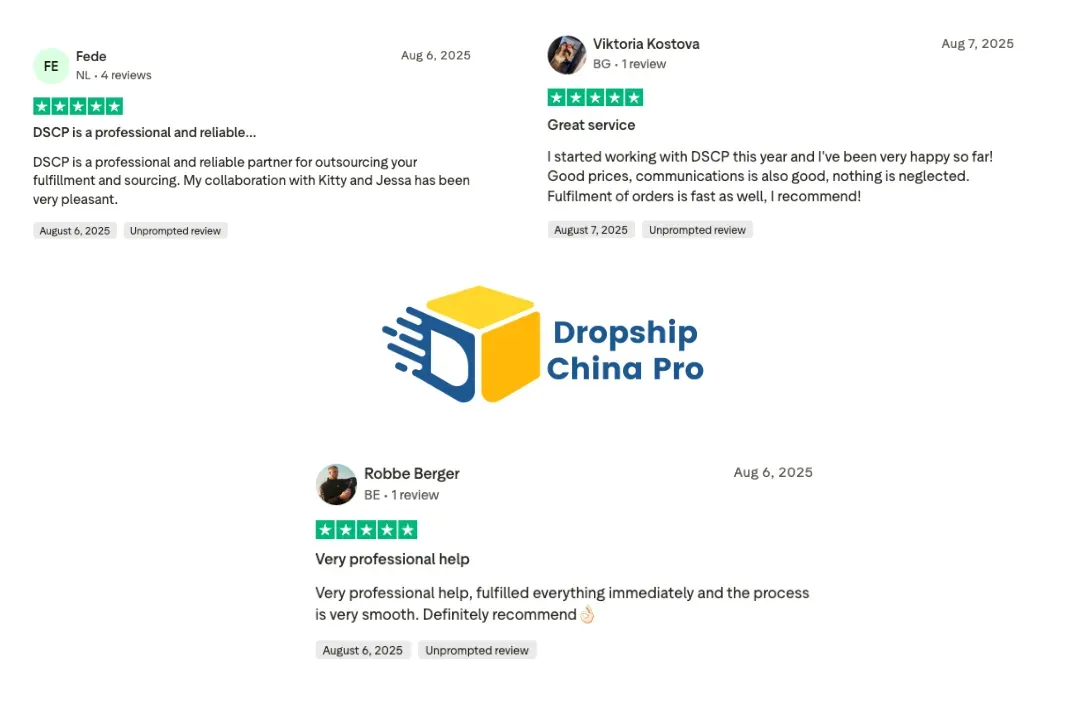
Viktoria from Bulgaria: “I started working with DSCP this year and I’ve been very happy so far. Good prices, communication is also good and nothing is neglected. Fulfillment of orders is fast as well, I recommend.”
Robbe from Belgium: “Very professional help, fulfilled everything immediately and the process is very smooth. Definitely recommend.”
Fede from the Netherlands: “DSCP is a professional and reliable partner for outsourcing your fulfillment and sourcing. My collaboration with Kitty and Jesse has been very pleasant.”
Frequently Asked Questions
What is product sourcing in dropshipping?
Product sourcing in dropshipping is the process of identifying profitable products, finding reliable suppliers who fulfill orders directly to customers and establishing partnerships that enable you to sell without holding inventory. It involves market research, supplier vetting, negotiation and logistics coordination.
How much does it cost to source products for dropshipping?
Costs vary by supplier type. Direct manufacturers typically require minimum orders of $500 to $5,000 plus sample costs. Wholesalers have lower minimums of $100 to $1,000. Professional dropshipping suppliers often charge per order fulfilled ($2 to $8) with no large upfront commitment. Additional costs include quality inspections, international shipping and customs duties.
Should I source products from China or use local suppliers?
China sourcing typically offers 30 to 50 percent cost savings and a much wider product variety, with the trade-off of longer shipping times if shipping directly. The best approach for most dropshippers is hybrid fulfillment: source from China for cost advantages and store inventory in US or European warehouses for 2 to 3-day domestic delivery.
What are the biggest mistakes in product sourcing?
Choosing suppliers based solely on price, skipping sample orders before committing, underestimating total landed costs, failing to verify supplier credentials and not establishing clear quality standards in writing. Each of these mistakes typically costs more to fix than it would have cost to avoid.
How do I verify a supplier is legitimate?
Request business licenses and certifications, ask for direct client references, order samples before any large commitment, request a video factory tour and use secure payment methods such as escrow for initial transactions. Professional sourcing services like DSCP maintain pre-vetted supplier networks that significantly reduce this due diligence burden.
How long does the product sourcing process take?
Initial sourcing typically takes 2 to 4 weeks: roughly one week for supplier identification and one to two weeks for sample evaluation. Professional dropshipping suppliers can compress this timeline significantly through existing supplier relationships. Ongoing reorders are faster once partnerships are established.
Conclusion
Successful product sourcing in 2026 requires a strategic approach that balances cost, quality, supplier reliability and delivery speed. Whether you work directly with manufacturers, source through wholesalers, or partner with a professional dropshipping supplier, the fundamentals are the same: research thoroughly, vet systematically and confirm your margins before committing.
For most dropshipping businesses, professional suppliers offering a hybrid sourcing and fulfillment model provide the most accessible path to competitive pricing and fast delivery without the overhead of managing logistics independently.
References
- Alibaba Group. (2024). Global B2B Wholesale Marketplace Overview. alibaba.com
- Grand View Research. (2024). E-Commerce Fulfillment Services Market Size Report, 2030. grandviewresearch.com
- Shopify. (2024). 4 Real Dropshipping Success Stories. shopify.com/dropshipping-success

Hi, I’m Yavuz. I help e-commerce businesses grow through strategic content. Here, I share insights on fulfillment solutions, 3PL partnerships, and digital marketing strategies based on real data and industry trends.