
The ecommerce landscape has shifted. Generic products, thin margins and one-time transactions are giving way to a more sustainable model: personalized products that create genuine emotional connections with buyers. For small to mid-size online sellers, this shift is not just a trend to watch; it is an opportunity to build a business that is harder to copy, commands higher prices and earns repeat customers naturally.
This guide breaks down what personalized products are, why they work so well in 2026, and how to build a business around them the right way.
Key Takeaways for Building a Profitable Personalized Products Business in 2026
- Personalized products command higher prices and lower return rates than generic alternatives.
- Customers are more patient with delivery times when they have an emotional connection to their order.
- First-mover advantage in an underserved market can be the most powerful competitive edge a seller has.
- Product quality matters far more than speed when selling custom items.
- A reliable fulfillment partner that handles quality control is essential for scaling.
What Are Personalized Products?
A personalized product is any item customized to reflect something specific about the buyer or recipient. This could be a name engraved on jewelry, a photo printed on a canvas, a custom message on a gift box, or a design chosen by the customer at checkout.
Personalization is not limited to print-on-demand. It spans a wide range of categories, including apparel, home decor, accessories, pet products and gifting. What these products share is a key quality: the buyer feels ownership over the item before it even arrives. That emotional investment changes the entire customer relationship.
Generic vs Personalized Products
| Factor | Generic vs Personalized Products |
|---|---|
| Profit Margins | Low → High |
| Price Competition | Intense → Minimal |
| Customer Loyalty | Low → High |
| Return Rates | Higher → Lower |
| Delivery Patience | Very Low → High |
| Repeat Purchases | Unlikely → Likely |
| Emotional Value | None → Very High |
Why Personalized Products Work in 2026
The Numbers Back It Up
Consumer demand for customization has reached a tipping point. According to a study by Epsilon, 80% of consumers are more likely to make a purchase when a brand offers personalized experiences (Epsilon, 2022). Deloitte research goes further, finding that 1 in 5 shoppers willingly pays 20% more for a personalized product, and 46% of those buyers will wait longer to receive it (Deloitte, 2024). That patience around delivery time is significant for ecommerce sellers who source internationally.
The market is growing to match this demand. The global print-on-demand market alone is projected to surpass $12 billion by 2026, driven by rising consumer appetite for customization and flexible ecommerce models (Statista, 2024). McKinsey research adds that companies excelling at personalization generate 40% more revenue than those that do not (McKinsey, 2021).
Lower Competition, Higher Margins
Sellers in communities like r/ecommerce and r/dropship on Reddit consistently note that personalized product niches attract far less price-based competition than generic dropshipping. When a product is built around a customer’s name, photo, or personal story, competing on price becomes almost irrelevant. The value is in the meaning, not the material.
This pricing power translates directly into margins. Nike’s custom NIKEiD shoes, for example, sell at a 30-50% premium over standard retail versions. While not every seller is Nike, the principle applies at every scale: customization justifies a higher price point.
Emotional Value Reduces Returns
Personalized products have lower return rates than generic items. When customers have invested thought and decision-making into an order, they are far less likely to regret the purchase. This reduces the operational burden of returns handling and protects margins over time.
Real-World Proof: Colin’s Story
One of the clearest examples of this model working in practice comes from Colin, a long-term client of Dropship China Pro and a successful ecommerce entrepreneur who has been building his business for nearly two years.
Colin’s breakthrough came from systematic market research. He identified a personalized product that performs well in the US market but has virtually no competition in Germany. Using ad intelligence tools to validate the product’s performance before committing to it, he recognized an opportunity: strong proof of demand in one market, a gap in another and a product with natural wow factor.
“I went to PipiAds, checked the US market, saw this product with a wow effect and with no competition in Germany, so I immediately knew this was going to be successful since it was performing so well in the US already. My edge was being first to market,” Colin explained.
His strategy worked because he combined market intelligence with the right product type. Personalized items gave him a defensible position: even when competitors eventually entered the market, the emotional specificity of custom products made it difficult for others to replicate his offer on price alone.
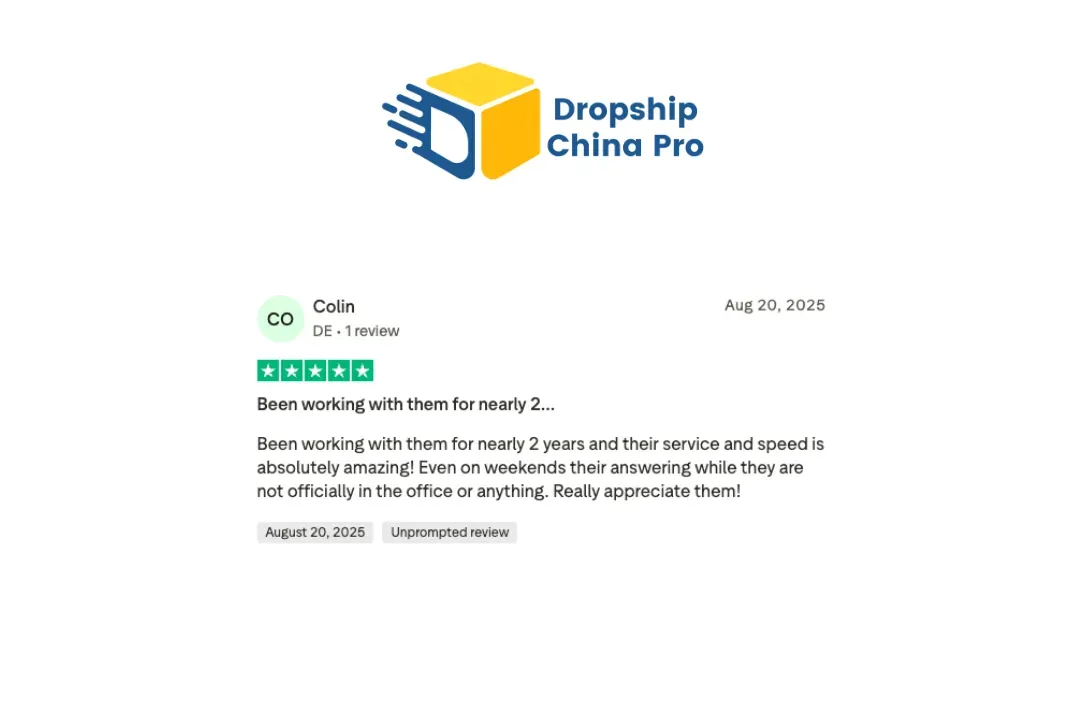
Colin’s experience with Dropship China Pro reflects the operational side of this kind of business. In his Trustpilot review, he noted: “Been working with them for nearly 2 years and their service and speed are absolutely amazing. Even on weekends, they’re answering while they are not officially in the office or anything.”
That level of reliability matters when you are selling products that customers have emotionally invested in. A delayed or damaged custom order creates far more frustration than a delayed generic one.
How to Build a Profitable Personalized Products Business
Step 1: Find a Market Gap, Not Just a Product
Colin’s approach illustrates the right starting point. Rather than picking a product he liked and hoping for demand, he found proof of demand first and then looked for where that product was missing.
Tools like PipiAds, Minea and Google Trends allow sellers to spot products gaining traction in one market before they saturate another. The question to ask is not “what is popular?” but “where is this popular product not yet being sold?”
Look for products that:
- Have a clear emotional or sentimental angle (gifts, milestones, relationships)
- Are performing in one market but absent from another
- Have a “wow factor” that makes people stop scrolling
- Can be customized in a way that adds genuine value
Step 2: Prioritize Quality Over Speed
This is where personalized product selling differs from conventional dropshipping wisdom. Colin’s approach to supplier selection puts quality and margins at the top of the priority list, not delivery time.
“Especially when it comes to personalized products, the delivery time is not that important. If you deliver them an emotionally personalized product, then once they receive it, they will still love it because of what they connect with it,” he said.
This does not mean being reckless about shipping times. Products should arrive as quickly as reasonably possible. But a supplier offering slightly slower production in exchange for meaningfully better print quality or material quality is often the right trade-off for custom items. A customer who waited two weeks for a personalized gift will be delighted if the quality exceeds expectations. The same customer will be devastated if a cheaper supplier delivers something that looks nothing like the preview image.
Supplier Priority for Custom Products
| Supplier Factor | Priority for Custom Products |
|---|---|
| Product Quality | Critical — non-negotiable |
| Profit Margins | Critical — must be protected |
| Customization Capability | Essential — core requirement |
| Communication Speed | High — errors need fast fixes |
| Delivery Speed | Secondary — quality compensates |
| Scalability | Important — plan ahead |
| Sample Testing | Always required before launch |
When evaluating suppliers for custom products, prioritize:
- Sample testing before committing
- Clear communication and response times
- Proven experience with customization at scale
- Consistent quality control processes
Step 3: Set Up Systems for Customization Errors
Even with great products and suppliers, personalized orders introduce a specific operational challenge: customers sometimes enter incorrect information at checkout and then dispute the order when it arrives. This is one of the most common pain points sellers face with custom items.
The solution is preventive, not reactive. Set up:
- Confirmation emails that display the customization details the customer entered
- A preview system if your product type allows it
- A clear and visible policy on custom orders before checkout
- A responsive customer service process for catching errors before production begins
Handling this well protects your chargeback rate and builds customer trust, both of which matter more in a personalized product business than in a generic one.
Step 4: Build Around Customer Lifetime Value
One of the most important shifts in ecommerce right now is the move away from first-purchase profitability. Colin captures it directly: “You can’t rely anymore on ad platforms being first-purchase profitable. The biggest profits are coming after the first purchase.”
Personalized products are particularly well-suited to repeat purchase strategies. Customers who buy a custom gift for one occasion are naturally primed to return for the next. A customer who ordered a personalized item for a birthday may want one for an anniversary, a graduation, or a holiday. Building email flows that prompt these moments, rather than chasing cold traffic constantly, is how the economics of this model improve over time.
Step 5: Work With a Fulfillment Partner That Understands Custom Orders
As order volume grows, fulfillment becomes a defining factor in whether the business scales smoothly or falls apart. For personalized products specifically, the fulfillment partner needs to handle variable production requirements, quality checks on each custom item and packaging that supports the premium experience customers expect.
Dropship China Pro’s hybrid model, which combines China-based sourcing with US warehousing in Pomona (CA) and New Brunswick (NJ), is designed for exactly this kind of operation. Sellers can source cost-effectively while maintaining the flexibility to ship domestically for products that need faster turnaround. The Shopify app makes integration straightforward for Shopify-based stores.
DSCP has supported over 2,500 active stores since 2016, processing more than 30,000 parcels per day with a 4.9/5 Trustpilot rating. For sellers building a personalized product business that depends on consistency, that kind of track record matters.
Common Mistakes to Avoid
Competing on price in a personalization niche. If you find yourself lowering prices to match competitors on custom products, it usually means the product itself lacks enough emotional differentiation. A stronger wow factor, a better niche focus, or better quality will do more than a lower price.
Ignoring the supplier relationship. For custom products, your supplier is not just a logistics partner; they are a co-producer of the customer experience. A bad batch of quality can undo months of marketing and brand building.
Launching in an already-saturated market. Colin’s competitive edge was being first to market in Germany. If you are entering a niche where five established sellers are already running ads, you need a clear angle: better content, a specific sub-niche, a stronger offer, or a unique product variant.
Ready to Scale Your Personalized Products Business?
If you are growing and need a fulfillment partner that can handle custom order workflows, quality inspection and reliable delivery to the US and beyond, reach out to Dropship China Pro to discuss your specific needs. You can also install the DSCP Shopify app to get started.
Conclusion
Building a profitable personalized products business in 2026 is less about finding a magic product and more about building a smarter model. The sellers who thrive are those who identify real demand in underserved markets, prioritize product quality over shortcuts and treat every customer as a potential repeat buyer rather than a one-time transaction.
Colin’s journey from testing niches to building a sustainable personalized product business in the European market is a blueprint others can follow. The core ingredients are market research discipline, quality-first supplier selection and a fulfillment infrastructure that supports rather than limits growth.
The opportunity in personalized products is real, the demand is growing and the competitive moat it creates, once built, is genuinely difficult for others to erode.
Frequently Asked Questions
What are personalized products in ecommerce?
Personalized products are items customized to reflect something specific about the buyer or a recipient, such as a name, photo, message, or design. They span categories including apparel, home decor, jewelry and gifting.
Why do personalized products have better margins?
Customers buying personalized items focus on emotional value rather than price comparison. This reduces price sensitivity and allows sellers to charge a premium. Deloitte found that 20% of consumers will pay 20% more for a product they have personalized (Deloitte, 2024).
How do I find a good niche for personalized products?
Look for products with proven demand in one market that have not yet appeared in another. Use ad intelligence tools to validate performance before committing. Focus on products with a clear emotional angle and strong wow factor.
Does delivery speed matter less for personalized products?
To an extent, yes. Customers who have invested thought into a custom order are more patient with delivery times than buyers of generic items, provided the final product meets or exceeds quality expectations.
How do I handle customization errors?
Set up confirmation emails that display the entered customization, use preview tools where possible and make your custom order policy visible before checkout. Having a responsive customer service process for catching errors before production is also essential.
References
- Deloitte. (2024). Deloitte Consumer Personalization Research. Retrieved from deloitte.com
- Epsilon. (2022). The Power of Me: The Impact of Personalization on Marketing Performance. Retrieved from epsilon.com
- McKinsey & Company. (2021). The value of getting personalization right. Retrieved from mckinsey.com
- Statista. (2024). Global Print-on-Demand Market Projections. Retrieved from statista.com
- Straits Research. (2025). North America Print on Demand Market Size, Share and Trends Report.

Hi, I’m Yavuz. I help e-commerce businesses grow through strategic content. Here, I share insights on fulfillment solutions, 3PL partnerships, and digital marketing strategies based on real data and industry trends.